Most of a commercial credit request is preparation: reading statements and returns, typing them into a spread, reconciling them, working the ratios, adding up the grade points, valuing the collateral, testing the policy and writing the memo. Very little of it is judgement. That makes credit a good fit for AI agents, and a risky one, because the small part that is judgement (whether to lend, on what terms, and whether an exception is acceptable) is exactly what a credit officer signs for and an examiner asks about. The design question isn’t whether agents can do the work. It is which decisions they must never take, and how that is enforced rather than promised.
In short
- Give each agent one job on the request. Eight agents, each with a narrow role: read the documents, spread and reconcile, value the collateral, grade, test the policy, draft the memo, check what blocks, and watch the loan book.
- Agents prepare; people decide. Anything that reaches the borrower, clears a check, justifies an exception, orders an appraisal, puts a borrower on the watchlist or decides the request is a prepared decision a person accepts, rejects or asks about.
- Autonomy is a dial with a hard ceiling. Every action starts at “Draft”. No credit agent can go above “Ask first”, whatever its record.
- Figures come from the engines, not the model. Every number an agent writes comes from the reader, the spread or the grade. With the model switched off, the agents still run, on rules.
Eight agents, one request
InsightCredit runs eight agents on the platform’s agent layer. Seven work a credit request in order, from intake to submission; the eighth watches the loan book. Each one does the preparation for its step and, where it finds something only a person can act on, prepares a decision.
| Agent | What it does | What it can prepare for a person |
|---|---|---|
| Intake agent | Reads statements, returns, bank statements, agings, rent rolls, personal financial statements and appraisals into fields, each quoted from its line | A request to the borrower for what is missing |
| Spreading agent | Spreads three fiscal years and reconciles them with the tax returns, the agings, the bank statement and the rent roll | A request to the borrower to explain the differences |
| Collateral agent | Values the collateral from the appraisals and the aging at the bank’s advance rates, computes LTV and coverage, flags appraisals too old for new money | An appraisal order, for a person to place |
| Credit analyst agent | Computes the scorecard grade from the ratios, global cash flow, collateral and guarantors, and explains what drives it | A request to the borrower to explain a decline in earnings |
| Policy agent | Runs the bank’s credit policy controls and drafts a mitigant for each exception from the case’s figures | The drafted mitigants, for the analyst to edit and record |
| Memo writer | Drafts the credit memo from the spread, the grade, the collateral and the exceptions | The memo, for the analyst to accept or edit |
| Supervisor | Checks what blocks a decision and which approval authority the request needs | Submitting the request for approval |
| Covenant monitor | Tests covenants on each borrower’s quarterly reporting, flags declining coverage, lists late packages and overdue annual reviews | Watchlist additions; opening the overdue reviews |
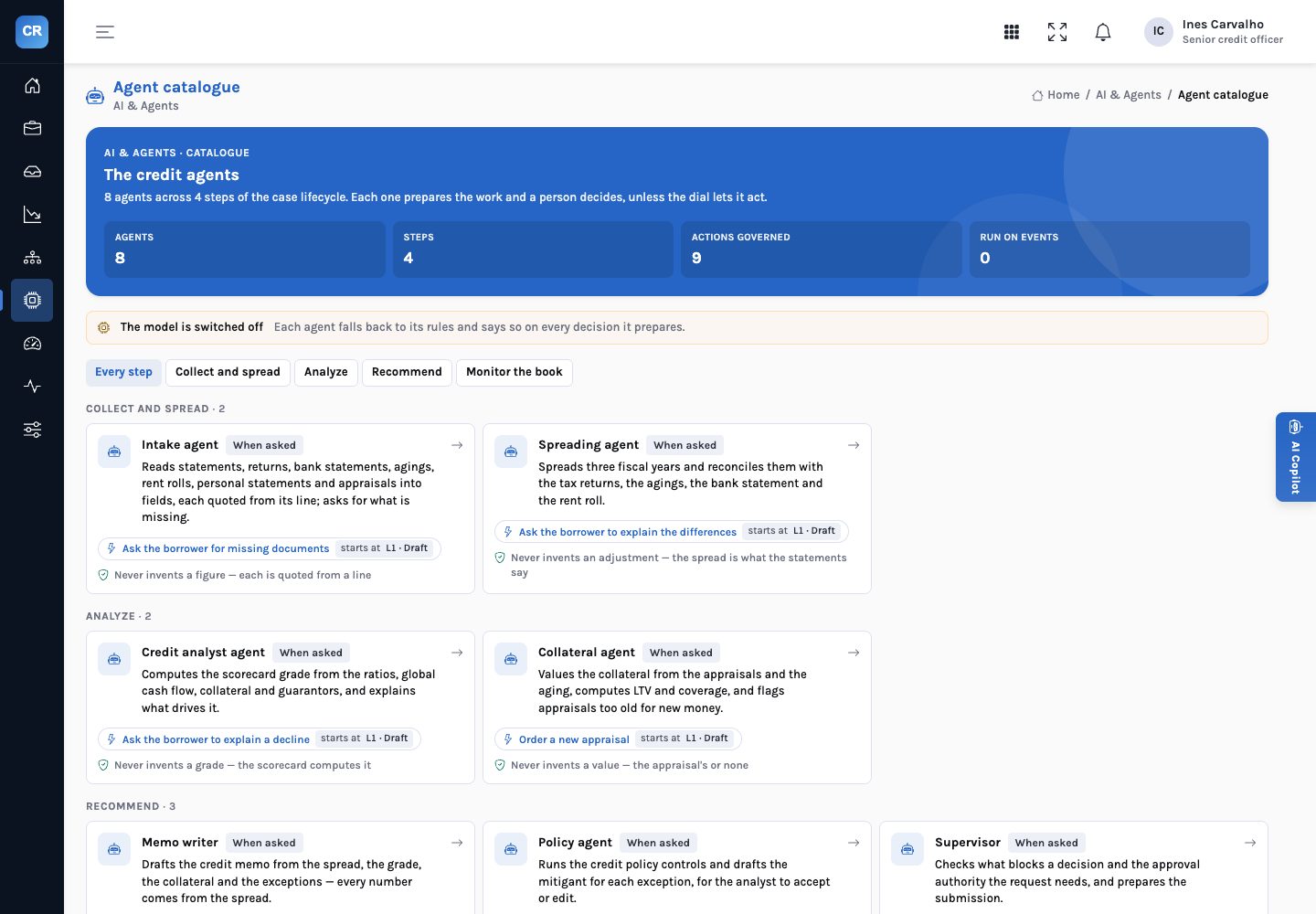
The case agents run in the order of the stages. The last step on the path is always two people.
What no agent does
The line between preparing and deciding is drawn around actions that have consequences outside the case, or that a credit officer or an examiner would expect a named person to own.
| Action | Who | Why |
|---|---|---|
| Send anything to the borrower | A person, from a held request | What the bank asks a borrower is a communication on its behalf, and hard to take back |
| Clear or waive a failed check | A person, with a reason | A waiver is a judgement that the evidence is good enough |
| Justify a policy exception | A person, who edits and records the mitigant | Accepting a request outside policy is a credit judgement |
| Order an appraisal | A person | It commits the bank to an engagement, and appraiser independence matters |
| Put a borrower on the watchlist, or clear it | A person, with a reason | It changes how the relationship is managed and reported |
| Override a risk grade | A credit officer, with a reason | The grade sets the policy outcome and the scrutiny |
| Approve or decline a request | An officer with the authority, never the submitter | The decision is the bank’s, and it goes on the decision record |
Enforced in the product, not in a prompt
These actions aren’t forbidden by telling a model not to do them. The agents have no way to do them: the functions that send, waive, justify, order, add to the watchlist and decide take a person as the actor, and the routes check that person’s role and authority. Every action an agent can prepare is also capped by a tenant setting (CREDIT_AGENTS_MAX_LEVEL) that can’t be raised above “Ask first”.
A prepared decision
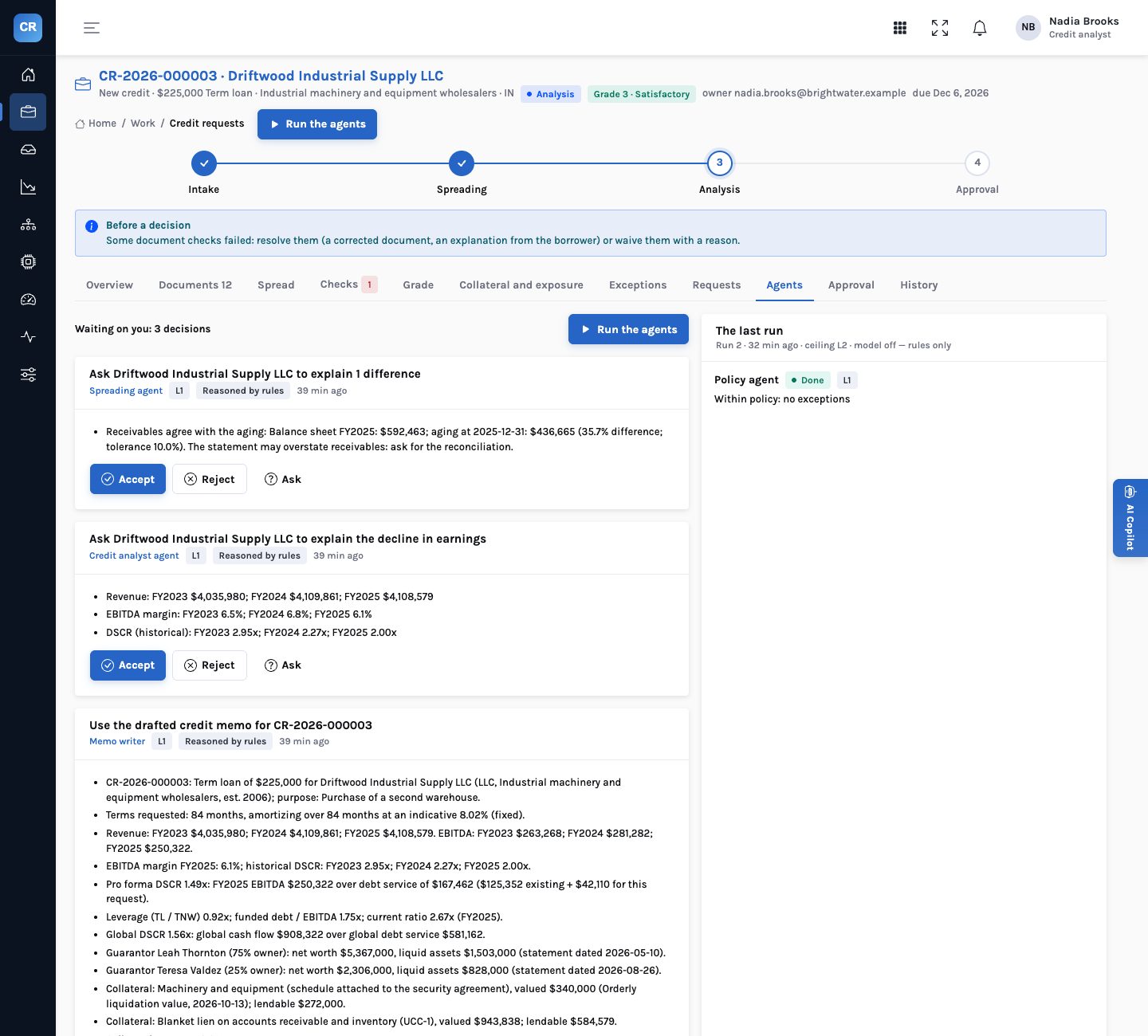
When an agent finds something only a person can act on, it prepares a decision: a title, the lines of evidence, the reason, and the action that will happen if the person accepts. On the fictional Larkfield Heating & Air request, for example, the credit analyst agent prepared “Ask Larkfield Heating & Air Inc. to explain the decline in earnings”, with its evidence taken straight from the spread: revenue of $2,044,845, $1,949,915 and $1,802,738 over FY2023 to FY2025, an EBITDA margin falling from 9.6% to 6.1%, and historical coverage from 5.32x to 1.58x. (Every borrower, person and figure here is from our demo bank, Brightwater Commercial Bank, and is fictional.) The person has three answers.
Every answer, including a rejection, is recorded, and counts towards that action’s agreement rate.
Accepting still doesn’t reach the borrower
Even an accepted request doesn’t go to the borrower. On Driftwood, the receivables on the 2025
balance sheet ($592,463) don’t agree with the aging ($436,665), a 35.7% difference against an
illustrative 10% tolerance, so the check failed and the spreading agent prepared a request for the
reconciliation. When the analyst accepted it, InsightCredit created a request held for review.
The analyst edits the wording, which must keep the [request link] placeholder, and sends
it. Two deliberate steps, because a message to a borrower is hard to take back.
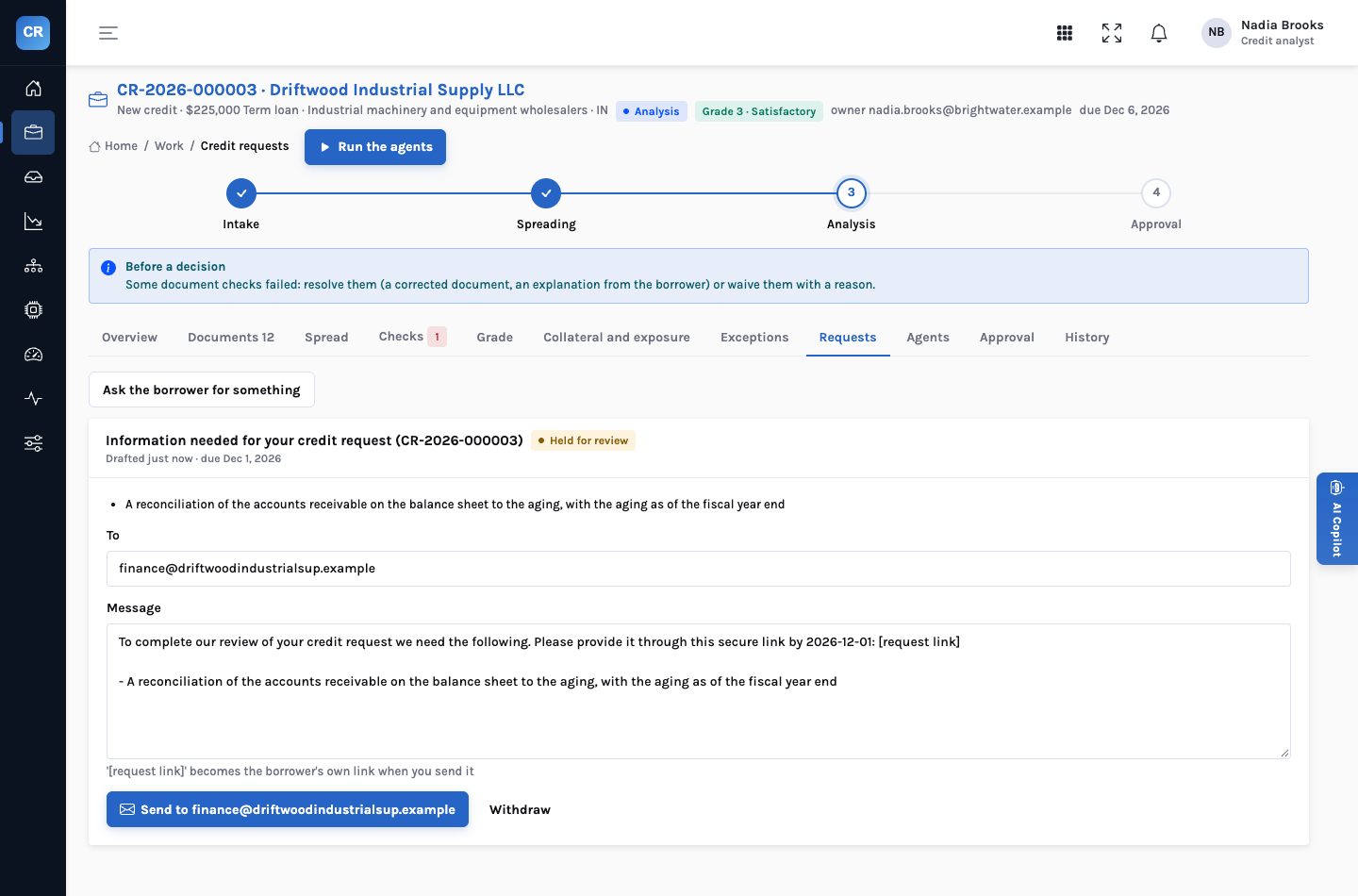
The placeholder becomes the borrower’s own link, with no login; InsightCredit stores only a fingerprint of it, and shows it once. In the demo environment nothing is delivered: the person sends the message themselves. When the borrower uploads, the document is read at once and the spread and checks run again.
The same pattern holds elsewhere. On the fictional Birchwood Commerce Center request, the collateral agent found that the property was last valued on September 25, 2023 and prepared “Order a new appraisal of 1 property”. Accepting it records the order; nothing is sent to an appraiser from the demo environment, and placing the engagement remains a person’s job. On Tidewater Industrial Properties, the policy agent drafted mitigants for two referred exceptions, such as global coverage of 1.32x with the guarantors’ cash flow and their liquid assets of $2,163,000, but the request also has a block (pro forma coverage of 0.77x, below the illustrative 1.00x floor) that no mitigant can justify: it has to be cured or declined.
Autonomy, capped
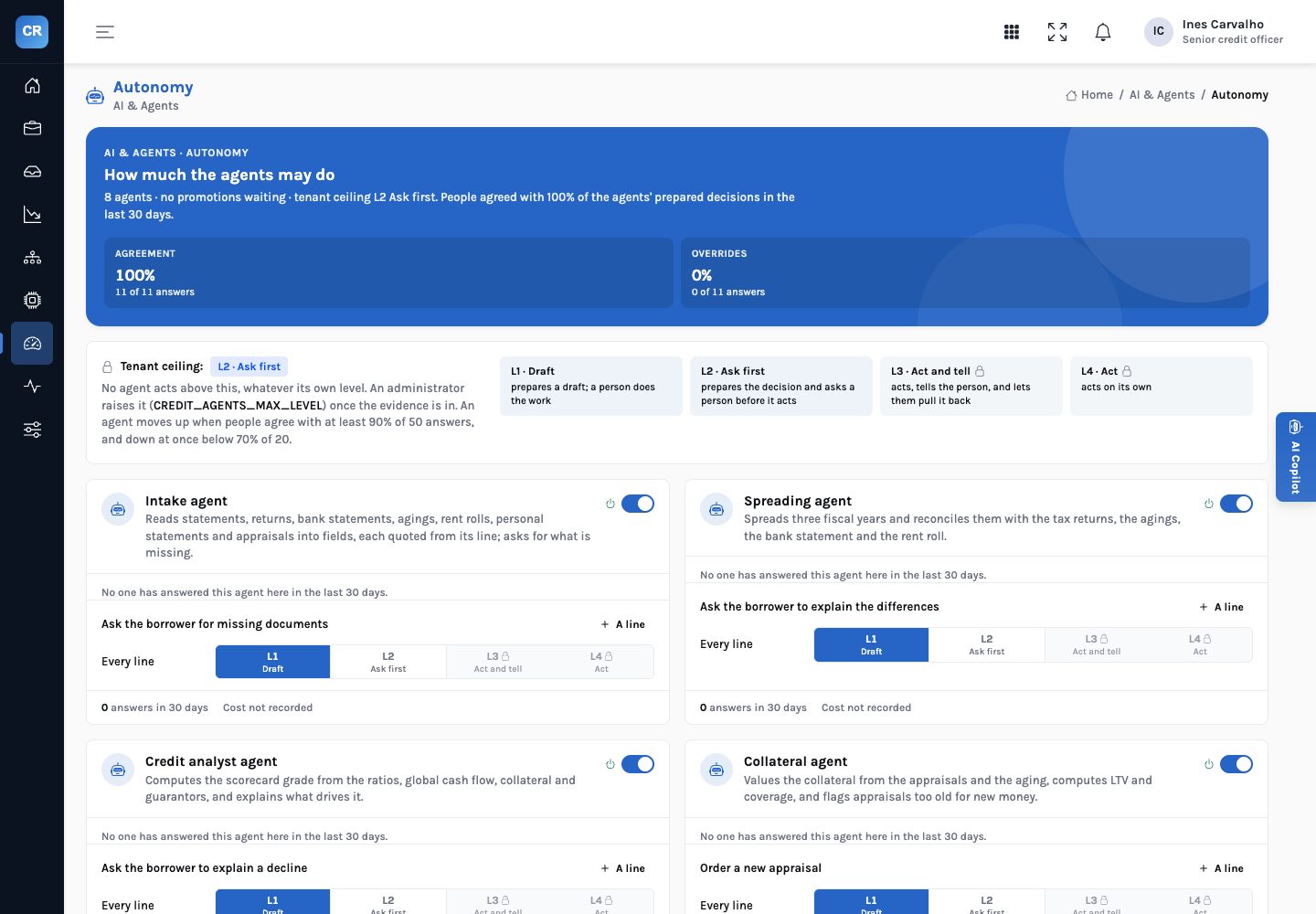
Each action an agent can prepare has a level, and every action starts at the lowest.
| Level | Name | What happens | Available to credit agents? |
|---|---|---|---|
| L1 | Draft | The agent prepares a draft; a person does the work | Yes; where every action starts in the demo |
| L2 | Ask first | The agent prepares the decision and asks a person before it acts | Yes; the ceiling |
| L3 | Act and tell | The agent acts, tells the person, and lets them pull it back | No: locked |
| L4 | Act | The agent acts on its own | No: locked |
The ceiling is a hard cap, not a default. Agreement and override rates are tracked for every action: how often people accepted what was prepared, changed it or rejected it. The autonomy page shows that record and, on the demo settings, recommends a move up only after at least 90% agreement over at least 50 decisions in 30 days, and a move down when agreement falls below 70%. A recommendation changes nothing by itself, and nothing moves above the ceiling. An administrator can also hold any agent lower.
The model is optional; the figures are not
Each agent has a rules path that works with no language model at all. The demo runs with the model
switched off (CREDIT_AGENTS_LLM=0), and every screenshot here comes from that mode. When a
model is switched on, it can improve the wording of the memo and the reasoning, but its output is
checked: the memo writer works from numbered facts the engines produced, and a sentence carrying a
number or a name that isn’t among those facts is thrown away, leaving the engine’s wording in
its place. The arithmetic (coverage, leverage, global cash flow, grade points, lendable value) is never
asked of a model.
Fluent, and occasionally wrong: a coverage ratio that isn’t in the spread, a guarantor’s net worth that isn’t on the statement. Nobody can tell which sentences to trust.
Every number and name is checked against the numbered facts. An ungrounded sentence is discarded and the engine’s draft stands. A person still accepts the memo.
On the loan book, too
The covenant monitor applies the same rule after the loan is booked. On the demo book it ran 701 covenant tests on 257 loans and found 6 breaches, 5 borrowers with coverage still passing but falling, and 5 quarterly packages late, with 46 annual reviews due within 60 days, 13 of them overdue. It prepares watchlist additions for breaches and declining coverage, and on its last run it prepared “Open 13 overdue annual reviews”. A person adds a borrower to the watchlist and clears it, with a reason: on the demo book the 11 borrowers there (6 covenant breaches, 5 declining coverage) were added by a credit officer. Late packages go to the relationship manager to chase, not to the watchlist.
Who does what on a request
The case agents run in order; each records what it did, what it found and what it prepared.
Accept, reject or ask on each prepared decision. Every answer is recorded and counts towards the action’s agreement rate.
Resolve or waive checks with a reason, send held requests, edit and record mitigants, edit the memo.
When the borrower answers or a document changes, the spread and checks rerun and the agents run again on the new figures.
The supervisor agent says when nothing blocks and which authority is needed; the analyst submits.
Someone other than the submitter, holding the authority the exposure and exceptions require, approves or declines with a reason.
What it means for each audience
For the chief credit officer
The boundary between automation and judgement is written into the product, not into a procedure manual. Every agent action has a level, a ceiling, an owner and a history.
When an examiner asks “who decided?”, the answer is always a named person with the authority to decide.
For the credit team lead
Analysts start each request with the reading, spreading, reconciling and drafting done, and a short list of decisions waiting.
Agreement and override rates show which agents to rely on, and which rules or settings need work.
For the board
AI shortens the path to a credit decision without moving accountability. That is the version of AI in lending that survives an examination.
Autonomy is held at “Ask first” at most; any change to that is a governance decision, not a software update.
What to be careful about
- Agreement can be lazy. If analysts accept everything, the agreement rate rises without meaning anything. Sample accepted decisions the way credit risk review samples files.
- Agents inherit the documents’ gaps. An agent can’t spread a year the borrower didn’t send or read a scan with no text layer. The prepared decision says what it looked at; read that.
- The policy is yours. The controls, tolerances, advance rates and authorities the agents apply in the demo are illustrative. A credit officer edits them in Rules Studio and the bank’s settings.
Let agents do everything that is preparation. Make sure they can’t do anything that is a decision.
Narrow roles, prepared decisions, autonomy capped at asking first, and every figure from the engines.