- contact@insightcreditai.com
The platform
Everything a credit request needs, in one place
From the application to the decision record and on to covenant monitoring. Each capability below is in the product today, shown on the demo bank’s data.
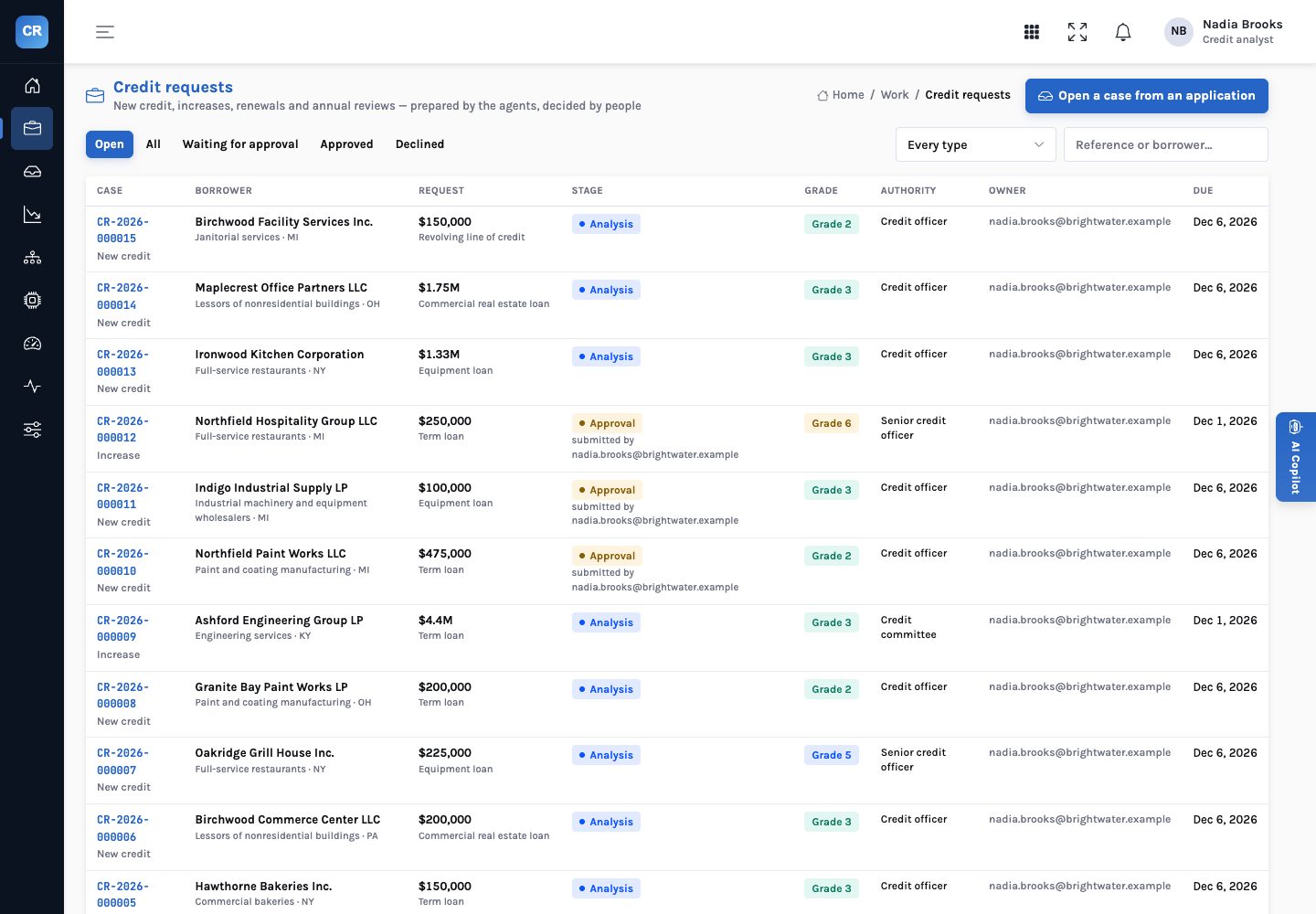
Credit requests
One case for every request, and every annual review
A case opens from an application the relationship manager submitted (new credit, an increase or a renewal) or, for an annual review, from a loan in the book. The borrower, the guarantors, the documents and the collateral come across from the bank’s systems. Each case moves through intake, spreading, analysis and approval, and the case page says what still stands between it and a decision.
- Four case types — new credit, increase, renewal and annual review, each with a due date from your service levels
- The queue — case, borrower, request, stage, grade, the authority it needs, owner and due date
- What blocks a decision — the credit policy controls and open exceptions, in plain sentences, at the top of the case
- Run the agents — one button runs the seven case agents in order; each stops at what it prepared
Document reader
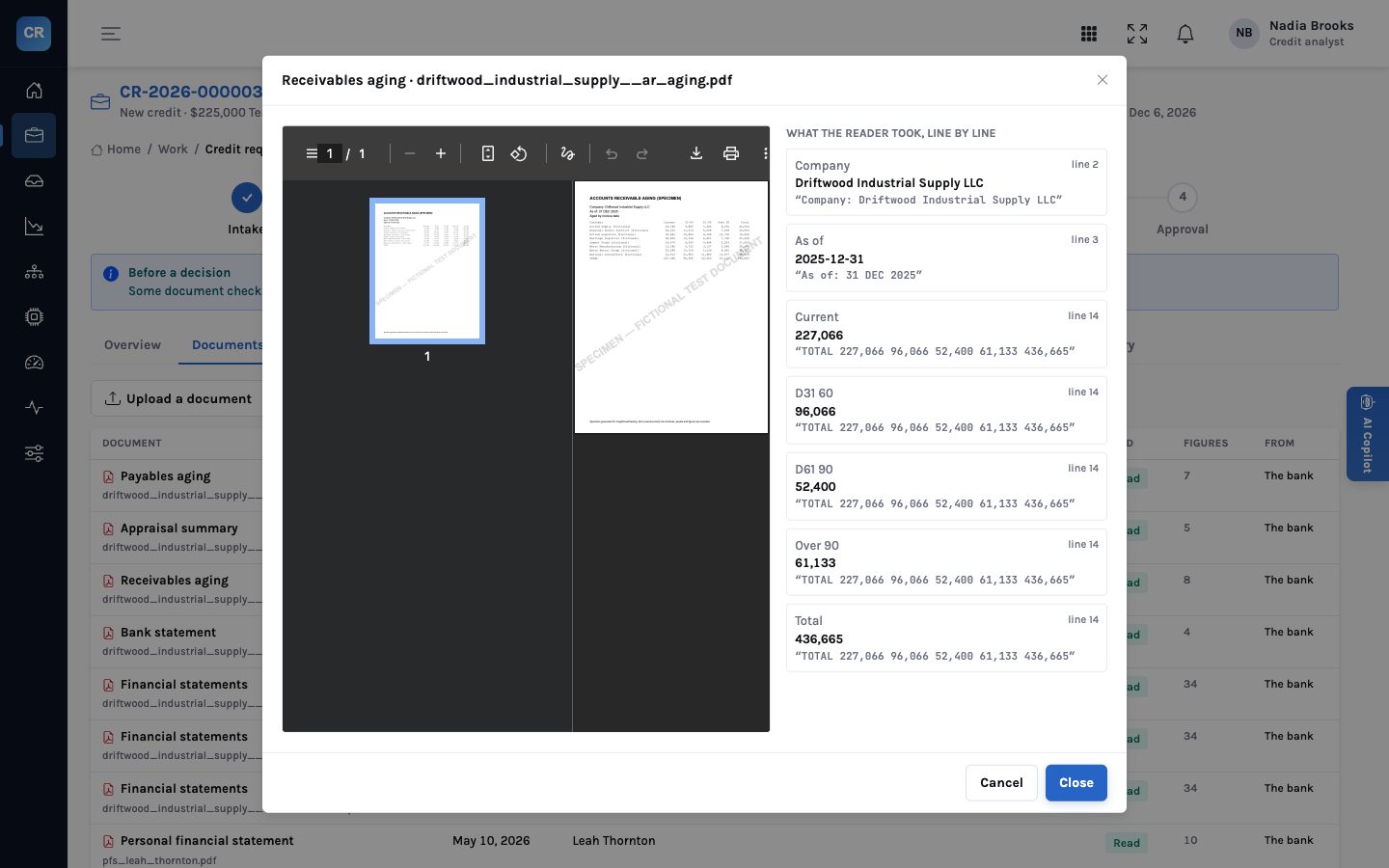
Every figure quoted from the line it came from
The reader turns each document into fields with the line number and the exact text, shown beside the PDF. It reads income statements and balance sheets, business tax returns, bank statements, receivables and payables agings, rent rolls, personal financial statements and appraisal summaries. A figure it can’t find is noted for a person, never estimated; a scan with no text layer is refused in plain words.
- Statements — thirty lines of income statement and balance sheet, and the basis: audited, reviewed, compiled or company-prepared
- Returns — Forms 1120, 1120-S and 1065: gross receipts, cost of goods sold, deductions, ordinary and taxable income
- Supporting documents — deposits and NSF items, aging buckets and customers, rent and occupancy, appraised value and date
- Personal statements — each guarantor’s assets, liquid assets, liabilities, net worth, income, living expenses and debt payments
Spreading
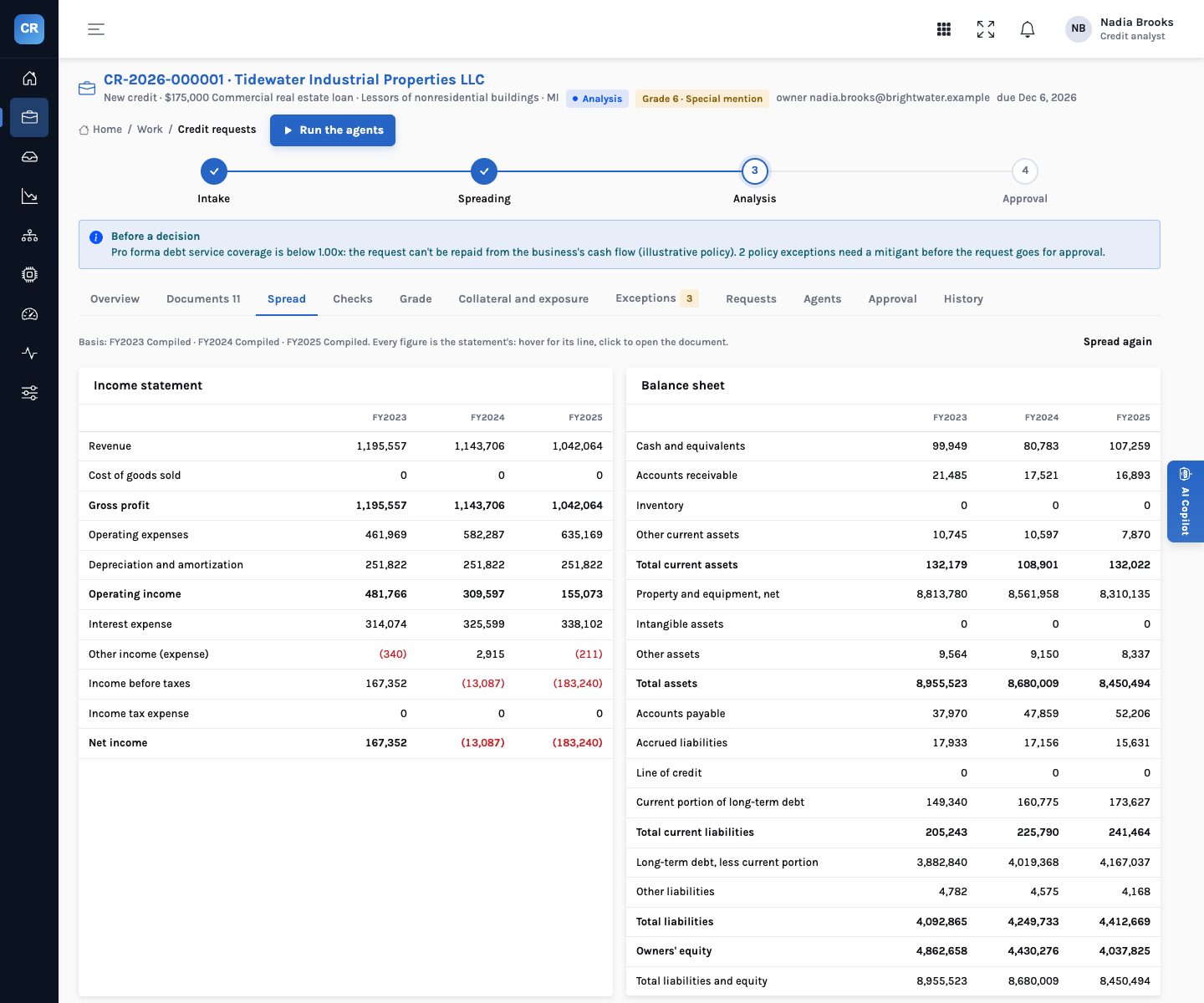
Three years side by side, every cell traceable
The spread is built only from what was read, the latest three fiscal years side by side. Hover over a cell for its document line; click to open the document at it. Ratios are computed from those figures, each with its formula, and pro forma and global coverage are worked out the same way for every request.
- Derived lines — EBITDA, historical debt service, tangible net worth and funded debt
- Ratios — margins, DSCR, TL / TNW, funded debt / EBITDA, current ratio, DSO, DIO and DPO
- Pro forma DSCR — the request’s own debt service at its indicative rate and amortization; a revolver at full commitment, interest only
- Global cash flow — the business plus each guarantor’s income, living expenses and debt payments from their personal statement
Reconciliations
The statements against everything else in the file
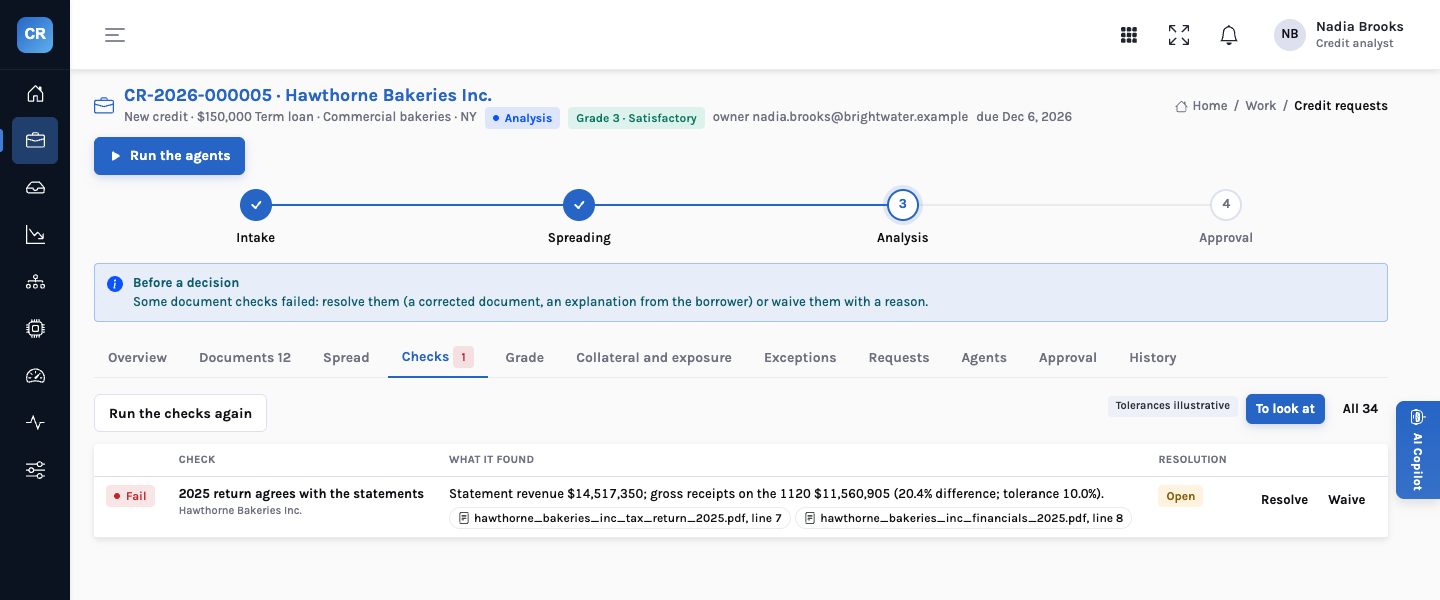
Checks compare the statements with the business’s other documents and quote both lines: the tax returns, the agings, the bank statement and the rent roll. They also check what should be on file and how old it is. A failed check stays open until a person resolves it or waives it, always with a reason; an agent can’t clear one.
- On file — three years of statements, two returns, bank statements, agings or a rent roll, each guarantor’s statement, appraisals
- Agreement — receivables and payables against the aging, revenue against the return, deposits against revenue, rent roll against rental income
- Age — the latest fiscal year, each personal statement and each appraisal (stale is a fail when there is new money)
- Your tolerances — 10% on receivables and returns, 75% deposits to revenue and so on, all illustrative and set per deployment
Risk grade
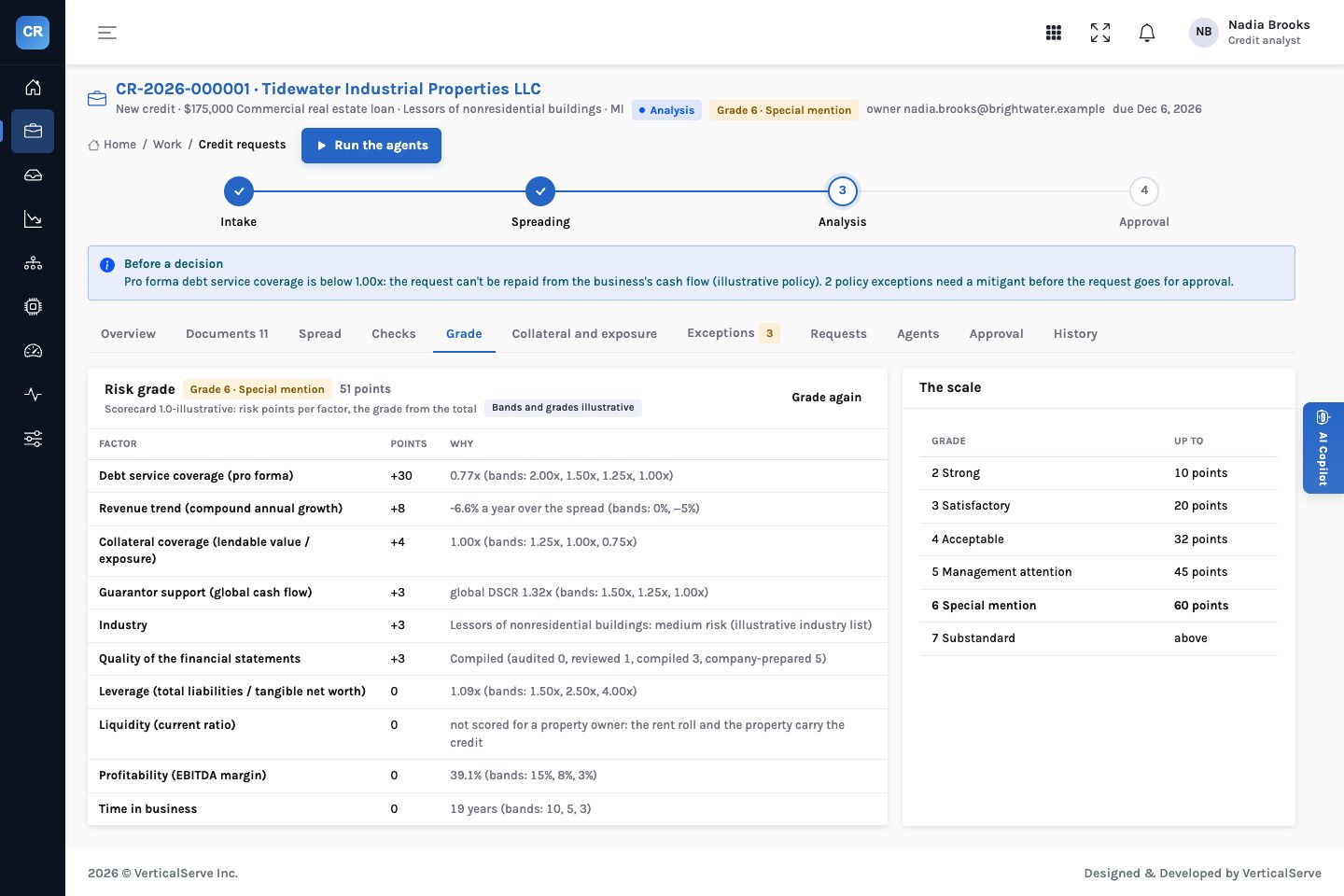
A grade that shows every point
The grade is a points scorecard over ten factors: pro forma coverage, leverage, liquidity, profitability, revenue trend, collateral coverage, guarantor support, time in business, industry and the quality of the statements. Each factor shows its points and the figure and band behind them. A credit officer can override the grade, and the reason stays on the case and the decision record.
- Ten factors — each with its band, its points and why
- Your scale — an eight-grade scale with boundaries you set; the demo’s are illustrative
- Override with a reason — only a credit officer, and the original grade is kept
- Versioned — the model version is stored with every grade
Collateral and exposure
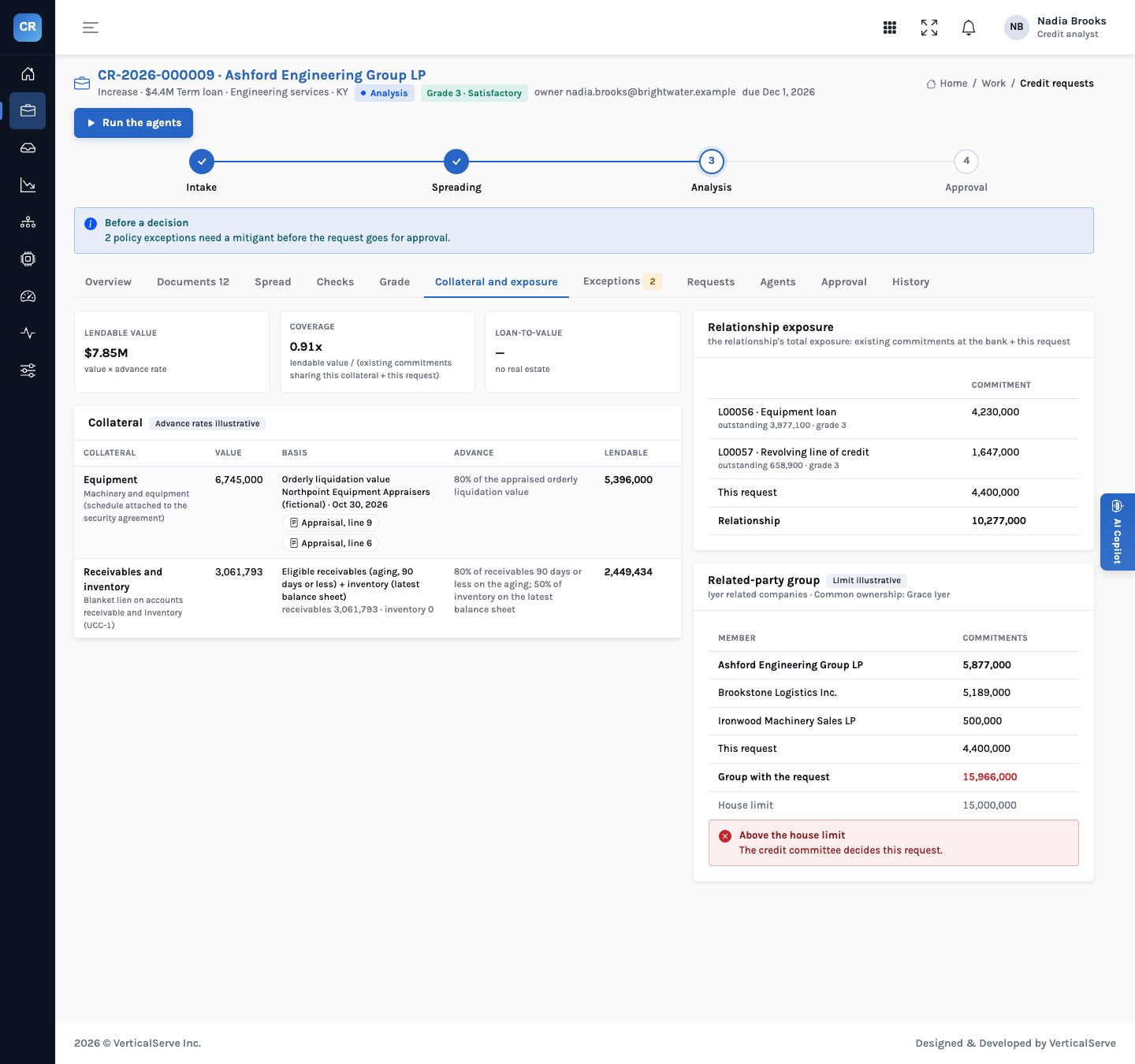
What the collateral is worth to the bank, and what the group owes
Lendable value comes from the appraisals and the aging the reader took, at your advance rates: never typed in. Loan-to-value and coverage follow. Exposure is aggregated for the relationship and for its related-party group, against your house limit.
- Advance rates — real estate and equipment at 80% of appraised value, eligible receivables at 80%, inventory at 50% (illustrative)
- LTV and coverage — with the basis of each written beside it
- Related groups — every borrower under common ownership, its commitments and the requests in the pipeline
- Stale appraisals — flagged when new money is advanced; the collateral agent prepares the order and a person places it
Policy exceptions
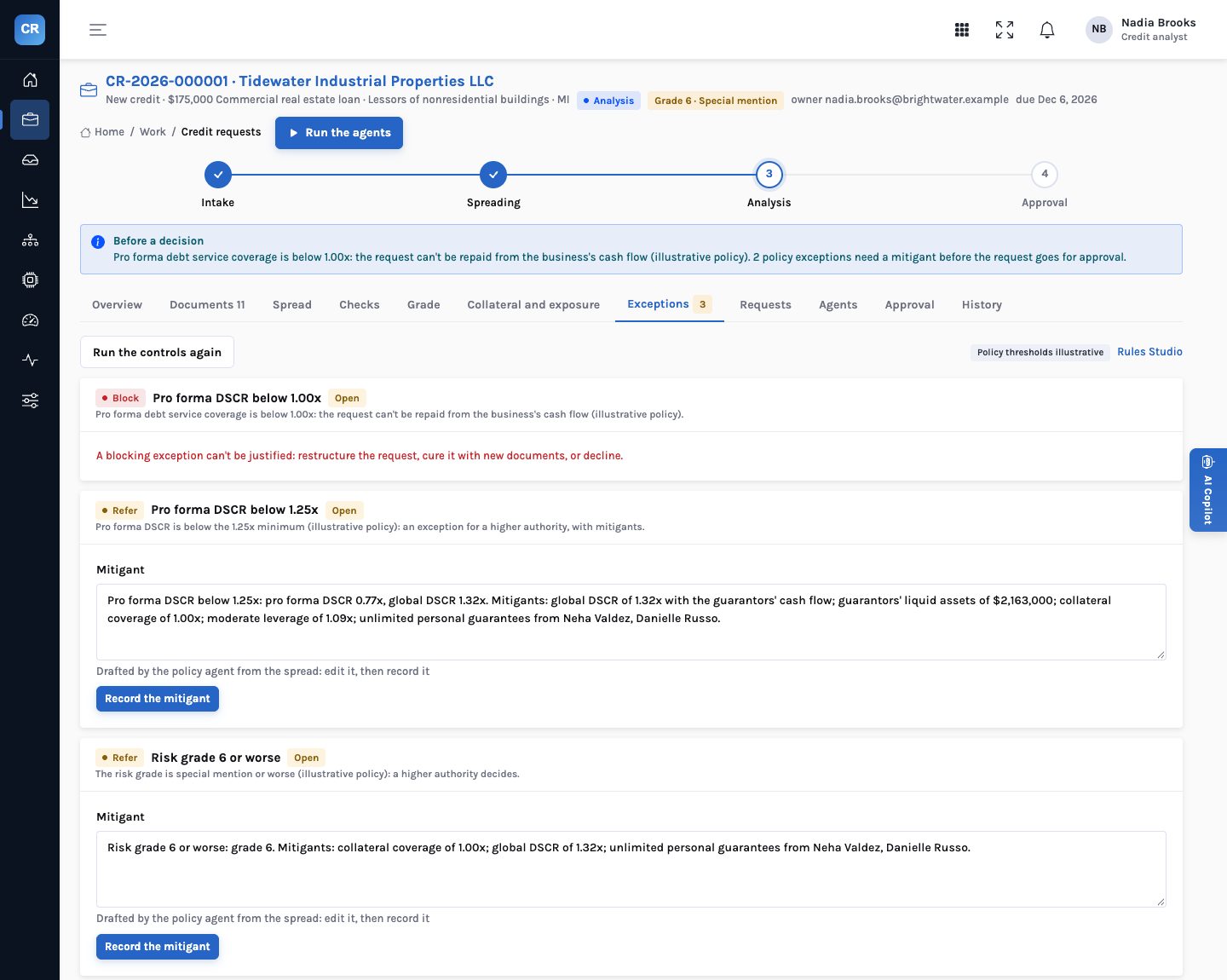
Every exception visible, with its mitigant
Twelve credit policy controls live in Rules Studio, where a credit officer can read, test and change them. Each control that blocks or refers becomes a policy exception on the case. A referred exception needs a mitigant: the policy agent drafts one from the spread, the collateral and the guarantors’ statements, and a person edits and records it. A block can’t be justified; the request is cured or declined.
- Block — failed checks open, pro forma DSCR below 1.00x, a substandard grade at origination
- Refer — DSCR or global DSCR below 1.25x, leverage above 4.0x, negative TNW, current ratio below 1.00x, LTV above 80%, coverage below 1.00x, grade 6 or worse, a group over the house limit
- Mitigants from the figures — global coverage, guarantors’ liquid assets, collateral coverage, moderate leverage, personal guarantees
- Illustrative thresholds — every one is yours to set
Credit memo
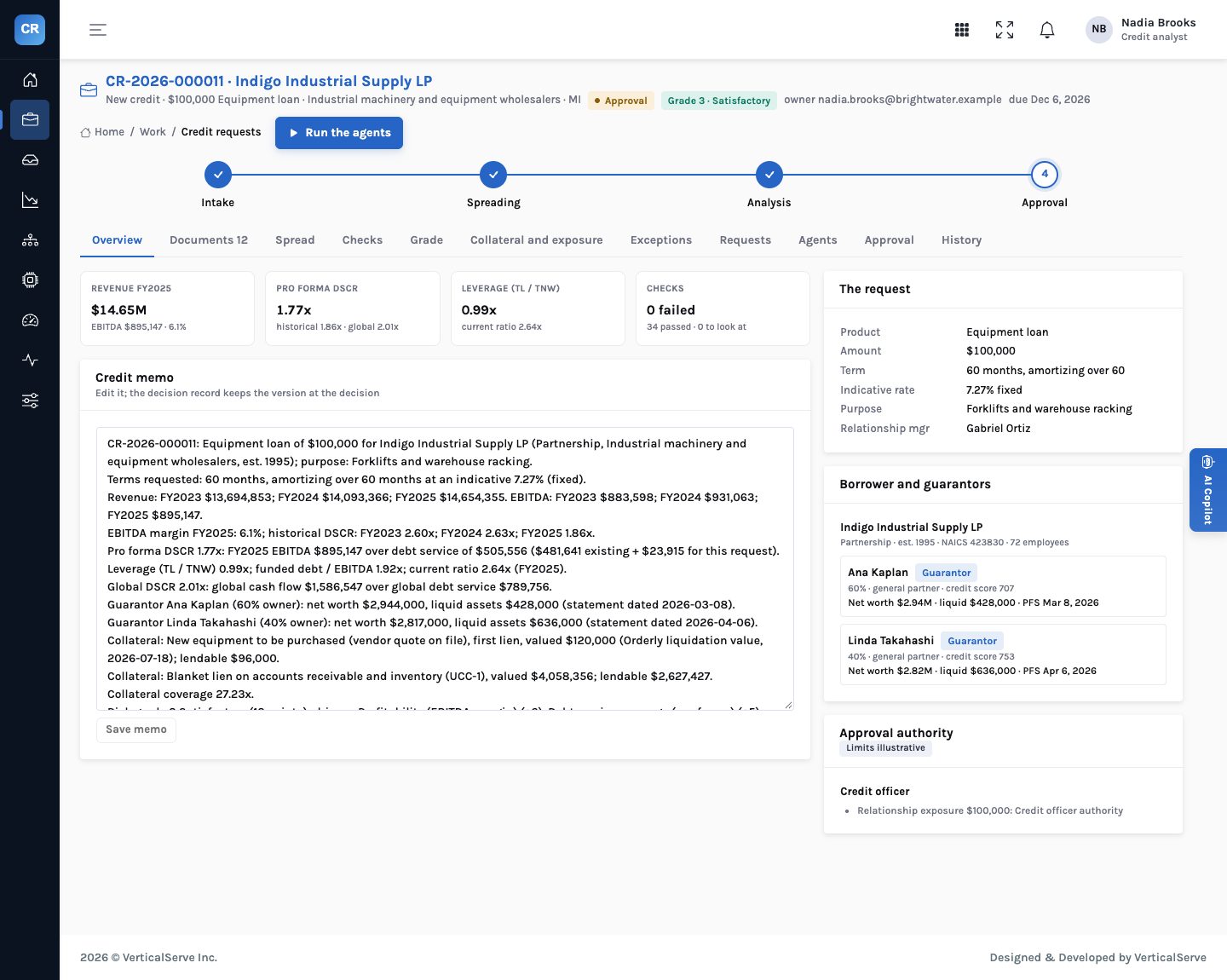
A memo whose figures come from the engines
The memo writer drafts the credit memo from what the engines computed: the request and terms, revenue and EBITDA by year, margins, historical and pro forma coverage, leverage, liquidity, global cash flow, each guarantor, the collateral, the group exposure, the grade and its drivers, every exception with its mitigant, and any check still open. With a model on, it may improve the wording; a sentence that carries a number or a name not in the facts is thrown away.
- Grounded — every number in the draft is the spread’s, the collateral’s, the grade’s or the exposure’s
- Tested — a test checks the memo’s figures against the engines
- Yours to edit — the analyst accepts the draft and edits it on the case
- Kept — the decision record keeps the version at the decision
Approval
Four eyes, and the authority the request actually needs
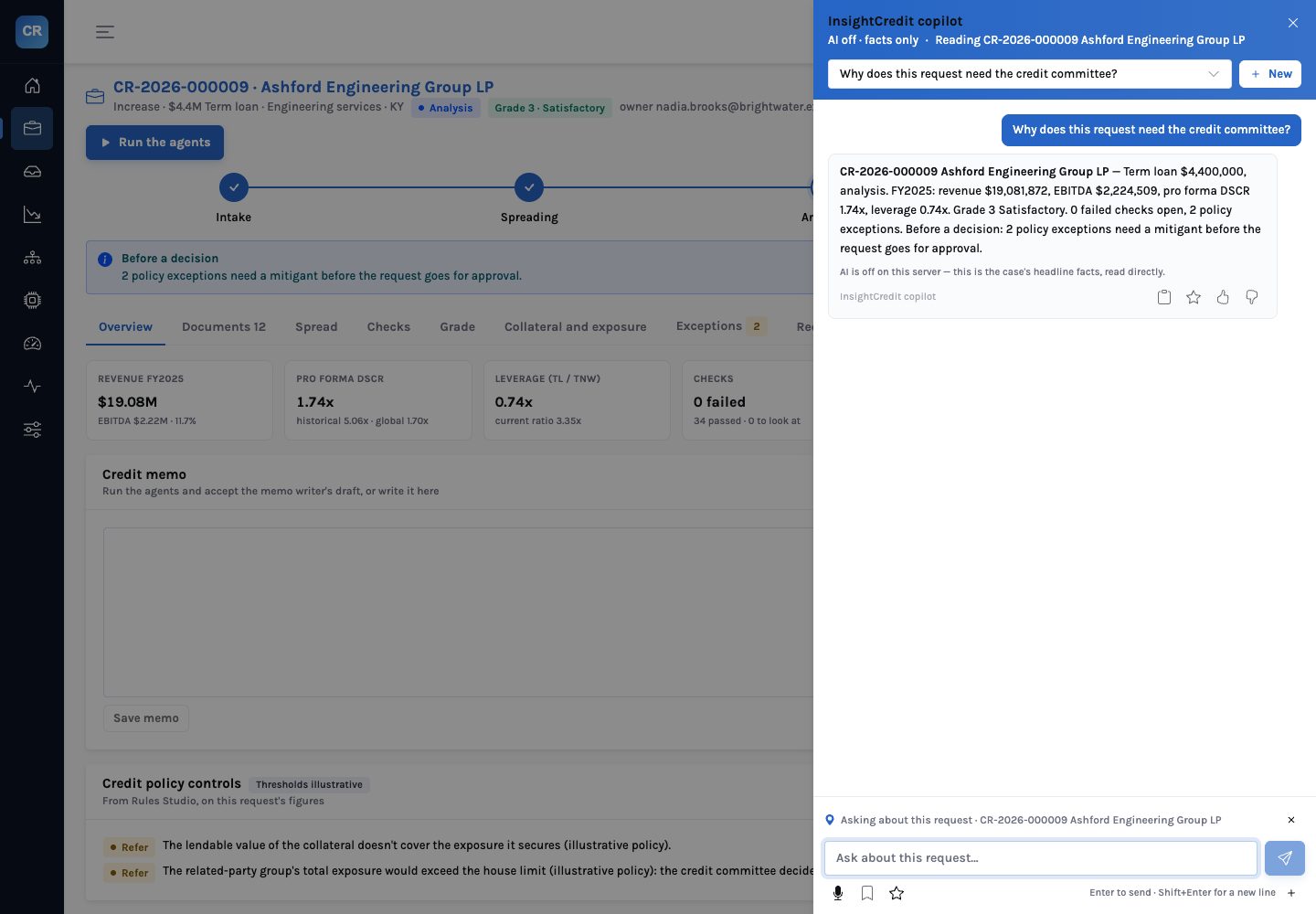
Every approval needs a second person: whoever submits can’t approve. The authority a request needs is set by the relationship’s total exposure, raised to a senior credit officer by any referred exception, and to the credit committee when the related group would pass the house limit. A senior credit officer records the committee’s decision with its minute. The decision record keeps it all as it stood.
- Delegated authority — credit officer to $2.5 million of relationship exposure, senior credit officer to $10 million, then the credit committee (illustrative)
- Enforced, not advised — the Approve button isn’t there for someone without the authority
- Conditions — recorded with the approval
- The decision record — verdict, controls, exceptions and mitigants, grade, coverage, leverage, authority, submitter and approver
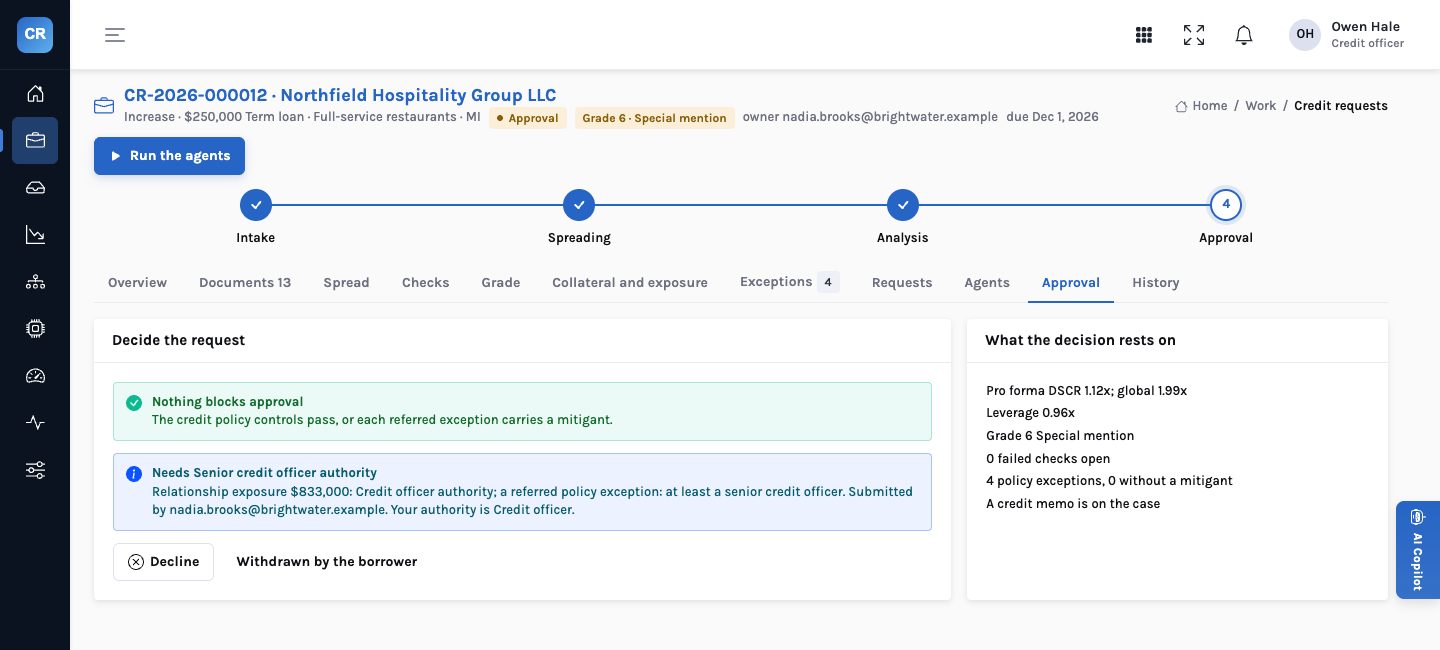
Requests to the borrower
Held until a person sends them
The intake, spreading and analyst agents draft a request when something is missing or two documents disagree; an analyst can write one too. Requests are held for review. The borrower answers through a link with no login, and uploads are read straight away; the spread and the checks run again.
- Held — no agent can send to a borrower
- A link per request — shown once; only a fingerprint is stored; withdrawn, it stops working
- PDFs read on arrival — each upload becomes a case document
- Dry run until you turn delivery on — in the demo the person sends the message themselves
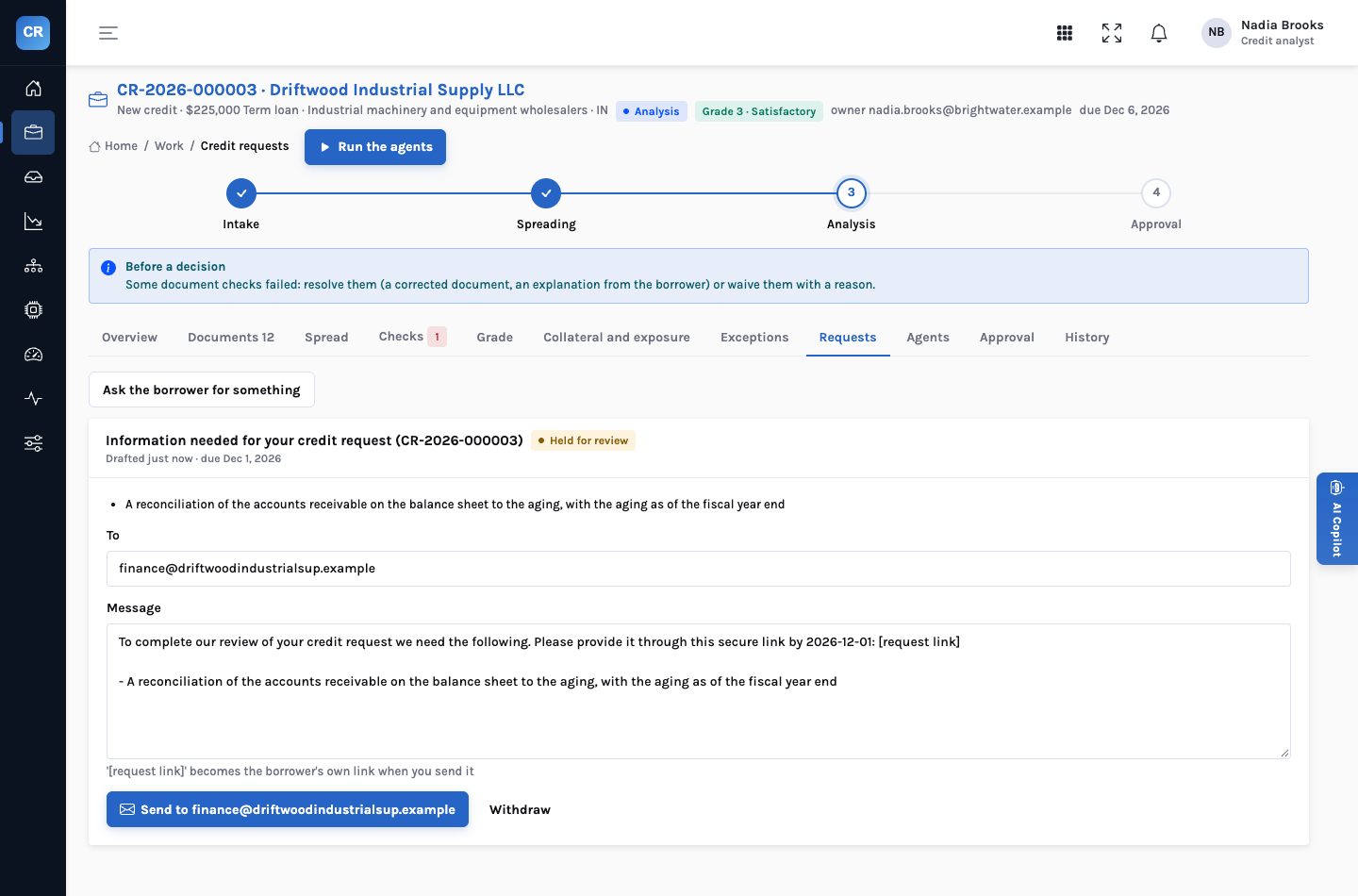
Portfolio monitoring
Covenants tested every quarter, across the book
The covenant monitor tests every covenant on the borrowers’ quarterly reporting: minimum DSCR, maximum leverage and minimum current ratio. It catches coverage that has fallen three quarters running before it breaches, lists late packages for the relationship manager, and lists the annual reviews coming due. A person decides who goes on the watchlist.
- Deterministic tests — each result keeps the quarters behind it
- Declining coverage — lower in each of the last three quarters and down at least 15% (an illustrative early warning)
- Watchlist — prepared by the monitor, added and cleared by a person, with a reason
- Annual reviews — due within 60 days, overdue flagged, opened as cases in one step
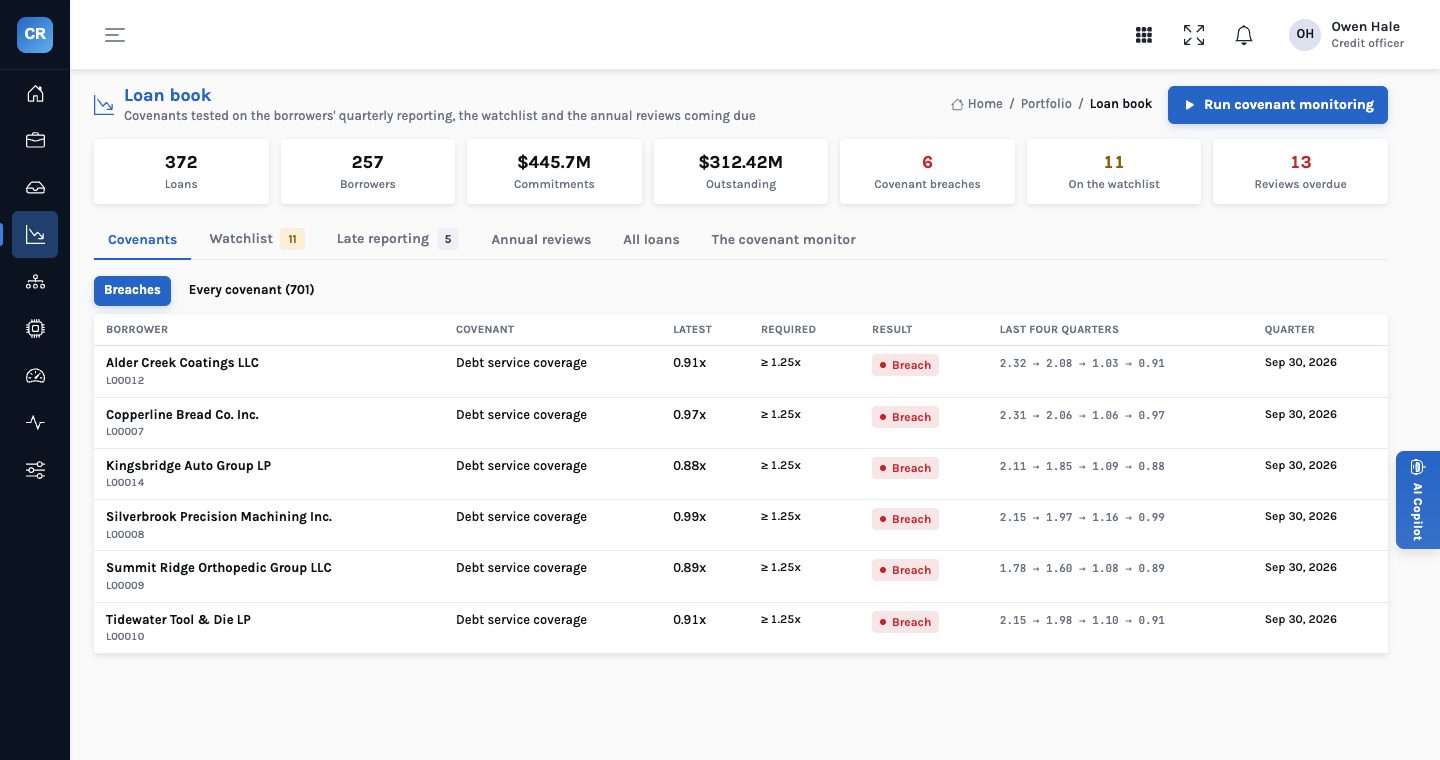
Copilot
Ask the case a question
The copilot reads one credit request through read-only tools (the summary, the spread and ratios, global cash flow, the checks, the grade, the collateral, the exposure, the exceptions, what the agents prepared and the book’s covenant results) and answers with its sources. Every figure and name it gives is checked against what the tools returned.
- Read-only — no tool changes a case
- Cited — each answer links to what it rests on
- Model optional — with AI off it answers with the facts and says so
The arithmetic
Every ratio carries its formula
Deterministic code computes every figure below from the spread. The same formulas appear on the screen, in the memo and in the decision record.
| Measure | How it is computed |
|---|---|
| EBITDA | Operating income + depreciation and amortization |
| DSCR (historical) | EBITDA / (interest expense + current portion of long-term debt) |
| DSCR (pro forma) | Latest EBITDA / (latest historical debt service + the request’s annual debt service) |
| Global DSCR | (EBITDA − income tax + Σ guarantors’ income − living expenses) / (pro forma debt service + Σ guarantors’ debt payments) |
| Leverage | Total liabilities / tangible net worth (owners’ equity − intangible assets) |
| Funded debt / EBITDA | (Line of credit + current portion + long-term debt) / EBITDA |
| Current ratio | Total current assets / total current liabilities |
| DSO, DIO, DPO | Receivables / revenue × 365; inventory / COGS × 365; payables / COGS × 365 |
| Collateral coverage | Lendable value / the exposure the collateral secures |