Every bank’s loan policy has a page of delegated lending authority: who may approve what, up to how much, and what goes to committee. The page is usually right. The question is whether it is enforced at the moment someone says yes. If the answer depends on the approver remembering their limit, adding up the relationship’s other loans correctly, and noticing that a policy exception should have sent the request one level higher, then delegated authority is a good intention, not a control.
In short
- Four eyes on every approval. The person who submits a request can never be the person who approves it. InsightCredit checks this at the moment of approval, not when the request is routed.
- Authority follows the relationship, not the request. The tier is set by existing commitments at the bank plus this request, and raised by referred policy exceptions and by a related-party group over the house limit.
- The system shows the approver only what they may do. A credit officer who opens a request needing senior authority sees why, and sees no Approve button.
- The decision record freezes the evidence. Verdict, controls, exceptions and mitigants, grade, coverage, leverage, the authority and why, who submitted, who approved, and the conditions.
What delegated authority is for
A bank’s board is responsible for its lending, and delegates the authority to approve loans through the loan policy: to individual officers up to set limits, to senior officers above them, and to a committee for the largest or riskiest credits. The OCC’s Comptroller’s Handbook booklet Commercial Loans describes lending authority as one of the core elements of a loan policy. The idea is simple: the bigger the exposure, or the further outside policy, the more senior and experienced the person who accepts the risk.
InsightCredit’s demo uses three tiers. The limits are illustrative settings
(CREDIT_AUTHORITY_OFFICER_USD and CREDIT_AUTHORITY_SENIOR_USD); a bank
sets its own.
| Tier | Who | Relationship exposure (illustrative) | Also required when |
|---|---|---|---|
| 1 | Credit officer | Up to $2,500,000 | — |
| 2 | Senior credit officer | Up to $10,000,000 | Any referred policy exception, whatever the size |
| 3 | Credit committee | Above $10,000,000 | A related-party group would exceed the house limit; a senior credit officer records the committee’s decision |
What sets the authority a request needs
Three things, each computed from the case rather than typed by the person submitting it.
Relationship exposure. The tier starts from the borrower’s existing commitments at the bank plus this request, not the request alone. A $250,000 increase for a borrower with $583,000 already committed is an $833,000 decision.
Referred policy exceptions. A refer is, by definition, a request outside policy that the policy allows a more senior person to accept with a mitigant. Any referred exception that is still live, open or justified, lifts the request to at least a senior credit officer.
Related-party groups. Borrowers under common ownership are aggregated, and their total
exposure is tested against a house limit ($15,000,000 in the demo, illustrative,
CREDIT_GROUP_HOUSE_LIMIT_USD). A request that would take the group over it goes to the
credit committee.
The authority is the highest of three tests. Dollar limits and the house limit are the demo’s illustrative settings.
Four demo requests, all on Brightwater Commercial Bank’s fictional data, show each path:
| Request | Exposure | Exceptions | Group | Authority needed |
|---|---|---|---|---|
| CR-2026-000010 Northfield Paint Works, $475,000 term loan | $475,000 | None | — | Credit officer |
| CR-2026-000001 Tidewater Industrial Properties, $175,000 | $175,000 | Two refers (and a block) | — | Senior credit officer |
| CR-2026-000012 Northfield Hospitality, $250,000 increase | $833,000 | Four refers, justified | — | Senior credit officer |
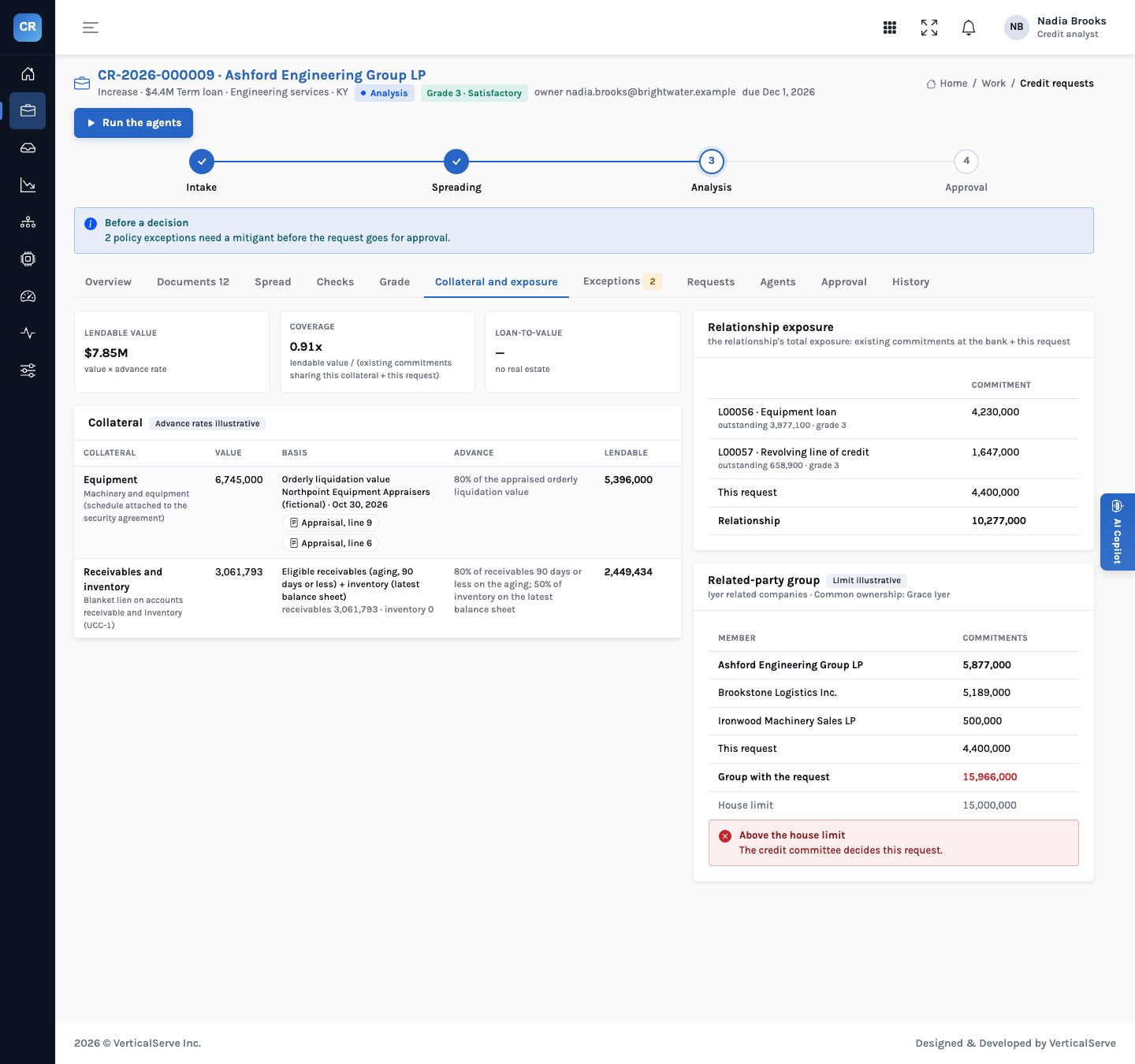
| CR-2026-000009 Ashford Engineering, $4,400,000 term loan | $10,277,000 | Two refers | Iyer related companies: $15,966,000 against $15,000,000 | Credit committee |
Ashford is the instructive one. Its own request is $4,400,000, but with an existing $4,230,000 equipment loan and a $1,647,000 revolving line the relationship comes to $10,277,000, above senior authority on size alone. Its related-party group, the Iyer related companies, would reach $15,966,000 with the request, over the house limit. Either test sends it to the credit committee; the case says both, in plain words.
A house limit is not the legal lending limit
The house limit is the bank’s own appetite for one group of related borrowers, usually set well inside its legal lending limit. The legal limit is a separate, statutory test: for national banks, 12 CFR Part 32 sets it as a share of capital and surplus and has its own rules for combining related borrowers; state-chartered banks follow state law. InsightCredit’s house-limit control does not calculate the legal lending limit.
Four eyes, enforced at the moment of approval
The other half of the control is separation: the person who prepared and submitted the request does not approve it. In InsightCredit this applies to every approval, not only to large ones. When someone presses Approve, the system checks, in order, that nothing blocks the request, that it was submitted, that the approver is not the submitter, and that the approver’s tier covers the authority the request needs as computed at that moment. If the case changed after submission (a new exception, a larger exposure) the approval is tested against the new state, not the old one.
The supervisor agent prepares the submission; a person submits; a different person with the authority approves. No agent can decide.
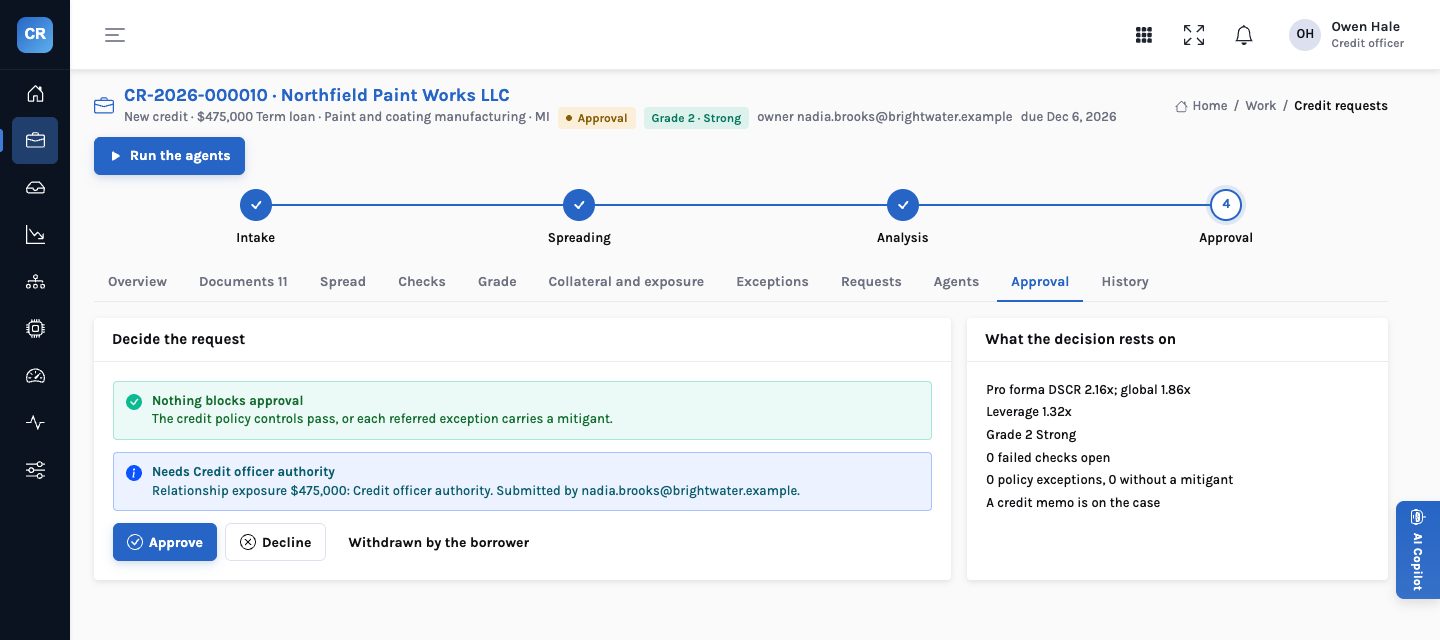
Northfield Paint Works (CR-2026-000010) is the clean case: a $475,000 term loan for a plant
expansion, grade 2 Strong, pro forma DSCR 2.16x, no exceptions. Nadia Brooks, the credit analyst,
submitted it. Owen Hale, a credit officer, sees “Nothing blocks approval”, “Needs
Credit officer authority” and who submitted it, and he has an Approve button.
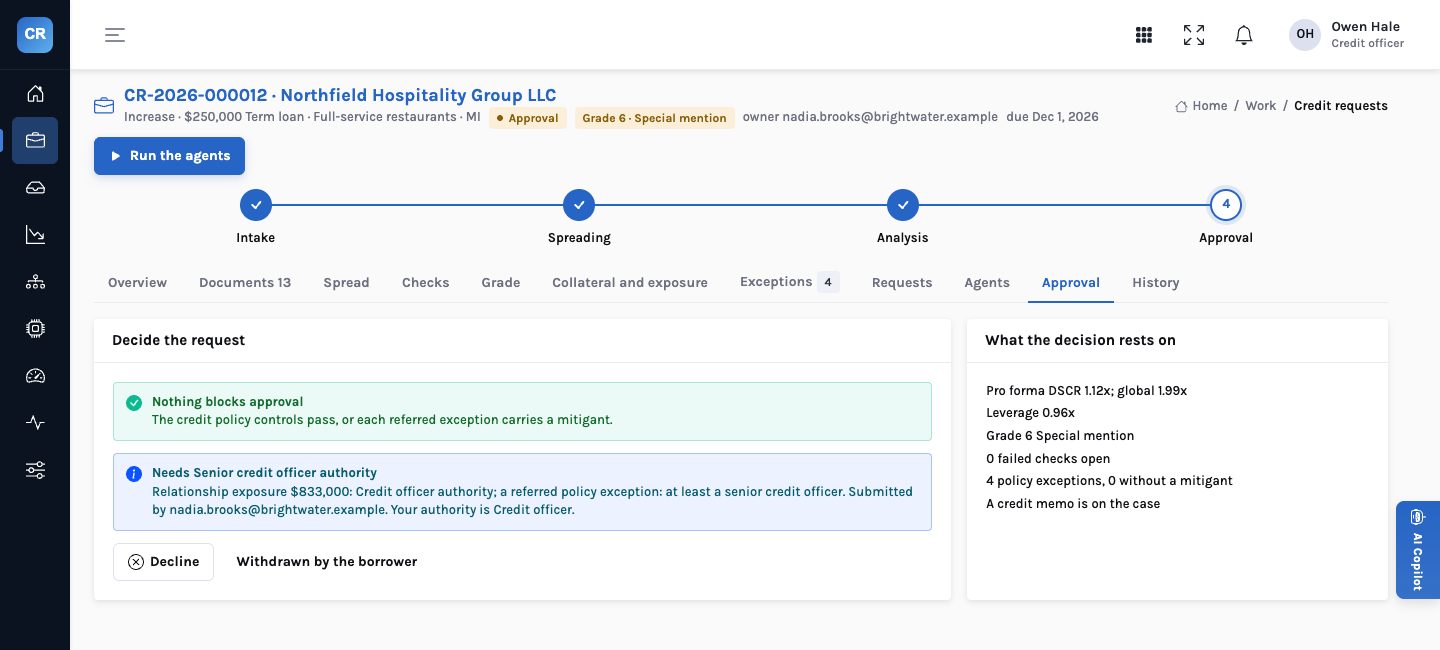
Northfield Hospitality (CR-2026-000012) looks similar at first glance: nothing blocks it,
because each of its four referred exceptions carries a recorded mitigant. But Owen opens it and reads
“Needs Senior credit officer authority. Relationship exposure $833,000: Credit officer
authority; a referred policy exception: at least a senior credit officer. Your authority is Credit
officer.” There is no Approve button. He can still decline, with a reason, or record that the
borrower withdrew; approving is for someone with tier 2 authority, such as Ines Carvalho, the senior
credit officer.
The credit committee
Committee decisions are made in a meeting, not in a system, and InsightCredit doesn’t pretend otherwise. A request needing the credit committee is recorded by a senior credit officer, who must enter the meeting date and the minute reference with the decision. A credit officer can’t record it, and the four-eyes rule still applies: the person recording can’t be the person who submitted. Ashford’s approval tab today says it is not ready, because two exceptions still need a mitigant, and that it needs credit committee authority.
What the decision record freezes
A credit request keeps changing after the decision: new statements arrive, covenants are tested, the grade moves at annual review. If the bank keeps only the current state, it can’t answer what it knew when it said yes. So the decision is written as a record at the moment it is made:
| The record keeps | So that later you can answer |
|---|---|
| The verdict, who decided and when, who submitted | Was it four eyes? Who accepted this risk? |
| Every credit policy control’s outcome and rule version | Did policy block or refer anything, under which version of the rule? |
| Each live exception with its mitigant | What was outside policy, and what reason was accepted? |
| The grade with its model, factors and any override | Why was it a 2 then, when it is a 5 now? |
| Pro forma DSCR, global DSCR and leverage | What did the numbers look like on the day? |
| The authority required and why, and the approver’s tier | Was it approved at the right level? |
| The note and the conditions, signed off as a human decision | What did the approver require? |
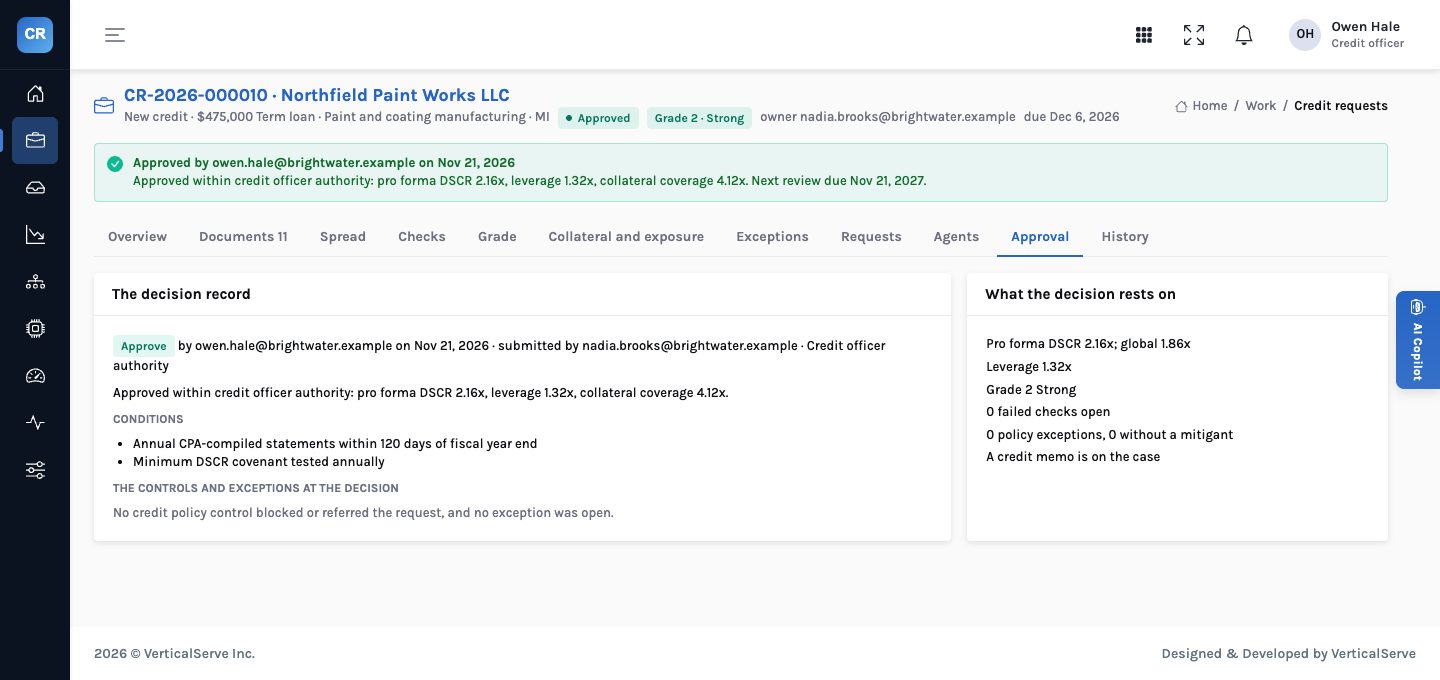
Owen approved Northfield Paint Works on 21 November 2026. The record reads: approved by owen.hale, submitted by nadia.brooks, credit officer authority, “Approved within credit officer authority: pro forma DSCR 2.16x, leverage 1.32x, collateral coverage 4.12x.” Two conditions: “Annual CPA-compiled statements within 120 days of fiscal year end” and “Minimum DSCR covenant tested annually.” No control blocked or referred the request and no exception was open. The next review is set a year out, 21 November 2027.
Declines need a reason
A decline can’t be recorded without a written reason. That is good practice for the credit file, and it matters beyond it: Regulation B, which implements the Equal Credit Opportunity Act, applies to business credit, including its rules on notifying applicants of action taken. The reason the officer writes in InsightCredit is the bank’s internal record; it is not itself the notice to the applicant, which the bank sends through its own process.
What agents do here, and what they can’t
The supervisor agent reads the blockers and the authority and prepares the submission: “Submit CR-2026-000013 for approval by a credit officer”, for a person to accept, edit or reject. That is as far as it goes. Deciding a credit request is refused for any agent in code (“Deciding a credit request is a person’s call”), and so is justifying an exception. Every answer a person gives to an agent’s prepared decision is recorded with who and when.
Resolve or waive failed checks, record mitigants for referred exceptions, cure or decline a block.
States whether anything blocks and which authority the request needs, and why.
With a recommendation and a note. The case records who submitted and when.
Approve within their authority, or decline with a reason. Blockers and authority are checked again at that moment.
For tier 3: the committee’s verdict with the meeting date and minute reference.
The decision record is written with the decision; approval sets the next review a year out.
What it means for each audience
For the chief credit officer
Delegated authority is enforced at the moment of decision, from computed exposure and live exceptions, not from the submitter’s reading of the policy.
Every approval answers who, at what level, on what evidence and under which version of the rules.
For the credit team lead
Approvers see only requests they may decide, with the reason spelled out when they can’t. Nobody discovers a limit by having an approval bounce.
Analysts know before submitting which level the request will need.
For the board
The board can see that its delegations are followed: no self-approval, nothing above a limit, committee decisions tied to minutes.
Approvals by level, exceptions accepted at each level and declines by reason become things the bank can report.
What to be careful about
- Four eyes can become a rubber stamp. A second approver who never declines or questions is not a control. Look at approval patterns, and at how long approvers spend on a file.
- Exposure is what the bank knows. The demo counts commitments at the bank plus the request. Guarantees the borrower gave elsewhere, or debt at other lenders, are for the analysis, not the tier. If your policy counts more, the exposure definition must match it.
- Limits are policy. $2,500,000, $10,000,000 and the $15,000,000 house limit are illustrative. Many banks also scale authority by grade, not only by size. Make the system match the board-approved policy, and change both together.
- A frozen record is not a frozen borrower. The record shows what was known at the decision. Covenant monitoring and annual review catch what changed afterwards.
Delegated authority is only a control if it is checked at the moment someone says yes.
Compute the tier from the relationship, the exceptions and the group, keep the submitter away from the approval, and freeze the evidence with the names of the people who decided.