Every risk grade is challenged by somebody. The relationship manager thinks a long-standing client deserves better than a 6. The approver wants to know whether the grade would change if the guarantors were counted differently. Credit review samples the file and asks why a borrower with falling revenue was graded the same as one with rising revenue. The examiner asks how the scale works and whether it is applied consistently. “The analyst’s judgement” is part of every good answer. It can’t be the whole of one.
In short
- A grade is a decision with consequences. It can decide who approves a request, whether policy refers or blocks it, how closely the loan is watched, and how it is counted in reports to the board.
- Use points with reasons. Each factor adds risk points and says why, with the value and the bands it was measured against. The total maps to a grade at published boundaries.
- Know which factor carries the grade. On a points scorecard you can read what would move it: on the demo’s Tidewater request, 30 of 51 points come from one ratio.
- Overrides are allowed and visible. A credit officer can change the grade with a reason. The model’s grade, its version and the override all stay on the record.
What the grade decides
A commercial risk grade summarises the likelihood that a borrower repays as agreed. Many banks use a scale of eight to ten grades, with the weakest grades lining up with the classifications the US banking agencies use: special mention, substandard, doubtful and loss. Those regulatory terms have published definitions. Special mention describes potential weaknesses that deserve management’s close attention; substandard describes an asset inadequately protected by the current sound worth and paying capacity of the obligor or by the collateral pledged, with a well-defined weakness; doubtful adds that collection in full is highly questionable and improbable. The OCC’s Comptroller’s Handbook booklet Rating Credit Risk sets them out.
Inside the bank the grade does practical work. In InsightCredit’s demo policy it does three things directly:
| Grade | Up to (points) | Label | What it triggers in the demo policy |
|---|---|---|---|
| 1 | — | Exceptional | Reserved for cash-secured credit |
| 2 | 10 | Strong | Nothing extra |
| 3 | 20 | Satisfactory | Nothing extra |
| 4 | 32 | Acceptable | Nothing extra |
| 5 | 45 | Management attention | Nothing extra; worth reading the drivers |
| 6 | 60 | Special mention | GRADE_WATCH refers the request: a mitigant, and at least a senior credit officer |
| 7 | above 60 | Substandard | GRADE_SUBSTANDARD blocks it at origination |
| 8 | — | Doubtful | On the scale, reached only by override |
The boundaries, labels and consequences in that table are the demo’s illustrative settings. A bank sets its own scale and its own policy in Rules Studio. What matters is the mechanism: the grade isn’t a label that sits on the file, it feeds the controls that decide what happens next.
Why a grade needs to show its work
Grades go wrong in familiar ways. A spreadsheet scorecard drifts as someone changes a weight and nobody records which version graded which loan. A judgemental grade is defensible on the day and impossible to reconstruct two years later. A statistical score can be well calibrated across a portfolio and still unable to say why this borrower is a 6 rather than a 5. Each of these fails the same test: the next person to read the file can’t argue with it.
A number and a label. The relationship manager can’t tell what would change it, and credit review can’t test whether it was right.
Every point has a reason and a measured value. Disagree with one line and you know exactly what would move the grade.
The scorecard, factor by factor
InsightCredit’s demo scorecard is model 1.0-illustrative. It reads ten factors, all
from figures the case has already established in the spread, the collateral valuation and the
guarantors’ personal financial statements. Higher points mean more risk. Each factor states the
value it measured and the bands it compared it against:
| Factor | Points | Bands |
|---|---|---|
| Pro forma DSCR | 0 / 5 / 10 / 20 / 30 | 2.00x, 1.50x, 1.25x, 1.00x |
| Leverage (TL / TNW) | 0 / 4 / 8 / 15 | 1.5, 2.5, 4.0; TNW ≤ 0 scores 15 |
| Liquidity (current ratio) | 0 / 3 / 6 / 10 | 1.5, 1.2, 1.0; not scored for property owners |
| EBITDA margin | 0 / 3 / 6 / 10 | 15%, 8%, 3% |
| Revenue CAGR | 0 / 4 / 8 | 0%, −5% |
| Collateral coverage | 0 / 4 / 8 / 12 | 1.25, 1.00, 0.75 |
| Guarantor support (global DSCR) | 0 / 3 / 6 / 10 | 1.50, 1.25, 1.00; +5 if a guarantor’s net worth is negative (max 15) |
| Time in business | 0 / 2 / 4 / 6 | 10, 5, 3 years |
| Industry | 0 / 3 / 6 | low, medium, high on an illustrative industry list |
| Statement quality | 0 / 1 / 3 / 5 | audited, reviewed, compiled, company-prepared |
The weights say something about credit philosophy, and that is the point of writing them down. Repayment capacity carries the most: pro forma DSCR alone can add 30 points, enough to move a borrower three grades. Collateral and guarantors matter, but less. Statement quality is a small factor that rewards better evidence. A bank that disagrees changes the bands and weights, and the change is visible in the next model version.
A grade, worked: Tidewater, 51 points
The demo’s first request, CR-2026-000001, is Tidewater Industrial Properties LLC
(fictional, like all of Brightwater Commercial Bank’s demo data): a Michigan lessor of
nonresidential buildings, in business since 2007, asking for $175,000 to replace a roof and HVAC. Its
grade, exactly as the case shows it:
| Factor | Points | Why |
|---|---|---|
| Debt service coverage (pro forma) | +30 | 0.77x (bands: 2.00x, 1.50x, 1.25x, 1.00x) |
| Revenue trend (compound annual growth) | +8 | −6.6% a year over the spread (bands: 0%, −5%) |
| Collateral coverage (lendable value / exposure) | +4 | 1.00x (bands: 1.25x, 1.00x, 0.75x) |
| Guarantor support (global cash flow) | +3 | global DSCR 1.32x (bands: 1.50x, 1.25x, 1.00x) |
| Industry | +3 | Lessors of nonresidential buildings: medium risk (illustrative industry list) |
| Quality of the financial statements | +3 | Compiled |
| Leverage (total liabilities / tangible net worth) | 0 | 1.09x |
| Liquidity (current ratio) | 0 | not scored for a property owner: the rent roll and the property carry the credit |
| Profitability (EBITDA margin) | 0 | 39.1% |
| Time in business | 0 | 19 years |
| Total | 51 | Grade 6, Special mention (46 to 60 points) |
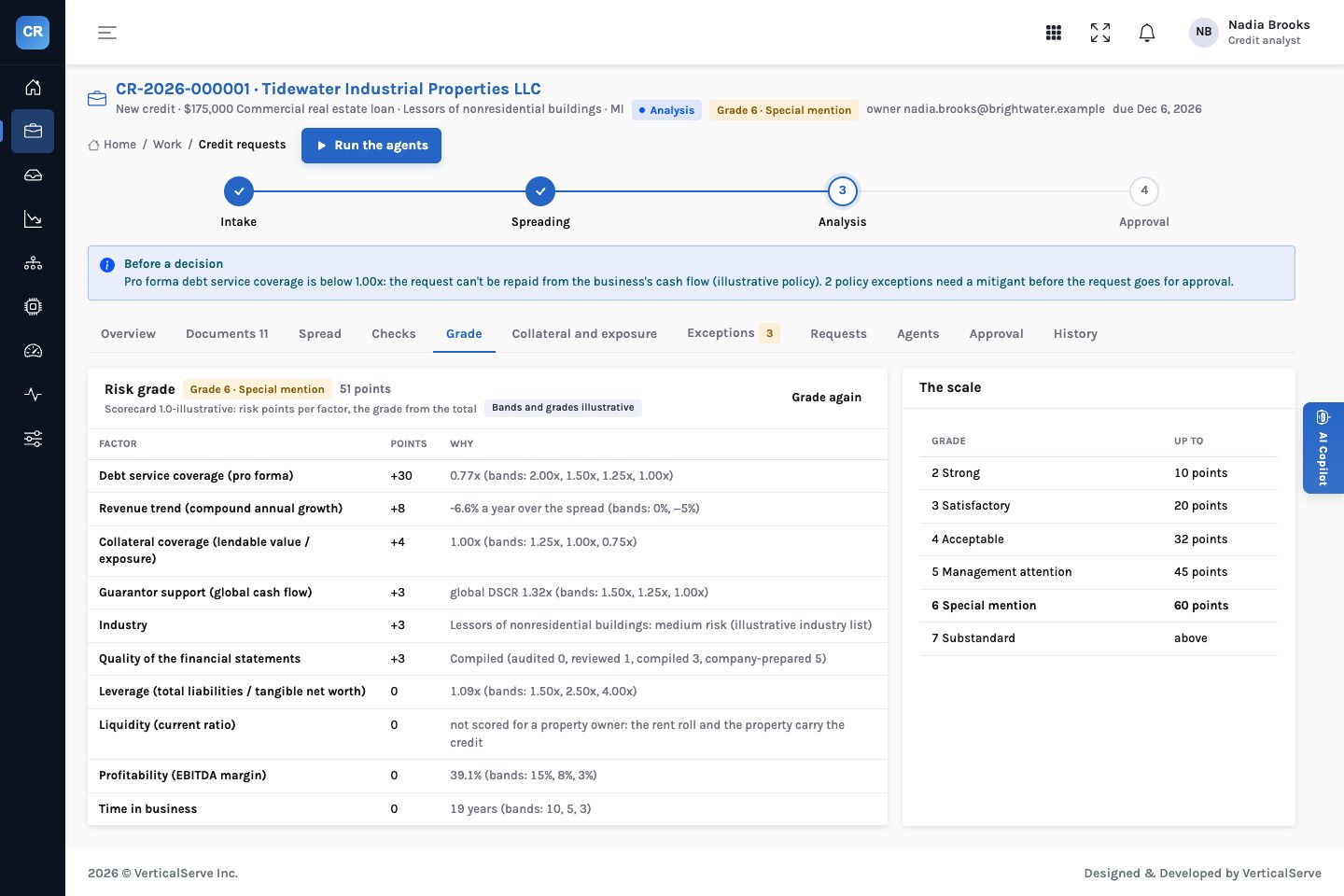
Read it the way an approver would. Of the 51 points, 30 come from a single fact: pro forma coverage below 1.00x. Everything else together adds 21. That tells you where the argument is. If the borrower’s coverage were between 1.00x and 1.25x, that factor would add 20 and the total would be 41, a grade 5. Between 1.25x and 1.50x it would add 10, for 31 and a grade 4. Nobody needs to rerun a model to see that; it is arithmetic on the screen.
It also shows what the grade is not saying. Tidewater’s leverage is low (1.09x), its margin is high (39.1%) and it has been in business 19 years; those factors score nothing. The grade is special mention because the property no longer covers its debt from its own cash flow, and partly because revenue is falling. Those are the two things a credit officer would want the memo to explain, and the credit analyst agent has already prepared a request asking the borrower to explain the decline in earnings, waiting for a person to accept, edit or reject it.
Boundaries matter
Points scorecards have edges, and an honest one shows them. Northfield Hospitality Group
(CR-2026-000012), a full-service restaurant group asking for a $250,000 increase, scores
exactly 60: pro forma DSCR 1.12x (+20), collateral coverage 0.48x (+12), current ratio 0.80x (+10),
EBITDA margin 7.9% (+6), company-prepared statements (+5), revenue trend −0.7% a year (+4) and
a medium-risk industry (+3). Sixty is the top of grade 6. One more point and it would be a 7,
Substandard, which the demo policy blocks at origination.
At the other end, Northfield Paint Works (CR-2026-000010) scores 4: three points for an
EBITDA margin of 11.8% (between the 8% and 15% bands), and one for reviewed statements. Grade 2, Strong. Two
borrowers with similar names, and grades you can explain in a sentence each.
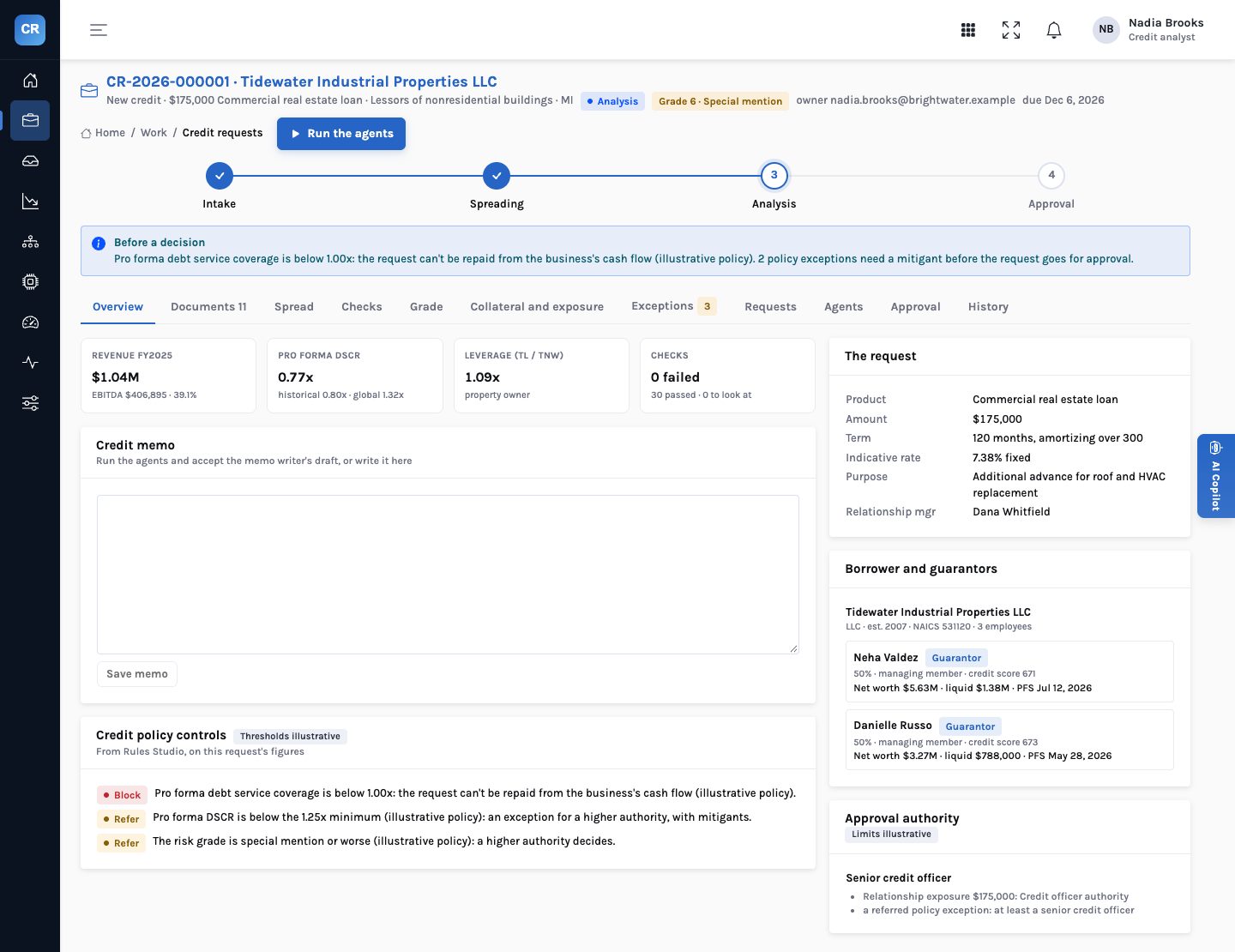
The grade reads only established facts, and its consequences are controls, not habits. Boundaries and controls are the demo’s illustrative settings.
Overrides with a trail
No scorecard sees everything. A credit officer may know the borrower has signed a lease that isn’t in the statements yet, or that a weak year was one fire, insured and rebuilt. InsightCredit lets a credit officer override the grade, and requires a reason. The record then keeps both: the model’s grade with its points, factors and model version, and the override with who made it and why. The effective grade is the override; the model’s view doesn’t disappear.
A wrong fact is fixed at its source; a judgement the model can’t see is an override, in writing.
The distinction in that diagram matters. If a factor is wrong because a figure is wrong, the fix is a corrected document and a fresh spread, after which the grade is computed again. An override is for when the facts are right and the scorecard still misjudges the risk. Mixing the two is how grade histories become unreadable.
The grade runs after the spread, the reconciliations and the collateral valuation, because it reads their results.
Applies the scorecard, records the model version, every factor’s value, points and reason, and the total.
Which factors carry the points? Is each value right? A wrong one is fixed at its source and the case graded again.
With a written reason. The model’s grade stays on the record beside the override.
GRADE_WATCH refers at 6 or worse; GRADE_SUBSTANDARD blocks at 7 at origination; the decision record keeps the grade.
Governing the scorecard
A grading scorecard is a model in the sense of the US model risk management guidance, SR 11-7 from the Federal Reserve and OCC Bulletin 2011-12, and many banks put their rating tools through model validation. A transparent points model makes the main questions short:
- What does it do? The factor list, bands, weights and boundaries are its specification.
- Which version graded this loan? The model version is stored with every grade.
- Is it applied consistently? The same facts give the same points. Agents run it; they don’t vary it.
- Where does it disagree with people? Overrides and their reasons are on the record. A factor that is overridden again and again is the first candidate for recalibration.
The same transparency serves credit risk review, which the 2020 interagency guidance expects to assess the accuracy of risk ratings, and the allowance, since many banks use risk grades as a credit quality indicator under CECL (ASC 326). A grade that can be reproduced from its factors is one that review can test and finance can rely on.
What the scorecard is not
It is not a statistical default model, and the demo’s weights were not fitted to anyone’s loss history. It is an illustrative, explicit scoring of established facts, designed to be read. A bank adopting it replaces the bands, weights and boundaries with its own, approved like any other credit policy, and validates them.
What it means for each audience
For the chief credit officer
The rating methodology is its own documentation: factors, bands, weights, boundaries, model version, and every override with its author.
Grade-driven policy (watch, substandard) runs as controls, so it is applied the same way on every request.
For the credit team lead
Analysts check reasons instead of doing arithmetic. Officers argue about the factor that matters, not the total.
A grade that sits on a boundary is visible as one, before it becomes a surprise.
For the board
The bank can explain what makes a loan special mention in a sentence, and show how often people disagreed with the model and why.
Changing credit appetite is a change to a published scorecard, with a version number.
What to be careful about
- Points are not a classification. The regulatory terms describe weaknesses, not totals. A borrower can score 58 and still not have a well-defined weakness, or score 40 with one. The override exists for exactly that, and the bank’s grade definitions should say so.
- Additive scores miss interactions. Thin coverage plus a single dominant customer may be worse than their sum. Watch the overrides for patterns, and add a factor when you find one.
- Cliffs invite gaming. When 1.24x and 1.26x land in different bands, someone will notice. Keep the inputs traced to documents, and review requests that sit just over a line.
- A grade at origination ages. The grade on the decision record is what was known then. Covenant monitoring and annual review are what move it later.
If you can’t say which factor carries a grade, you can’t defend it.
Give every point a reason and a measured value, publish the boundaries, store the model version, and let people disagree only in writing.