Ask a credit analyst where a request’s days go and the answer is rarely the analysis. It is the wait: for last year’s tax return, for the receivables aging the bank asked for at intake, for an explanation of a number that doesn’t agree with another. Each needs an email, a reply with attachments, someone to save them to the file, and someone to check whether they answer the question. The way to shorten the wait is not to chase harder. It is to ask once, precisely, and do something with the answer the moment it arrives.
In short
- Requests come from what failed. A missing document or a reconciliation that doesn’t hold becomes a request item that names exactly what is needed, tied to the check it answers.
- Agents draft, people send. An agent’s request is a prepared decision; accepting it puts it on the case, held for review. A person edits the wording and presses Send.
- One link, no login. The borrower answers through a link that works only for that request. It is shown once; InsightCredit stores only a fingerprint of it.
- Answers are read on arrival. Uploaded PDFs are read at once, and the spread and checks run again, so the analyst sees what the answer settled.
The situation
The cases use InsightCredit’s demo data for Brightwater Commercial Bank. The bank, the borrowers and every figure are fictional, and in this environment no message is actually delivered: sending is a dry run, described below. Two requests need something from the borrower:
| Case | What is needed | Why |
|---|---|---|
| CR-2026-000008 Granite Bay Paint Works LP, $200,000 term loan for a plant expansion | The 2025 federal tax return and a receivables aging | Two checks fail because the documents were never supplied |
| CR-2026-000003 Driftwood Industrial Supply LLC, $225,000 term loan for a second warehouse | A reconciliation of receivables on the balance sheet to the aging | The balance sheet shows $592,463 of receivables; the aging totals $436,665, a 35.7% difference against an illustrative 10% tolerance |
Both cases are owned by Nadia Brooks, credit analyst. Neither is a weak credit on the figures that are there: Granite Bay grades 2 Strong with pro forma DSCR of 1.69x; Driftwood grades 3 Satisfactory at 1.49x. Both are stuck for the same reason. Something the bank needs is in the borrower’s hands.
Why requests stall
- Vague asks. “Please send updated financials” brings back the wrong year, or the wrong document. Every round trip adds days.
- Email as a filing system. Attachments land in one person’s inbox, get saved to a shared drive, and the spread is updated when someone gets to it.
- Nobody re-checks. The tax return arrives, but the check that failed for want of it stays failed until someone remembers to look.
- Security. Tax returns and personal financial statements travel as ordinary email attachments because that is how the bank asked for them.
The analyst writes from a template, the borrower replies with attachments, the analyst files them, re-keys the figures and re-checks by hand, if they remember.
The request is drafted from what failed, held for review, sent with a one-time link, and the answer lands on the case, where the reader, the spread and the checks run again.
How InsightCredit handles it
Nothing reaches the borrower until a person presses Send.
Missing documents: Granite Bay Paint Works
Granite Bay’s file has three years of statements, the 2023 and 2024 returns, bank statements, a payables aging, an equipment appraisal and three personal financial statements. Two checks fail, and each says why in one line:
| Check | Result | Detail |
|---|---|---|
| Business tax return 2025 on file | Fail | The 2025 return was not supplied. |
| Receivables aging on file | Fail | The receivables aging was not supplied (receivables of $1,001,424 on the latest balance sheet). |
The gaps have consequences beyond the checks. Without the 2025 return, FY2025 revenue of $7,672,977 has nothing to be reconciled against. Without an aging, no receivables count toward the borrowing base: the blanket lien on receivables and inventory lends $336,069, which is 50% of the $672,138 of inventory on the balance sheet and nothing for the $1,001,424 of receivables. And the illustrative FAILED_CHECKS control blocks the request until the checks are resolved or waived.
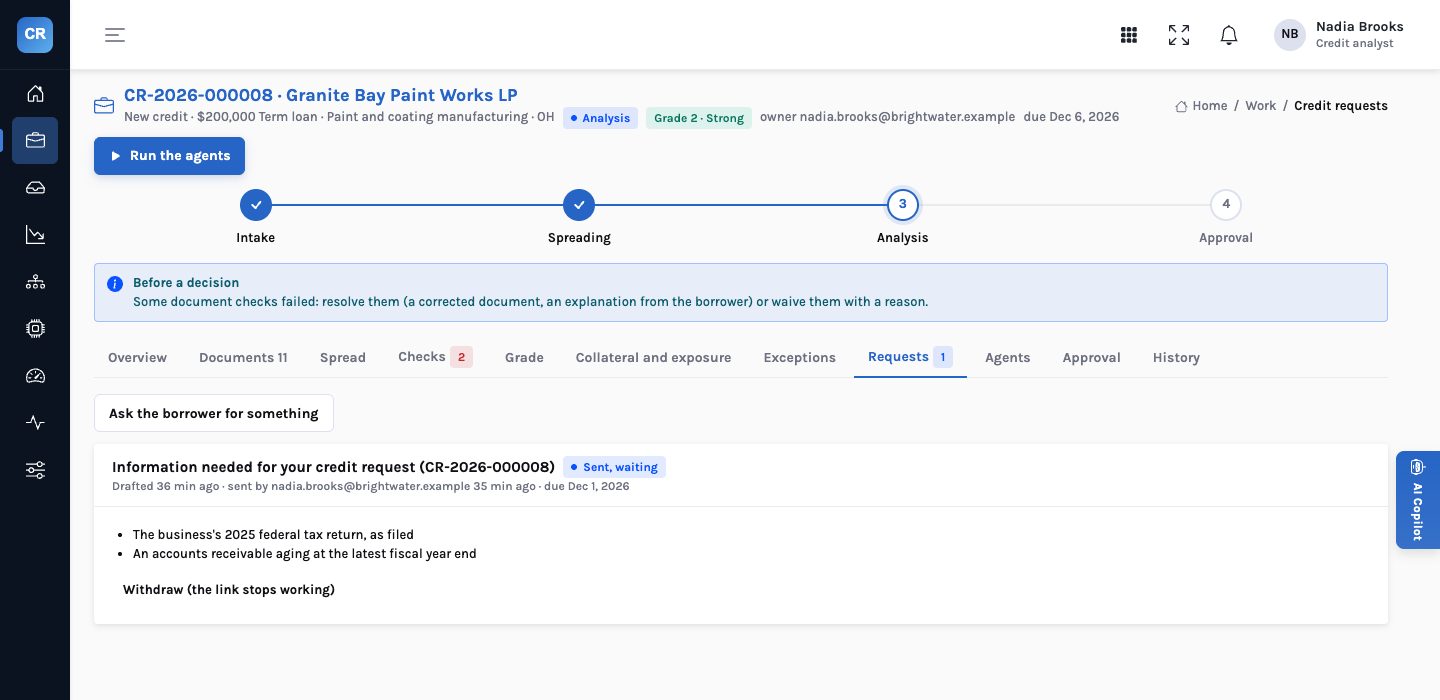
The request on the case asks for exactly those two documents, one item each. Each item carries the document type it expects and the check it answers, so an upload knows where it belongs:
- The business’s 2025 federal tax return, as filed
- An accounts receivable aging at the latest fiscal year end
Nadia sent it to finance@granitebaypaintworkslp.example with a reply-by date of 1 December 2026. The Requests tab shows it as Sent, waiting, with who sent it and when, and a way to withdraw it.
An explanation: Driftwood Industrial Supply
Driftwood’s case is subtler. Every document is there; the problem is that two of them disagree. The receivables check quotes both: $592,463 on line 22 of the FY2025 balance sheet, $436,665 on line 14 of the aging at 31 December 2025. A 35.7% gap means either the statement overstates receivables or the aging is incomplete, and the analyst can’t tell which from the file.
When the agents ran, the spreading agent prepared a decision titled “Ask Driftwood Industrial Supply LLC to explain 1 difference”, with the failing reconciliation as its evidence and one item:
The spreading agent’s request item
A reconciliation of the accounts receivable on the balance sheet to the aging, with the aging as of the fiscal year end.
The credit analyst agent prepared a separate request on the same case, asking the borrower to explain the change in revenue and EBITDA from FY2023 to FY2025 (historical DSCR went 2.95x, 2.27x, 2.00x) and for year-to-date 2026 statements. That one mixes a question, which the borrower answers in a text box, with a document. The analyst decides whether to send both, combine them, or hold one back.
Held for review
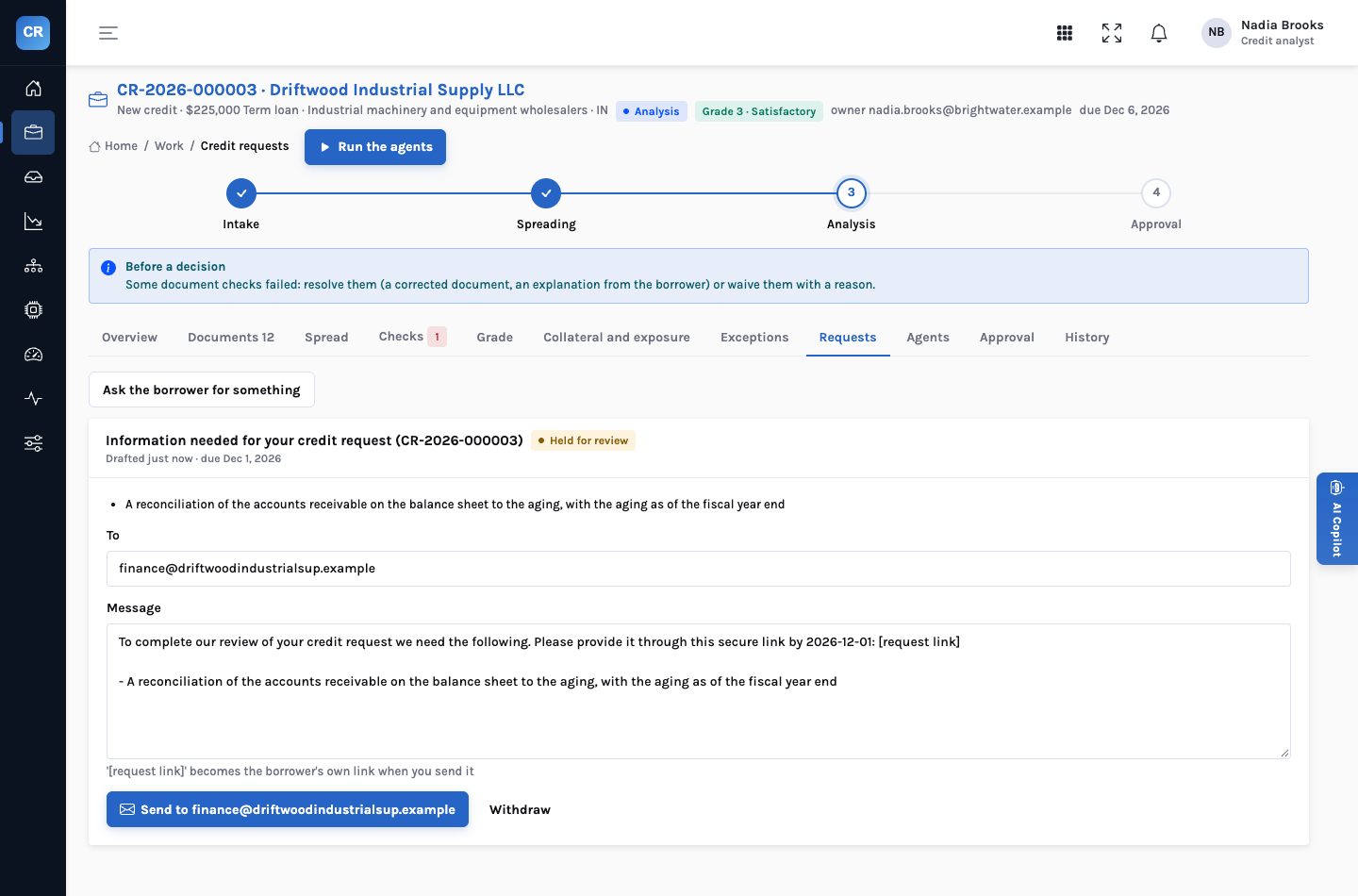
Nadia accepted the spreading agent’s request. Accepting doesn’t send anything. It puts the
request on the Requests tab, held for review, with the item, the borrower’s address and a
message she can edit. The message must keep the placeholder [request link]; that is where
the borrower’s own link will go.
Sent once, with a link
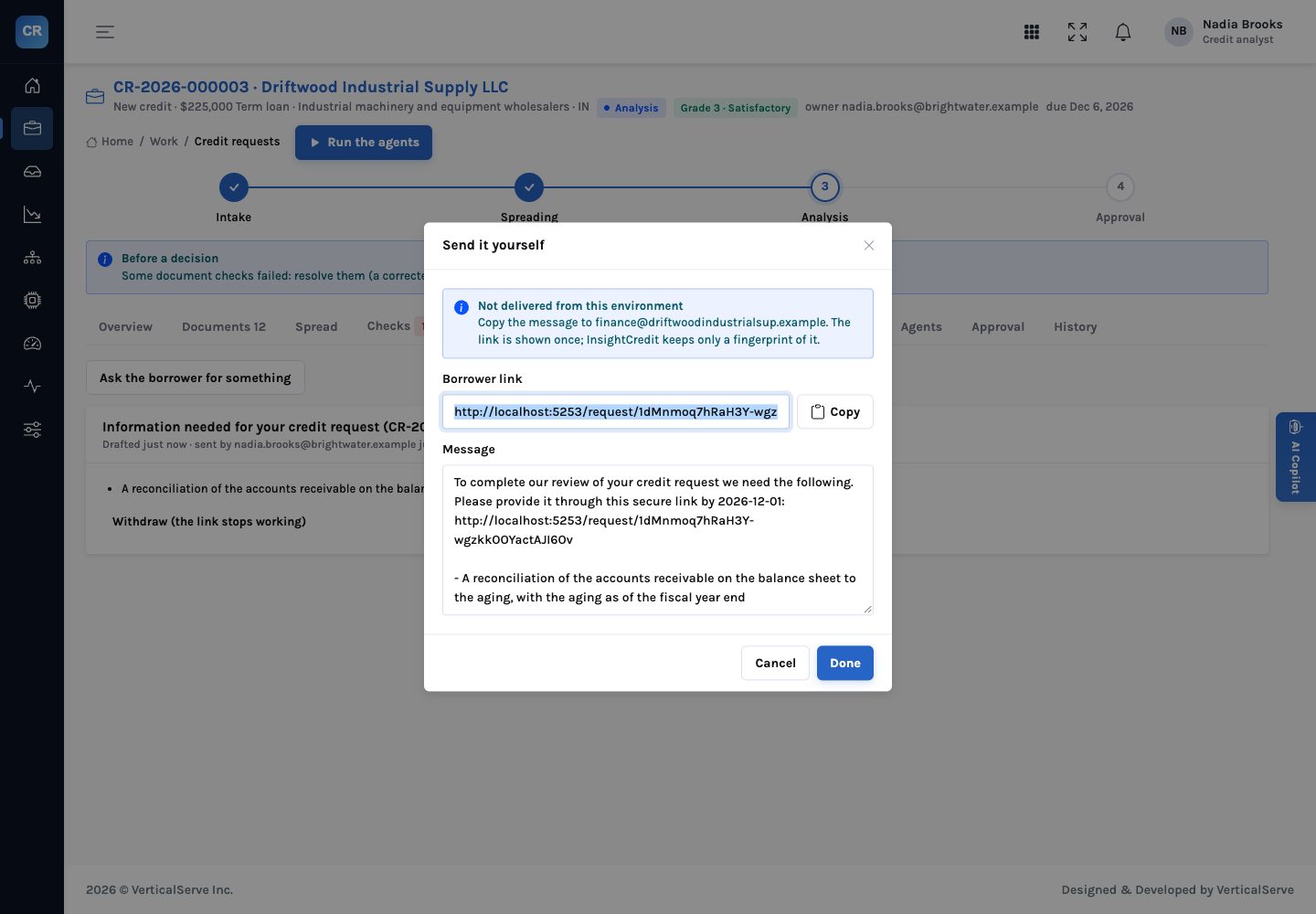
When she sends, InsightCredit creates the borrower’s link and puts it where the placeholder was. The link is shown to the sender once. InsightCredit stores only a fingerprint of the token, so the link can’t be read back from the database later, by anyone.
In this environment delivery is a dry run: the dialog says plainly that the message was not delivered, and Nadia copies the message and link and sends them herself. In a deployment, live delivery is switched on with a setting and goes through the bank’s own mail service.
The borrower’s page
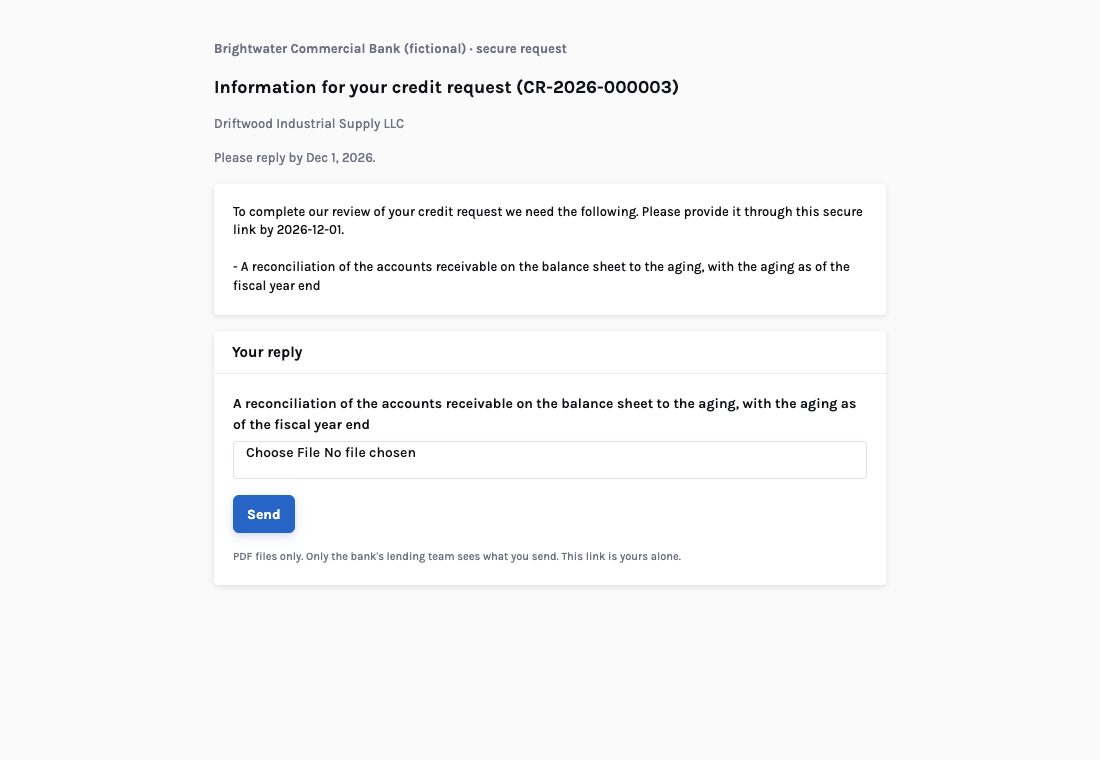
The link opens a page outside the bank’s systems, with no login. It shows the bank’s name, the case reference, the borrower’s name, the reply-by date, the message, and one field per item: an upload for a document, a text box for a question. It shows nothing else about the case: no figures, no grade, no other documents. Uploads are PDF only, up to 8 MB each.
Read on arrival
When the borrower sends, each uploaded PDF becomes a document on the case, typed by the item it answered. The reader runs at once: an aging is read into its buckets, total and customers, each with its line; a tax return into gross receipts, deductions and income. Then the spread and the checks run again.
- For Granite Bay, a 2025 return resolves the “on file” check and is reconciled against FY2025 revenue within the illustrative 10% tolerance, or fails that check instead. An aging resolves its check, feeds receivables 90 days or less into the borrowing base, and is reconciled to the $1,001,424 on the balance sheet.
- For Driftwood, a corrected aging that ties to $592,463 resolves the reconciliation. A schedule that explains the difference (for example, receivables not yet invoiced) doesn’t change the figures; the analyst reads it and resolves or waives the check with a reason that names it.
A scanned PDF with no text layer is refused in plain words rather than guessed at, and the analyst can ask again for a readable copy. A figure the reader can’t find is marked partial, never invented.
Who does what
The agent never contacts the borrower. The analyst sends; the answer comes back to the case.
Accept, reject or ask on each request the agents drafted. A rejection is recorded with its reason.
“Ask the borrower for something”: one item per line, a document or a question.
Check the address and the wording; keep [request link] in the message.
A withdrawn request’s link stops working at once.
Through the link, without an account. PDF files only, up to 8 MB each.
The uploads are on the case, read and quoted, and the checks have run again. Resolve or waive what remains, with a reason.
The analyst’s choices
| Situation | Choice |
|---|---|
| The agent’s draft asks for too much, or too little | Edit the item before sending, or reject the draft with a reason and write a narrower one |
| Two agents drafted requests for the same borrower | Send one combined request, so the borrower gets one message |
| The borrower sends the wrong document | Send a follow-up naming exactly what is needed; the wrong one stays on the case, read |
| The answer explains the difference without removing it | Resolve or waive the check with a reason that names the explanation |
| No reply by the date | Withdraw and re-send, or call; under the bank’s procedure an application may be treated as incomplete |
A note on regulation
data
Regulation B (ECOA) applies to business credit. Among other things it sets rules for notifying applicants of action taken on an application, including when an application is incomplete, and the timing and form of those notices differ for businesses with gross revenues of $1 million or less and those above it. A request for missing information is part of that process; how and when to treat an application as incomplete is the bank’s procedure to set.
Source: Regulation B, 12 CFR 1002.9 (notifications), including 1002.9(a)(3) for business credit. A summary, not legal advice.
InsightCredit keeps the record: what was asked, when, by whom, the message as sent, and what came back. It doesn’t decide when an application is incomplete or send adverse action notices on its own.
What it means for each audience
For the chief credit officer
Every request the bank made, what it asked, who sent it and what came back is on the case. Borrowers’ tax returns and statements arrive through a channel built for them, not ordinary email.
Agents never contact borrowers; people do.
For the credit team lead
Requests are drafted from what failed, so they are precise. Answers land on the case and rerun the spread and the checks, so nothing waits for someone to remember.
The Requests tab shows what is held, sent and answered.
For the board
Time to decision is the borrower’s experience of the bank, and most of it is waiting. Asking once, precisely, is the cheapest way to shorten it.
It also keeps sensitive documents out of inboxes.
Metrics to track
What to be careful about
- Delivery is the bank’s. The demo doesn’t send email. A deployment uses the bank’s own mail service and sender domain, so borrowers recognise the message.
- Links are bearer tokens. Anyone with the link can answer. Keep reply-by dates short and withdraw requests that are no longer needed.
- Phishing. Borrowers are rightly wary of links in emails. Tell them how to recognise the bank’s request, and offer another way to send.
- An explanation is not a correction. A reconciliation can explain a gap and still leave the bank lending against a figure it shouldn’t. Read it before resolving the check.
Most of a credit request is waiting. Ask once, precisely, and act on the answer the moment it arrives.
Let agents draft from what failed, let people decide what to send, and let the reader, the spread and the checks run again on what comes back.