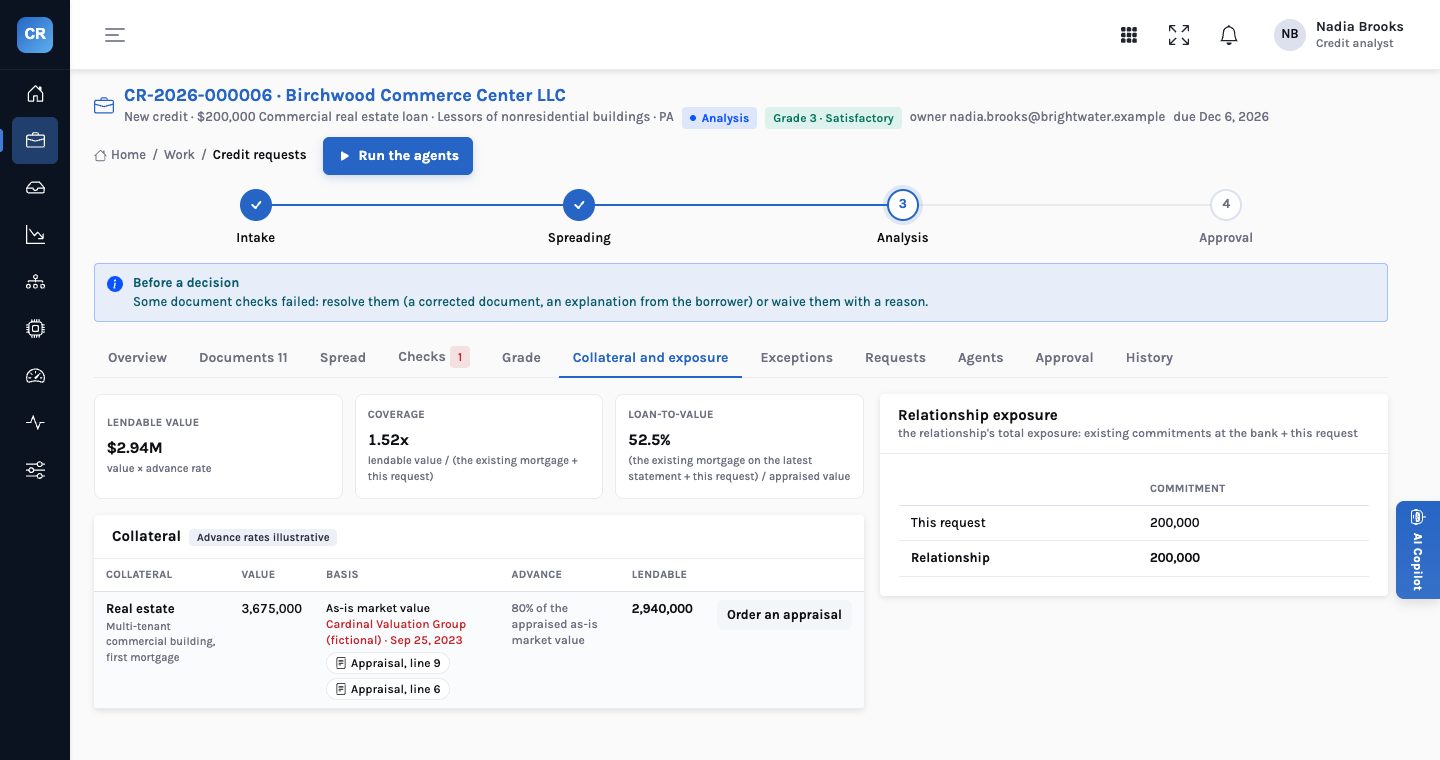
Birchwood Commerce Center LLC owns a fully let multi-tenant building in Pittsburgh and asks for a $200,000 additional advance to buy the adjoining parcel for parking. Coverage with the new loan is 1.48x, loan-to-value 52.5%, collateral coverage 1.52x, grade 3. Every one of those collateral figures rests on a single number: an as-is market value of $3,675,000, effective 25 September 2023. On the day the case was worked, that value was 1,153 days old.
In short
- Good ratios on an old value are still old. Loan-to-value, coverage and the collateral factor in the grade all inherit the age of the appraisal.
- The check knows the difference between new money and old. An appraisal over 365 days old fails when the bank is advancing new money and only warns otherwise (both illustrative policy).
- The collateral agent prepares the order; a person places it. Ordering an appraisal commits the bank’s money, engages a third party and has to respect appraiser independence.
- Regulation sets a floor, policy sets the rule. The request is $200,000, under the $500,000 commercial real estate appraisal threshold. Whether this advance needs a new appraisal, an evaluation or neither is for the bank’s appraisal policy to answer; this case makes sure someone answers it.
The situation
This case runs on InsightCredit’s demo data: a fictional bank, Brightwater Commercial Bank, with
fictional borrowers, appraisers, guarantors and figures. The case is CR-2026-000006, a new
credit for Birchwood Commerce Center LLC, a lessor of nonresidential buildings (NAICS 531120) in
Pennsylvania, established in 2005. Dana Whitfield is the relationship manager; Nadia Brooks owns the
case.
| Term | Requested |
|---|---|
| Product | Commercial real estate loan, additional advance, $200,000 |
| Purpose | Acquire the adjoining parcel for parking |
| Term and amortization | 120 months, amortizing over 300 months, at an indicative 7.15% fixed ($1,433 a month) |
| Guarantors | Neha Crowley (60%) and Mary Ostrowski (40%), unlimited personal guarantees |
| Collateral on the case | Multi-tenant commercial building, first mortgage |
The business is steady. Revenue went $508,314, $521,099, $541,075 over three years; the rent roll at 30 September 2026 shows $45,563 a month, $546,756 a year, at 100% occupancy; the tax returns agree with the statements within 0.3% each year; deposits run at 96.0% of revenue. The spread and the controls find nothing to argue with:
| Figure | How it’s computed | Value |
|---|---|---|
| Pro forma DSCR | FY2025 EBITDA 310,503 / (existing debt service 192,681 + this request 17,193) | 1.48x |
| Global DSCR | Global cash flow 741,703 / global debt service 472,274 | 1.57x |
| Lendable value | 80% (illustrative) of the appraised as-is value of 3,675,000 | $2,940,000 |
| Collateral coverage | Lendable value / (existing mortgage 1,727,850 + this request 200,000) = 2,940,000 / 1,927,850 | 1.52x |
| Loan-to-value | (1,727,850 + 200,000) / 3,675,000 | 52.5% |
| Grade | 18 points: coverage 10, company-prepared statements 5, industry 3 | 3, Satisfactory |
No policy exception fires. Twenty-nine of the thirty checks pass. The one that fails is about time.
Why this gets missed
A stale appraisal is not a hidden fact. The effective date is printed on the first page. It gets missed because of what it sits next to:
- The ratios are green. 52.5% loan-to-value leaves so much room that nobody asks what the value is worth. But every ratio on that row divides by the 2023 number.
- The appraisal is “on file”. Collateral checklists ask whether there is an appraisal. Fewer ask how old it is, and fewer still distinguish a renewal from new money.
- The amount is small. The $200,000 request is under the regulatory threshold for a certified appraisal of commercial real estate, so it is easy to conclude that valuation doesn’t matter for this request. The threshold settles what the regulation requires; it doesn’t settle what the bank’s policy requires, or whether the old value still holds.
- Ordering an appraisal costs time and money. The pressure on a small advance is to avoid it. That is exactly why the decision should be explicit.
What the agencies expect, briefly
The Interagency Appraisal and Evaluation Guidelines (2010) expect a bank to have criteria for deciding whether an existing appraisal or evaluation remains valid for a subsequent transaction, considering things like the passage of time, the volatility of the local market, changes in the property’s condition or use, and changes in the terms of the credit. Separately, the appraisal rules (12 CFR 34 subpart C, 12 CFR 323 and 12 CFR 225 subpart G) have, since 2018, exempted commercial real estate transactions of $500,000 or less from a certified appraisal, requiring an evaluation consistent with safe and sound practices instead. The rules also allow some subsequent transactions to rely on an existing valuation. How these apply to a given advance is a matter for the bank’s appraisal policy and its compliance staff; InsightCredit doesn’t decide it.
How InsightCredit finds it
The document reader takes an appraisal summary’s appraised value, effective date, appraiser and value type from the PDF’s text, each with its line. The collateral agent values the collateral only from what the reader took, never from a typed-in figure, and computes the lendable value, coverage and loan-to-value. The age check compares the effective date with today, and how strictly depends on whether the request advances new money.
The same two lines feed both the comfortable ratios and the failed check. The value’s age is what the ratios can’t show.
The check row says it in a sentence: “Multi-tenant commercial building, first mortgage: valued
2023-09-25 by Cardinal Valuation Group (fictional) (1153 days ago); order a new appraisal before
advancing new money.” It quotes line 9, “Appraised value: 3,675,000”, and line 6,
“Effective date of value: 25 SEP 2023”, of
birchwood_commerce_center_ll_appraisal_C00012.pdf.
Note the grade. The collateral factor scores 0 points because coverage of 1.52x is above the illustrative 1.25x band. The grade is only as current as the value it was given. A failed check is what stops that old value from carrying the request to approval unnoticed.
The prepared order, and why a person places it
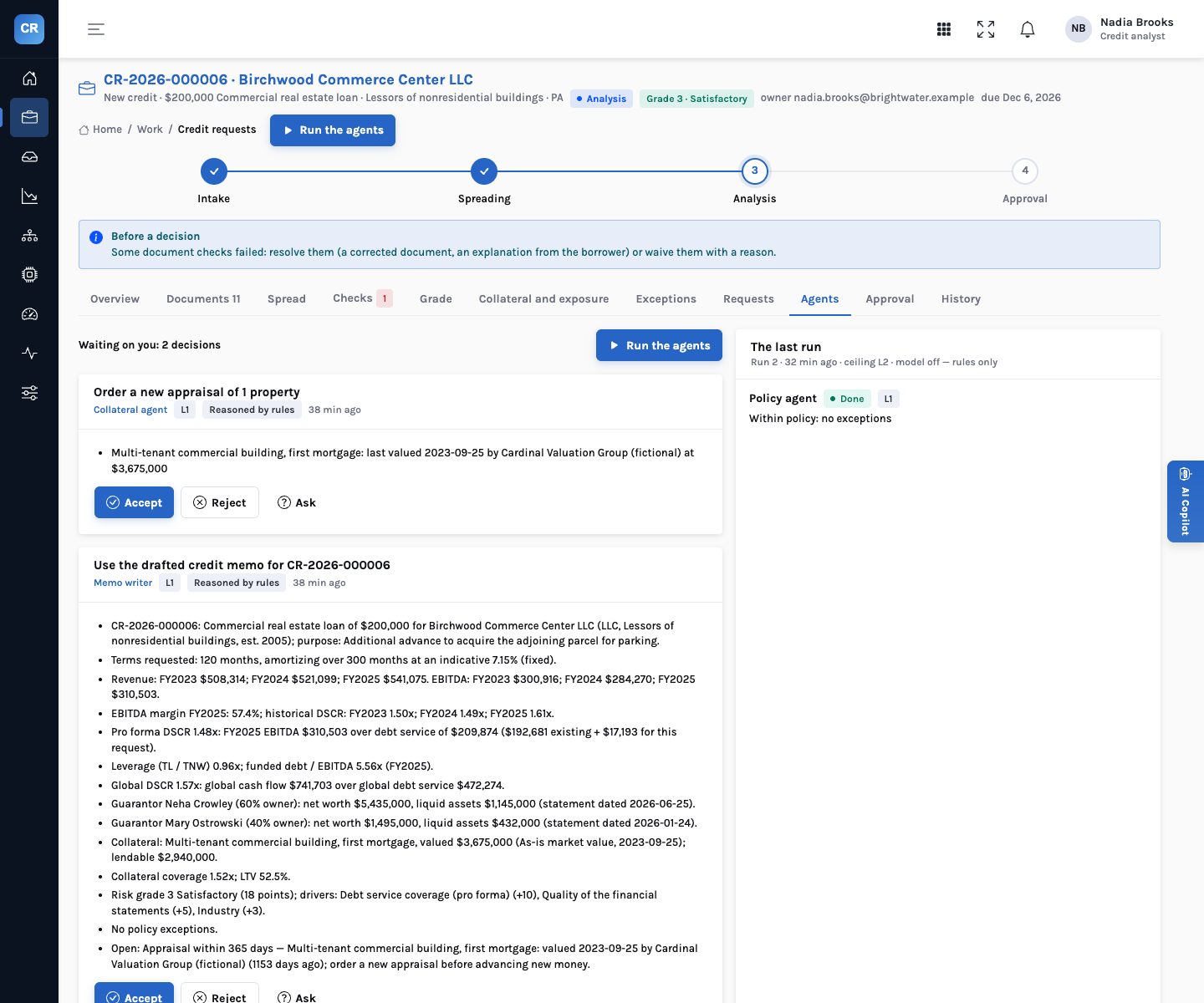
On the Agents tab the collateral agent has prepared one decision: “Order a new appraisal of 1 property”, with its fact: “Multi-tenant commercial building, first mortgage: last valued 2023-09-25 by Cardinal Valuation Group (fictional) at $3,675,000.” Below it, the memo writer’s draft lists the same open check. Each has three buttons: Accept, Reject, Ask.
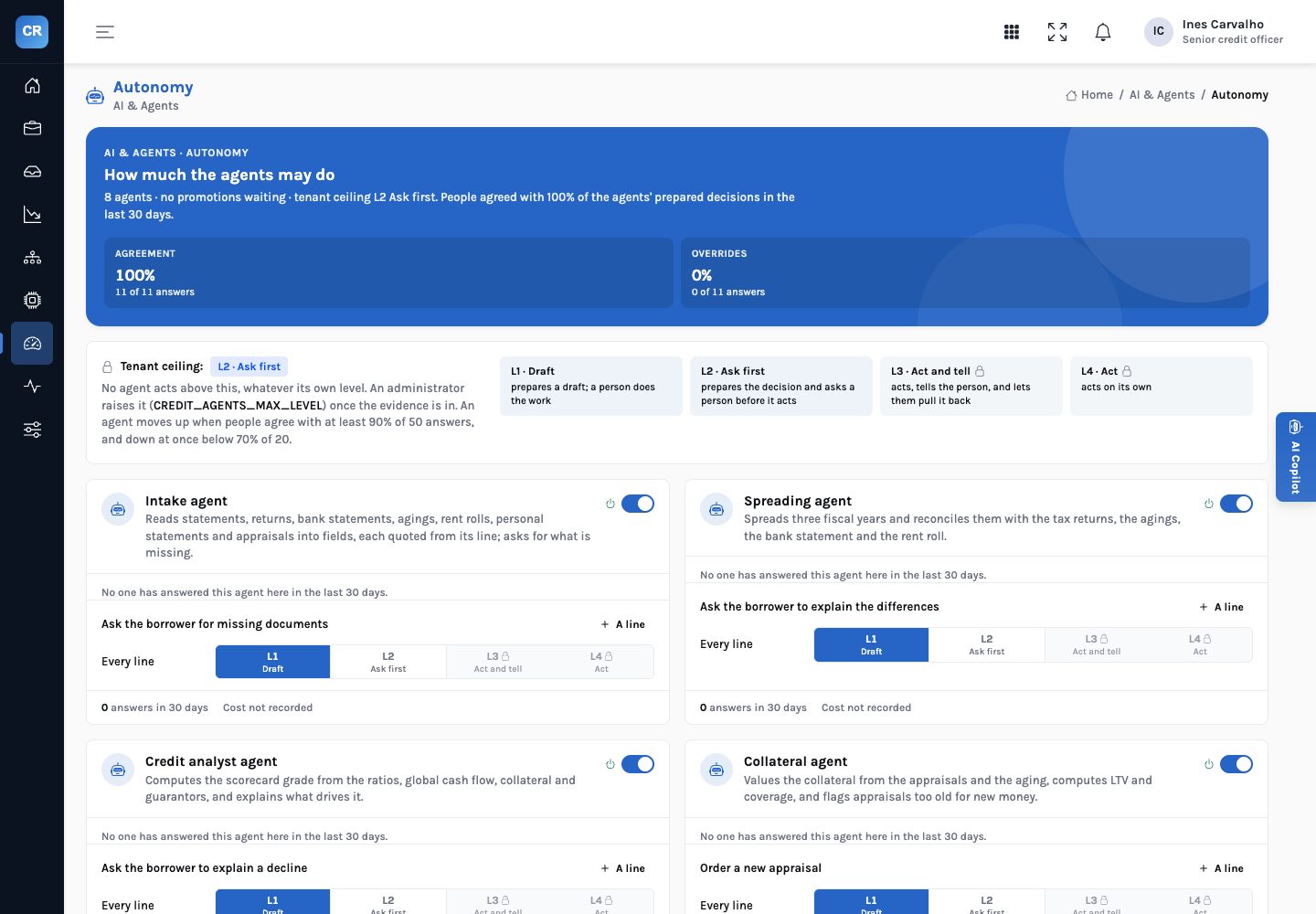
Ordering an appraisal is one of the things InsightCredit’s agents never do on their own, along with deciding a request, justifying an exception, clearing a check, sending to a borrower and putting a borrower on the watchlist. Every action is hard-capped at L2, Ask first, and the demo starts this one at L1, Draft. There are good reasons for this beyond caution:
- It commits money and a third party. An appraisal is an engagement with a fee and a turnaround time, and someone at the bank should own that commitment.
- Independence. The agencies’ guidelines expect the bank, not the borrower, to select and engage the appraiser, and the valuation function to be independent of loan production. Who orders, and through which channel, is defined by the bank’s appraisal policy. The product records who pressed the button; it doesn’t replace that policy.
- The scope is a judgement. A full appraisal or an evaluation? As-is value only, or a value that reflects the parking parcel once acquired? Should the parcel itself become collateral? The agent can see that the value is old; it can’t answer those questions.
When a person orders, InsightCredit records the order against the collateral with who and when. In the demo environment it says so plainly: recorded; nothing was sent from this environment. The engagement itself goes through the bank’s own appraisal process.
Who does what
The agent spots the age and prepares the order. People decide the scope, engage the appraiser and decide the credit.
Takes the value, effective date, appraiser and value type, each with its line.
Computes lendable value, coverage and loan-to-value; fails the age check because the request is new money.
Prepares “Order a new appraisal of 1 property” on the Agents tab, with the old value and date as its fact.
Appraisal or evaluation, as-is or including the parcel, and whether the parcel joins the collateral, under the bank’s appraisal policy.
Presses “Order an appraisal”; the order is recorded with who and when; the engagement goes through the bank’s own channel.
The new appraisal is uploaded; the reader takes its lines; coverage, loan-to-value, the grade and the check are recomputed.
Within credit officer authority for a $200,000 exposure. The submitter can never approve.
Outcomes, and what each means
| What happens next | Effect on the case | Likely outcome |
|---|---|---|
| A new appraisal close to $3,675,000 | The check passes; coverage and loan-to-value barely move | Proceed on current evidence |
| A materially lower value | Coverage, loan-to-value and the grade’s collateral factor are recomputed; the loan-to-value and coverage controls may now fire | A refer with a mitigant, a smaller advance, or a decline |
| The bank’s policy concludes the existing valuation is still valid | A person waives the check with a written reason citing that conclusion | Proceed, with the reason on the case |
| No new valuation and no documented conclusion | The failed check stays open; the case can’t go for approval | The request waits |
The checklist is ticked, loan-to-value is 52.5%, and nobody notices the value is from 2023 until loan review does.
The case can’t go for approval until someone orders a valuation or writes down why the old one still holds.
What the decision record keeps
The appraisal order is recorded against the collateral with who placed it and when. The new appraisal, once uploaded, sits on the Documents tab with every figure the reader took and its line. If the check is waived instead, the waiver, its reason and who gave it stay on the case. The memo writer’s draft lists the open check until it is cleared, and once accepted the memo carries the collateral value, coverage and loan-to-value. The decision record keeps the verdict, the grade, pro forma and global coverage, leverage, the authority and why, who submitted and who approved, and any conditions, such as an updated valuation at the next annual review.
What it means for each audience
For the chief credit officer
Collateral values are only as good as their date. A check that fails stale values on new money, and only warns on renewals, puts the bank’s appraisal policy into every case instead of relying on someone remembering it.
The 365 days is illustrative (CREDIT_APPRAISAL_MAX_DAYS). Set it to the validity criteria your appraisal policy already uses.
For the credit team lead
The analyst sees the age, the value, the appraiser and the lines in one row, with the order already prepared, instead of discovering the date after the memo is written.
The order stays a human act with a name on it, which is what the appraisal function and the auditors will ask for.
For the board
The bank doesn’t advance new money against a value nobody has looked at in three years without someone deciding that it’s acceptable and writing down why.
Comfortable ratios are not evidence on their own.
What to be careful about
- The product doesn’t interpret the appraisal rules. It doesn’t decide whether a transaction needs a certified appraisal, an evaluation, or qualifies to rely on an existing valuation. That is the bank’s policy and its appraisal and compliance staff.
- Age is a proxy. A one-year-old value in a falling market can be worse than a three-year-old value in a stable one. The guidelines name market volatility and changes in the property for a reason; a person should weigh them.
- The parcel isn’t on the case. The collateral recorded for Birchwood is the existing building. If the bank wants the parking parcel as collateral too, a person adds it, and it needs its own value.
- The advance rate is illustrative. 80% of as-is value, the 365-day limit and the authority limits were set for the demo.
Loan-to-value of 52.5% on a value from 2023 is a 2023 number.
Fail it when new money goes out, prepare the order, and let a person, under the bank’s appraisal policy, decide what to order and whether to lend.