Sooner or later an examiner will sit down with the chief credit officer and ask about the AI in commercial lending. It won’t be a hostile question. Supervisors have been asking banks how they use artificial intelligence for several years, and the existing guidance on model risk, third parties and fair lending already tells them what to ask. They will want to know what the AI does, what it decides, how the bank knows it works, how a decline is explained, and who is accountable when it is wrong. The banks that answer easily are the ones that designed for those questions before they were asked.
In short
- The first question is what the AI decides. A tool that prepares a credit request for a person is a very different conversation, in model risk and in fair lending, from one that approves or declines on its own.
- Know which parts are models. A scorecard that turns financial ratios into a grade is very likely a model under model risk guidance, even with no machine learning in it. A language model that drafts prose needs controls of a different kind.
- Every figure needs a source, and every grade its reasons. Extraction should quote the line; arithmetic should be code; prose should only restate facts the case already holds.
- Human review has to be real. Four eyes on every approval, easy disagreement, and agreement rates watched, so that “a person decided” is true and provable.
The frameworks a supervisor will reach for
There is no single rulebook for AI in credit. A US examiner will draw on several existing ones, and a bank operating in the UK or the EU will meet others. None of them was written with credit memos in mind, and all of them apply.
| Framework | Where it applies | What it brings to the conversation |
|---|---|---|
| SR 11-7 / OCC Bulletin 2011-12, Supervisory Guidance on Model Risk Management | US banks | What counts as a model; effective challenge; validation of conceptual soundness, ongoing monitoring and outcomes analysis; a model inventory and governance |
| OCC Comptroller’s Handbook, Model Risk Management (2021) | National banks and federal savings associations | How examiners assess a bank’s model risk management in practice |
| Interagency Guidance on Third-Party Relationships: Risk Management (2023) | US banks using vendors | Due diligence, contracts and ongoing oversight of a vendor whose product sits in the credit process |
| Equal Credit Opportunity Act and Regulation B | All creditors, including for business credit | No discrimination on a prohibited basis in any aspect of a credit transaction; notice and reasons when credit is denied, with some modified rules for business applicants |
| PRA Supervisory Statement SS1/23, Model risk management principles for banks | UK banks | Model identification, governance, validation and risk mitigants, explicitly including AI and machine-learning techniques |
| EU AI Act, Regulation (EU) 2024/1689 | Providers and deployers of AI in the EU | Risk categories; obligations for high-risk systems, including risk management, logging, transparency and human oversight |
Is commercial credit “high-risk” under the AI Act?
The AI Act’s high-risk list names AI used to evaluate the creditworthiness of natural persons or establish their credit score (with an exception for detecting fraud). Lending to companies isn’t named as such. That doesn’t settle it: small-business credit often involves sole traders and personal guarantors, whose own finances are assessed, and the Act’s obligations are phased in over several years with proposals to adjust the timetable. Check the current position with counsel rather than relying on a summary, including this one.
Question 1: what does the AI actually decide?
This question shapes every other answer. There is a large difference between software that prepares a credit request for an analyst and software that decides it.
It approves or declines requests, justifies its own policy exceptions or clears failed checks with no person in the loop. Model risk is high; every error is a credit decision the bank made without a person; explaining a decline means explaining the model.
It reads, spreads, reconciles, grades and drafts; an analyst reviews and submits; a different officer with the authority approves. The decision record shows both what was prepared and who decided.
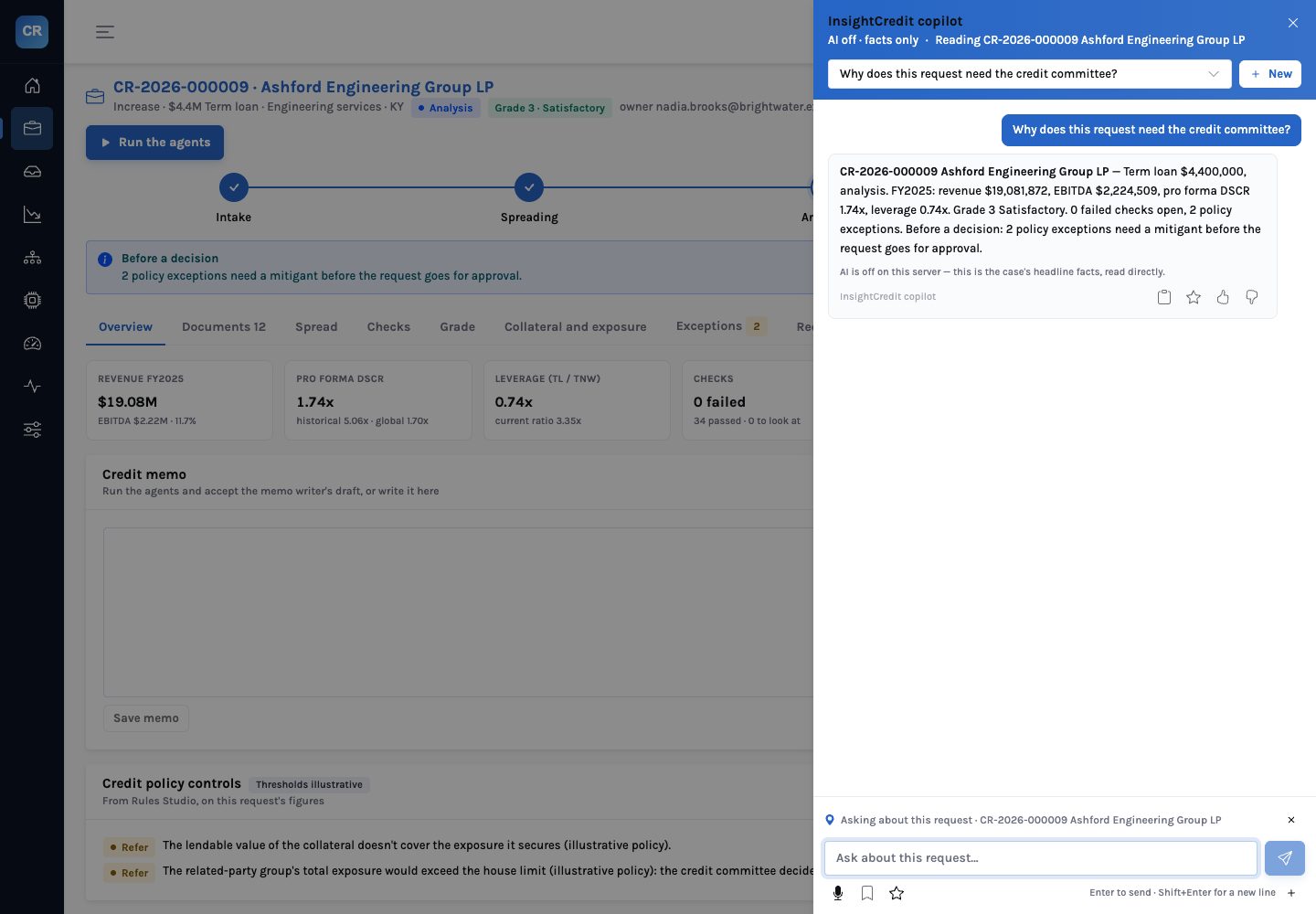
InsightCredit takes the second design and enforces it. Its agents are capped at preparing work and asking a person (level L2, “ask first”, as a hard ceiling; the demo starts every action at L1, “draft”). Some actions are outside any agent’s reach at any level: deciding a request, justifying an exception, clearing a check, sending anything to a borrower, ordering an appraisal and putting a borrower on the watchlist are always a person’s.
Question 2: which parts are models?
Model risk guidance defines a model broadly: a quantitative method that processes inputs into quantitative estimates, including approaches whose inputs are partly or wholly expert judgement. That catches more than machine learning. A bank’s inventory should be able to say, for each component of an AI-assisted credit process, whether it is a model and how it is controlled. For InsightCredit the honest breakdown looks like this.
| Component | How it works | Model in the SR 11-7 sense? | How it is controlled |
|---|---|---|---|
| Document reader | Deterministic patterns over the PDF’s text layer; no model | Arguably not; it is extraction | Every field keeps its line and exact text; a missing figure is marked, never guessed; a scan with no text layer is refused |
| Spread and ratios | Arithmetic on what was read, each ratio with its formula | No; it is calculation | Formulas visible on screen; tests |
| Risk grade | A points scorecard over coverage, leverage, liquidity, margin, trend, collateral, guarantors, time in business, industry and statement quality | Very likely yes | Model version stored with every grade; every factor shows points and why; overrides need a reason; the bank sets bands and boundaries |
| Policy controls | Rules the credit officer edits in Rules Studio | Usually treated as rules, not a model | Published, versioned controls; each block or refer becomes a visible exception |
| Memo wording, when a model is on | A language model may improve phrasing of a draft built from numbered facts | A tool to govern, whatever the label | A sentence carrying a number or name not in the facts is discarded and the engine’s wording stands; a person accepts the memo |
| Copilot | A read-only assistant answering questions about one case from tool results | A tool to govern | Every figure and name checked against what the tools returned; sources cited; it writes nothing |
The point of the table isn’t to argue anything out of the inventory. It is that each row has a short, checkable answer. The component a supervisor will spend most time on, the grade, has no machine learning in it at all, which makes conceptual soundness a matter of reading the factors and the bands.
Question 3: where did each figure come from?
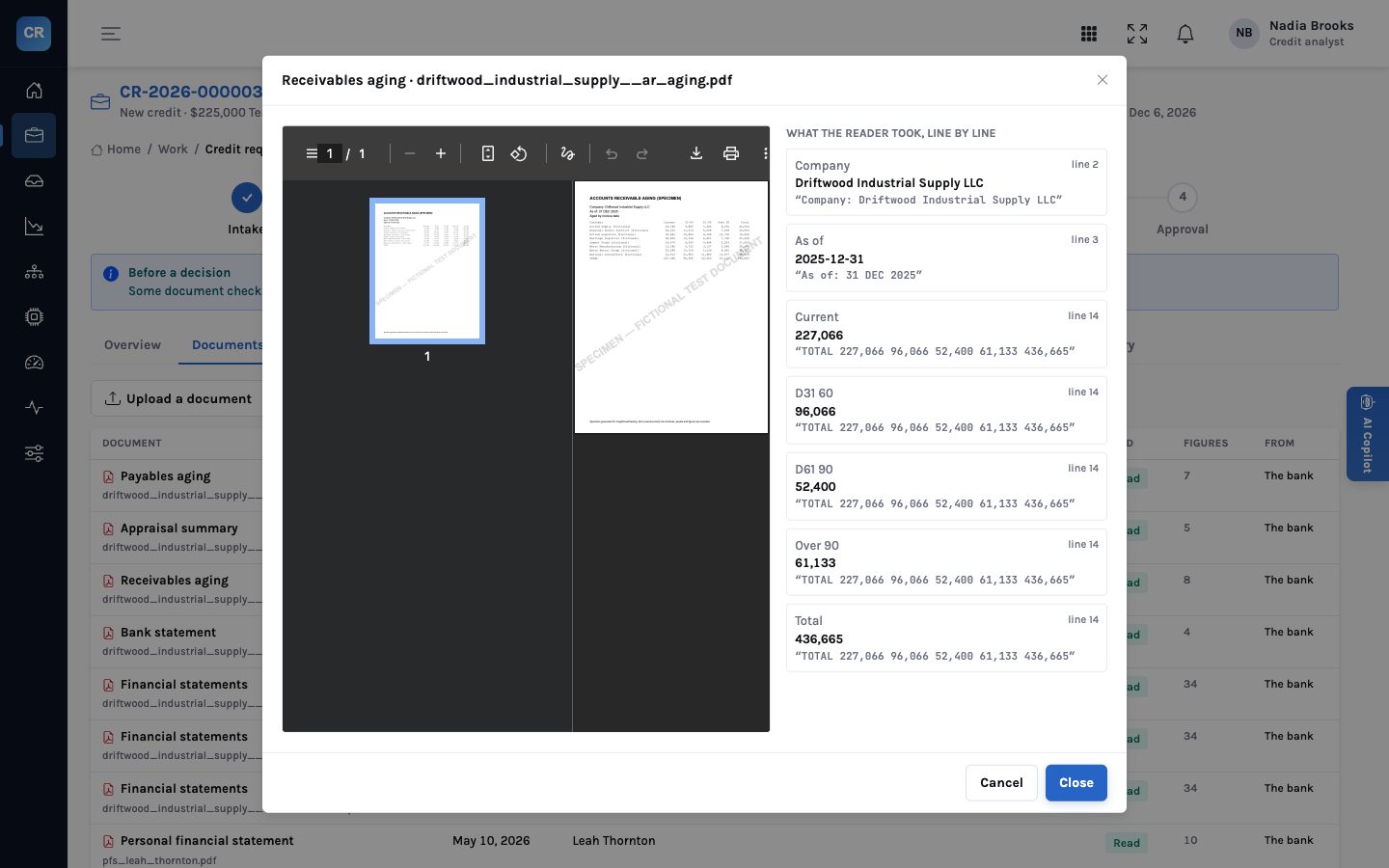
An examiner will pick a request and ask how a value got into the memo. “The AI read it” isn’t an answer. The answer should be a document, a line on it, and the formula that turned it into a ratio.
- Extraction should quote. Every field the reader takes keeps the line it came from and the text of that line, and the spread links each cell back to it.
- Calculation should be code. Coverage, leverage, global cash flow, lendable value and the grade points are deterministic code with tests. No model is asked to do arithmetic.
- Language should be grounded. The memo writer drafts from the engines’ figures; a test checks that every figure in a draft comes from them.
Question 4: can you explain a decline, and is it fair?
Regulation B applies to business credit. When a request is declined, the applicant must be told, and the rules on giving the reasons are modified for business applicants (they differ above and below $1 million in gross revenues). Whatever the model, the reasons a bank gives have to be specific and accurate, which is far easier when the arithmetic behind the decision can be read.
A design that keeps the arithmetic in a scorecard makes this tractable. Each factor carries its points and why; a decline in InsightCredit needs a reason written by the person declining; and the decision record keeps the controls that fired, the grade and its factors, the coverage figures and the exceptions. The reasons a bank gives are still the bank’s to write.
Fairness is a separate question from explanation. A scorecard built only on financial figures can still carry risk: factors such as industry and time in business could correlate with characteristics a lender may not consider. Testing for that is part of a bank’s fair lending programme, with its own data and its own counsel. Software that shows exactly which factors it uses makes that testing easier; it doesn’t replace it.
Question 5: how do you know it works?
Model risk guidance asks for validation before use and monitoring after. For a credit preparation tool that translates into evidence of four kinds.
A test set with planted problems and proof each is found. InsightCredit’s demo data plants declining coverage, a covenant breach, a related-party concentration, overstated receivables, a tax return mismatch, a stale appraisal, a guarantor with negative net worth and missing documents, each on a named borrower.
A written description of each engine: how statements are read, how each ratio is defined, how pro forma and global debt service are built, how grade points are assigned, and why.
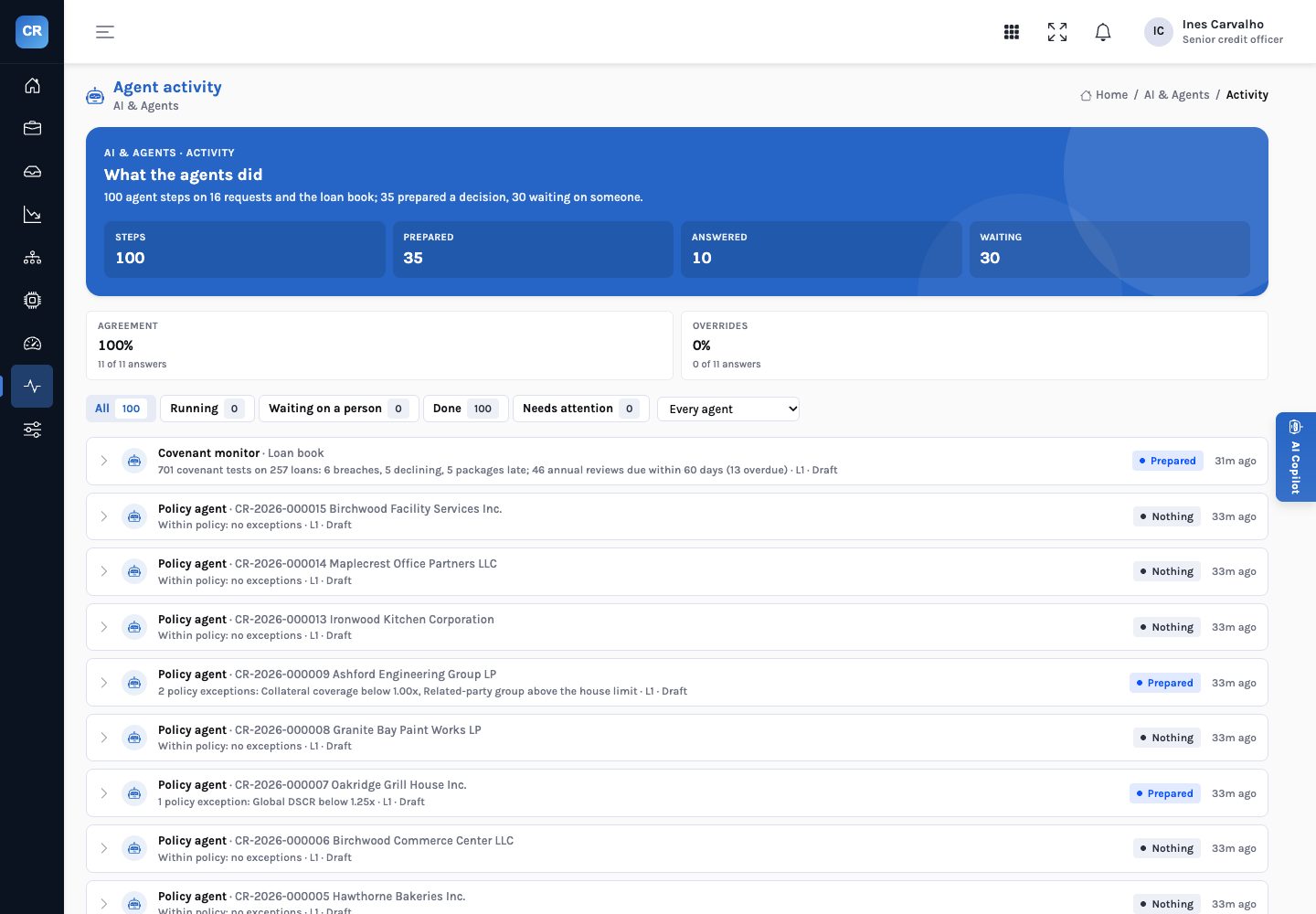
How often people accept, change or reject what each agent prepared, by agent and by action. A sudden change is a signal; so is perfect agreement.
Credit risk review sampling of decided requests, including ones where the analyst followed what was prepared, and of how graded loans actually perform.
Question 6: is the human review real?
A design where people approve whatever the software prepares is automated decision-making with an extra click. Supervisors know this and will ask how the bank prevents it.
- There is something to review. The analyst sees the evidence and the reasons, not just a recommendation, so disagreeing is possible.
- Disagreement is easy and recorded. Accept, reject and ask are equal answers to every prepared decision, and each answer is kept with who gave it and when.
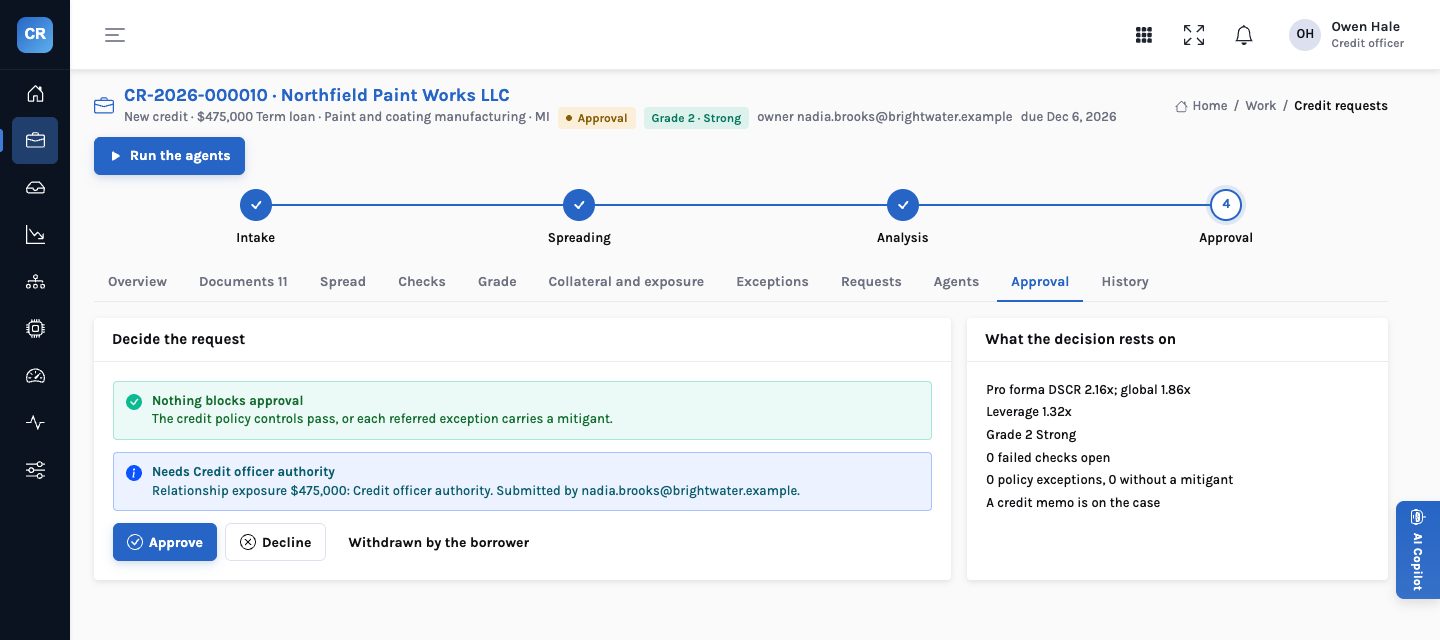
- Four eyes on every approval. The person who submits a request can never approve it, and the approver must hold the authority the exposure and exceptions call for.
- Agreement is watched. An analyst who accepts everything shows up in the numbers.
Three parties, and only people on the decision path. The agents’ part ends when the analyst picks up the request.
Question 7: what happens when the model fails?
Language models time out, return nonsense or become unavailable. A supervisor will ask what a request looks like then. The safest answer is that nothing important depends on the model. In InsightCredit every agent has a rules-only path: with the model switched off, as it is in the demo and in every screenshot here, the documents are still read, the spread built, the checks run, the grade computed and the memo drafted from the engines’ figures.
The model is optional and checked. Anything it adds that the engines didn’t produce is thrown away.
What it means for each audience
For the chief credit officer
Put every component in the model inventory with a one-line answer to “what does it decide?” If the answer is “nothing, a person does”, be ready to show where that is enforced.
Treat the scorecard as a model: document it, validate it, and own its bands and boundaries.
For the credit team lead
Train analysts that “prepared” means “checked by you”. Rejecting an agent’s work should be as normal as accepting it, and the reason recorded.
When a decline goes out, the reasons should be traceable to the grade factors and controls on the record.
For the board
AI in credit can shorten the time to a decision without moving accountability, if it is designed to be examined.
Ask management one question: for any request, can we show what the software did, where every figure came from, and who decided?
What to be careful about
- No product makes a bank compliant. Software can make the answers to these questions short and checkable. Whether the bank’s model risk, vendor and fair lending programmes meet expectations is for the bank and its supervisors.
- “Not a model” is a conclusion, not a default. Decide it per component, write down why, and revisit it when the component changes.
- The regulatory picture moves. Guidance on AI, on adverse action and on the AI Act’s timetable has changed more than once. Check the current text before relying on any summary.
A supervisor won’t ask whether you use AI. They will ask what it decides, how you know it works, and who is accountable.
Design so that the honest answers are: nothing on its own, here is the evidence, and a named person with the authority.