The fastest way to fail with credit automation is to switch it on for the whole commercial book on day one. The second fastest is a pilot so cautious that it never produces a number anyone trusts. This is a ninety-day plan between the two: one product line, real requests, the bank’s own credit policy entered as controls and settings, agents preparing and people deciding every request, and a measured answer at the end about whether to go further. It is written around how InsightCredit actually works, so the levers it names are real ones.
In short
- Days 1–30: connect and configure. Borrower, document, collateral and loan data connected; roles and approval authorities set; the credit policy entered in Rules Studio and the
CREDIT_*settings and signed off; a baseline measured before anything changes. - Days 31–60: one product line, live. Agents at L1 prepare every request in scope; analysts and credit officers do and decide every one; a sample is spread both ways; calibration issues are logged, fixed and re-tested.
- Days 61–90: widen and decide. Annual reviews and covenant monitoring for the same line, a validation pack for model risk, and a recommendation to the credit committee built on measured numbers.
- Autonomy does not rise during the ninety days. Every action starts at L1 and the platform caps every action at L2. Whether any single action should move to L2 is a decision for day 90, taken on evidence.
Before day one: choose the scope
Pick one product line and one or two request types. A good first scope has enough volume to produce a measurement in a few weeks, a process the team knows well, and decisions that mostly sit within a single approval tier, so that you are testing preparation rather than committee logistics. Renewals and increases for existing commercial and industrial borrowers are a common first choice: the borrower is known, prior statements are on file, and the analysis exercises spreading, cash flow, collateral and the memo together. Owner-occupied and investor real estate add rent rolls and appraisals, and are a natural second step.
| Decide up front | Why it matters |
|---|---|
| The product line and request types | Everything else is sized from it |
| Who prepares, who submits, who approves | Named analysts and credit officers, the same people throughout, so agreement rates mean something; four eyes is not optional |
| The sample spread both ways | A fixed share of requests spread by hand as well, to compare figures and outcomes |
| What success means | Agreement, credit review findings and time thresholds agreed before the pilot, not after |
| Whether a language model is on | The agents run on rules alone with CREDIT_AGENTS_LLM=0; many banks start there and add the model once the rules are trusted |
| The exit | What happens to requests in flight if the pilot stops, and where their decision records go |
The plan
Ninety days, three phases, two gates. People decide every request throughout.
Connect and configure
- Applications, borrowers, guarantors and their personal financial statements, documents, collateral and appraisals, loans with covenants and quarterly reporting connected
- Analysts, credit officers and senior credit officers set up, with approval authorities that match your delegation
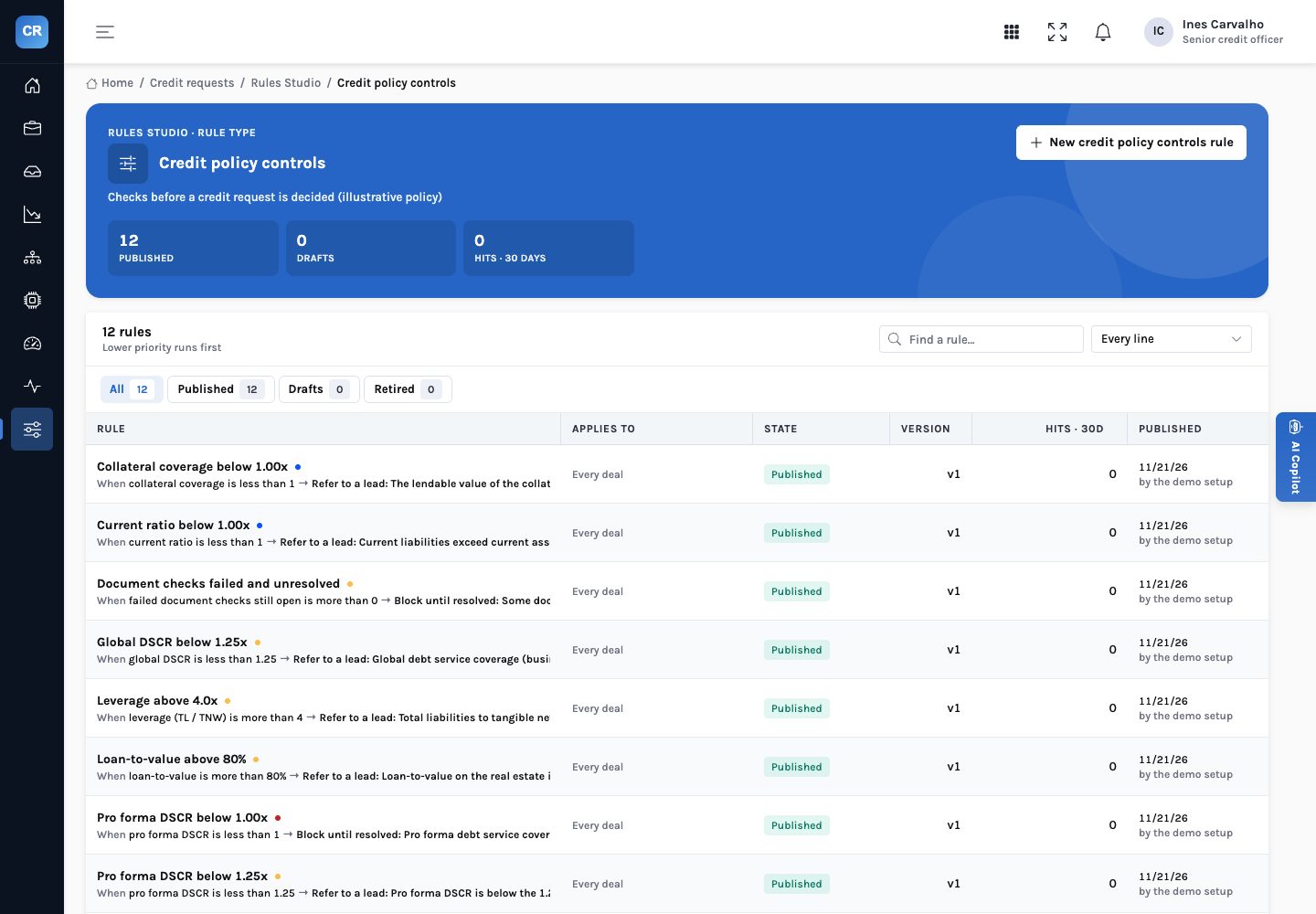
- The twelve credit policy controls in Rules Studio set to your policy and published
- Tolerances, staleness limits, authorities and the house limit set in
CREDIT_*settings and signed off - Baseline: days to decision, minutes per request by activity, memos returned, reviews overdue
One product line, live
- Agents prepare every request in scope at L1; people do every piece of work and decide every request
- A sample spread both ways and compared figure by figure
- Agreement tracked per agent and per action: accept, reject, ask
- Borrower requests drafted by agents, edited and sent by analysts
- Calibration issues logged, fixed and re-tested
Widen and decide
- Annual reviews opened from the loan book for the same line
- Covenant monitoring on quarterly reporting, with watchlist additions made by people
- Validation pack for model risk: design, tests, calibration log, agreement
- A recommendation with measured numbers, including any proposal on autonomy
Days 1–30: connect and configure
Connect the data an analyst uses today
A credit request in InsightCredit opens from an application (new credit, an increase, a renewal) or, for an annual review, from a loan. The borrower, guarantors, documents and collateral come from the bank’s systems, so the first job is to connect those, plus the loan book with its covenants and quarterly reporting for the monitoring phase later. Keep the source systems as the source: the platform keeps its own case, spread and decision record, and it should not become a second borrower master.
Check the documents early. The reader works on the PDF’s text layer and refuses a scanned PDF with no text layer in plain words rather than guessing at it. If a large share of your historical statements are image-only scans, you want to know in week one, not week six.
Put the policy in, as the bank wrote it
This is the step most often rushed. InsightCredit expresses credit policy in two places, and every value in our demo is illustrative; none of them should survive into a real deployment by default.
| Where | What you set | Examples (demo values, illustrative) |
|---|---|---|
| Rules Studio: twelve credit policy controls | What blocks a request and what refers it for a mitigant and higher authority | Block: failed checks open, pro forma DSCR below 1.00x, grade 7 or worse at origination. Refer: DSCR below 1.25x, global DSCR below 1.25x, leverage above 4.0x, LTV above 80%, collateral coverage below 1.00x, group over the house limit |
| Approval authority | Who may approve, by relationship exposure | CREDIT_AUTHORITY_OFFICER_USD $2.5M, CREDIT_AUTHORITY_SENIOR_USD $10M, above that the credit committee |
| House limit | Aggregate exposure to a related-party group | CREDIT_GROUP_HOUSE_LIMIT_USD $15M |
| Reconciliation tolerances | How far a figure may differ from its counterpart before a check fails or warns | CREDIT_TOL_RECEIVABLES, CREDIT_TOL_TAX_REVENUE (10%), CREDIT_TOL_RENT_ROLL (15%), CREDIT_MIN_DEPOSIT_RATIO (75%) |
| Staleness | How old an appraisal, a PFS or the latest statements may be | CREDIT_APPRAISAL_MAX_DAYS, CREDIT_PFS_MAX_DAYS (365), CREDIT_STATEMENT_MAX_DAYS (456, about 15 months) |
| Agents | The ceiling on autonomy and whether a model is used | CREDIT_AGENTS_MAX_LEVEL (hard cap L2), CREDIT_AGENTS_LLM; every action starts at L1 |
| Borrower messages | Whether the platform delivers requests itself | Off unless CREDIT_COMMS_LIVE is set: the analyst sends the message and its link themselves |
The risk rating needs its own conversation. The demo’s scorecard is labelled as an illustrative model, and every grade stores the model version and shows each factor’s points and why. Its bands, points and grade boundaries are set in the product’s grade module at deployment, not in Rules Studio, so changing them is a versioned release that model validation can review. Before a single grade is used in a real decision, map it to your own rating scale and definitions and put it through model risk review, in line with how your bank applies SR 11-7 / OCC Bulletin 2011-12. A credit officer can override a grade with a reason, and during a pilot every override is data.
Measure the baseline
Before a single request is prepared, record the numbers you will compare against: median days from a complete package to a decision, analyst minutes per request by activity, the share of memos returned, annual reviews overdue and covenant tests that slipped last year. The business case post describes a simple time sample.
Days 31–60: one product line, live
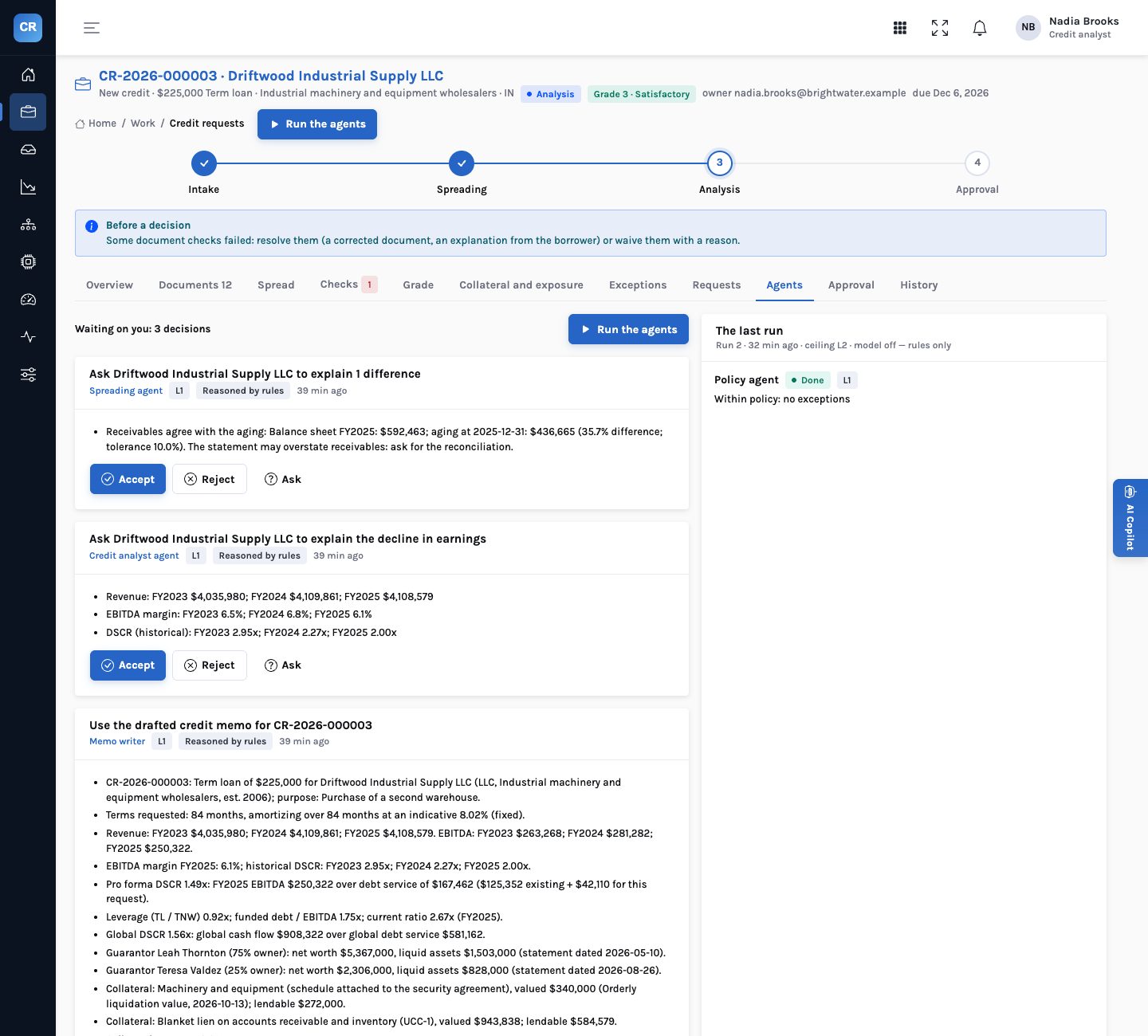
Now the agents prepare every request in scope: the intake agent reads documents and asks for what is missing, the spreading agent builds the spread and runs the reconciliations, the collateral agent values what was read from appraisals and agings, the credit analyst agent grades, the policy agent runs the controls and drafts mitigants for anything referred, the memo writer drafts the memo, and the supervisor lists what still blocks and which authority is needed. Each of them prepares a decision; at L1 a person then does the work.
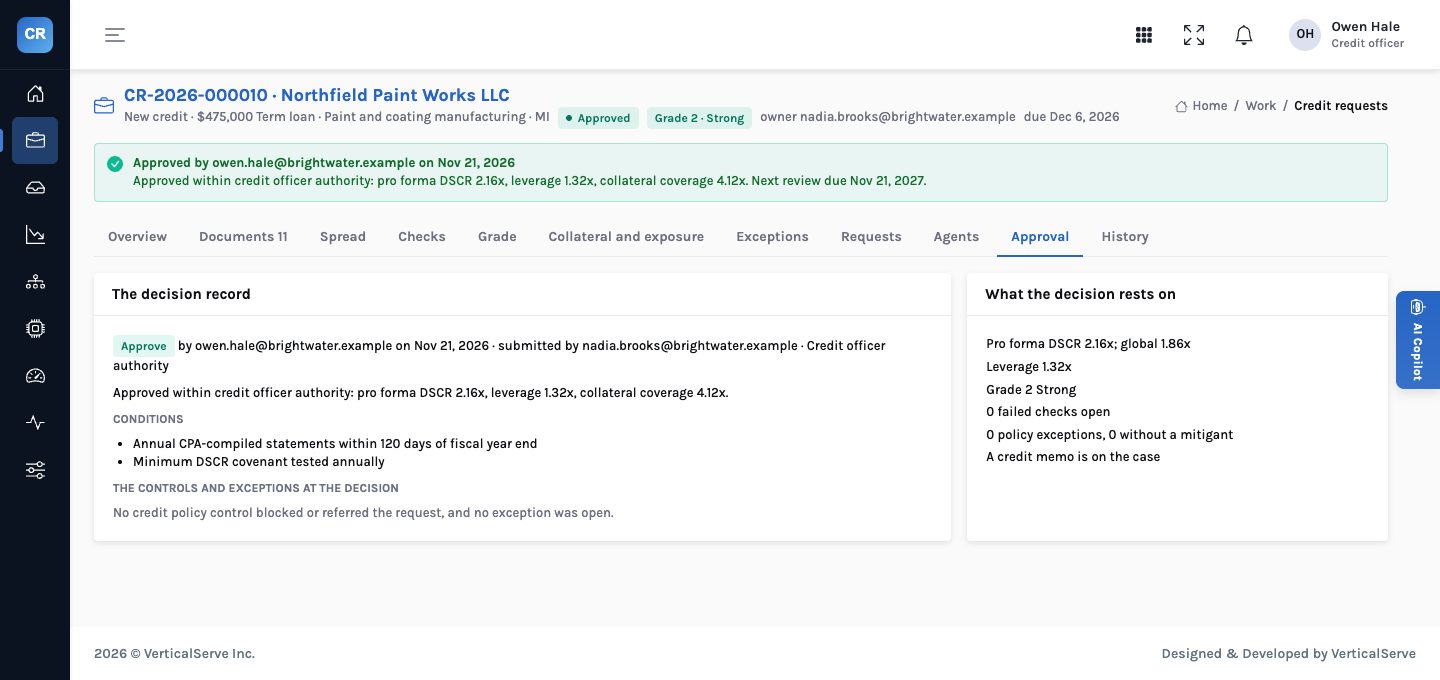
Nothing changes about who decides. The analyst resolves or waives each failed check with a reason (an agent cannot clear a check), records the mitigant for each referred exception, accepts or edits the memo and submits. A different person approves, within their authority: the submitter never approves, any open referred exception needs at least a senior credit officer, and a group over the house limit goes to the credit committee, whose decision a senior credit officer records with the meeting date and minute reference. A block cannot be justified at all; it is cured or the request is declined, with a reason.
Borrower requests in the pilot
When a document is missing or a figure does not reconcile, an agent drafts the request and holds it
for review. The analyst edits it and sends it; the message must keep its [request link],
which becomes the borrower’s own no-login page. Leave CREDIT_COMMS_LIVE off for the
pilot so analysts send each message through the channel they use today. Uploads are read at once and
the spread and checks rerun, which is one of the easiest places to measure days saved.
Expect calibration
Every deployment finds something to tune in the first weeks: a statement layout the reader does not recognise and marks as partial, a tolerance that fires on rounding in one accountant’s compilations, a control that refers more requests than the policy owner expected. Log each one with the request that exposed it, fix it, and re-run a fixed set of known requests (including past files whose outcome you know: an overstated receivables balance, a tax return that does not match, a stale appraisal) to prove nothing else moved.
Change policy through its owner
A tolerance or a threshold that fires too often is a policy question before it is a tuning question. If the policy owner decides the 10% receivables tolerance should be different, change the setting, record who signed it off, and re-test. If they decide it is right, the referrals are working.
Watch agreement, both ways
Agreement and override rates per action tell you where the preparation is trusted. Low agreement on one action points to a calibration problem. Agreement near 100% everywhere deserves its own credit review sample, to check that analysts are reviewing rather than clicking. Compare the both-ways sample figure by figure: where the hand spread and the prepared spread differ, find out which one was right.
Days 61–90: widen and decide
With one product line stable, add the work that keeps the book healthy. Annual reviews open from the loan book; the platform lists those due within 60 days, and the covenant monitor prepares opening the overdue ones for a person to accept. The monitor also tests each borrower’s quarterly reporting against the loan agreement’s minimum DSCR, maximum leverage and minimum current ratio, flags coverage that has declined for three quarters while still passing, and lists packages that are late for the relationship manager to chase.
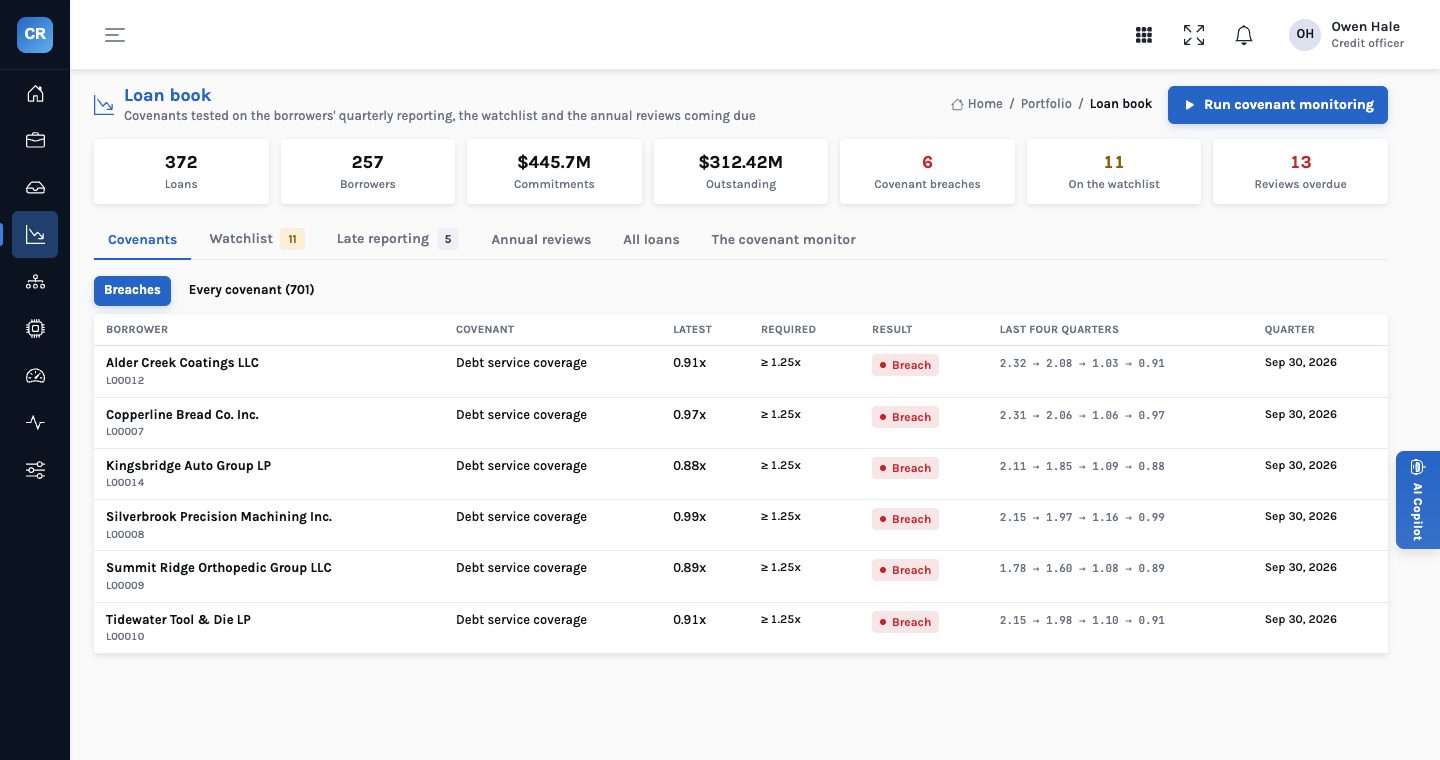
The monitor prepares watchlist additions; it never adds a borrower itself. A person adds and later clears each one with a reason. In a pilot, that distinction is the control that lets you switch monitoring on early.
The validation pack
Model risk will want to see the design of each engine (the reader, the spread and its formulas, the reconciliations, collateral valuation, the scorecard, the controls), the results against known requests, the calibration log, agreement rates and credit review results. If these were collected as the pilot ran, the pack is an export, not a project.
When to consider more autonomy
Not inside the ninety days. At day 90, with agreement measured per action, the policy owner may propose moving a specific action from L1 (the agent drafts; a person does the work) to L2 (the agent prepares the decision and asks a person before it acts). Opening overdue annual reviews is the kind of low-consequence, high-volume action where that conversation usually starts. L2 is as far as it goes: the platform caps every action there, and L3 and L4 stay locked.
Autonomy moves one action at a time, and only as far as L2. Some actions belong to people at every level.
What to report at day 30, 60 and 90
| Day | Report | Decision it supports |
|---|---|---|
| 30 | Systems connected; documents readable; policy entered and signed off, with every changed demo value listed; roles and authorities set; baseline numbers | Go live for one product line |
| 60 | Requests prepared and decided; agreement and override rates per agent and action; the both-ways sample compared; calibration log; any credit review findings | Continue, fix or stop |
| 90 | Measured review minutes and days to decision against the baseline; annual reviews and covenant monitoring running; validation pack; any proposal to move a named action to L2 | Scale to more product lines, and whether to change autonomy for any action |
What it means for each audience
For the chief credit officer
Own the policy inputs and the success criteria. The pilot tests whether the platform applies your policy, not whether you like its defaults.
Keep four eyes, approval authority and the decision record unchanged throughout; they are what makes the pilot safe to run on real requests.
For the credit team lead
Pick analysts who will disagree with the agents when they should. Their rejections and questions are how calibration happens.
Log every calibration change with the request that exposed it and the re-test that proved it.
For the board
Ninety days buys a measured answer, not a transformation. Ask at day 90 for the numbers against the baseline, the validation evidence and the decision records.
Raising autonomy is a separate decision, taken later, per action, and capped.
In the first ninety days, the agents earn trust by preparing requests. People keep deciding them.
Start narrow at L1, put your own policy in, measure honestly, fix what you find, and scale on evidence.