Credit decisions are made once; credit risk changes every quarter. After the loan closes, what the bank knows about a borrower comes from the reporting the loan agreement requires: a quarterly package, a covenant certificate, an annual review. Monitoring is where many portfolio teams fall behind, not because the tests are hard but because there are hundreds of them, they arrive on the same few days, and the interesting results are buried among the passes. This post follows one monitoring run over a whole loan book.
In short
- One run, the whole book. The covenant monitor tested 701 covenants on 257 loans against the quarter to 30 September 2026: 6 breaches, 5 borrowers with declining coverage, 5 packages late, 46 annual reviews due within 60 days, 13 of them overdue.
- The tests are arithmetic, not judgement. Minimum DSCR, maximum leverage and minimum current ratio are computed from each borrower’s reporting against the threshold in its own loan agreement. No model is involved.
- Declining coverage is the early warning. Five borrowers still pass their covenant, but their DSCR has fallen in each of the last three quarters and by more than 15% (an illustrative rule).
- A credit officer decides who goes on the watchlist. The monitor prepares additions; Owen Hale added all eleven. Late packages go to the relationship manager to chase; overdue reviews are opened by a person.
The situation
The run uses InsightCredit’s demo data for Brightwater Commercial Bank. The bank, the borrowers and every figure are fictional; each loan has six quarters of generated reporting, and covenant thresholds come from each loan’s own terms in the demo data.
Owen Hale, a credit officer, runs covenant monitoring from the loan book page. The run’s headline, word for word: “701 covenant tests on 257 loans: 6 breaches, 5 declining, 5 packages late; 46 annual reviews due within 60 days (13 overdue).” The run made no model calls; the model is switched off for these agents in the demo, so every finding comes from rules.
| Covenant | Tests | Passed | Breached | Thresholds in the loan agreements |
|---|---|---|---|---|
| Minimum debt service coverage (TTM) | 257 | 251 | 6 | 1.25x on 228 loans, 1.20x on 29 |
| Maximum leverage (TL / TNW) | 257 | 257 | 0 | 3.0x to 4.5x |
| Minimum current ratio | 187 | 187 | 0 | 1.10x to 1.25x |
Why monitoring falls behind
- Volume on a deadline. Quarterly packages arrive in the weeks after quarter end, all at once, and every one needs the same ratios computed.
- Passes hide the signal. In this run, 695 of 701 tests passed. The six that didn’t, and the five that passed while sliding, are the whole point.
- A pass looks the same at 2.3x and at 1.3x. Covenant tests are binary. A borrower whose coverage has fallen by a third in a year passes until the quarter it doesn’t.
- Missing reporting is silent. A package that never arrives produces no failed test. It produces nothing at all, until someone notices.
- Reviews slip. Annual reviews are due on anniversaries scattered through the year, and an overdue review isn’t anyone’s alert.
Analysts key each package into a tickler spreadsheet, compute the ratios, highlight breaches by hand and email the list. Late packages and declining trends are noticed by whoever happens to look.
Every covenant is tested on the reporting with its formula and trend, breaches and declining coverage are listed with the quarters behind them, late packages and due reviews are listed, and people decide what follows.
How InsightCredit handles it
Five outputs from one run. The monitor prepares; people add to the watchlist, chase packages and open reviews.
The breaches
All six breaches are on minimum debt service coverage, tested on trailing-twelve-month EBITDA over trailing-twelve-month debt service, against 1.25x in each loan agreement:
| Borrower | Loan | TTM DSCR, last four quarters to 30 Sep 2026 | Required |
|---|---|---|---|
| Alder Creek Coatings LLC | L00012 | 2.32x → 2.08x → 1.03x → 0.91x | ≥ 1.25x |
| Copperline Bread Co. Inc. | L00007 | 2.31x → 2.06x → 1.06x → 0.97x | ≥ 1.25x |
| Kingsbridge Auto Group LP | L00014 | 2.11x → 1.85x → 1.09x → 0.88x | ≥ 1.25x |
| Silverbrook Precision Machining Inc. | L00008 | 2.15x → 1.97x → 1.16x → 0.99x | ≥ 1.25x |
| Summit Ridge Orthopedic Group LLC | L00009 | 1.78x → 1.60x → 1.08x → 0.89x | ≥ 1.25x |
| Tidewater Tool & Die LP | L00010 | 2.15x → 1.98x → 1.10x → 0.91x | ≥ 1.25x |
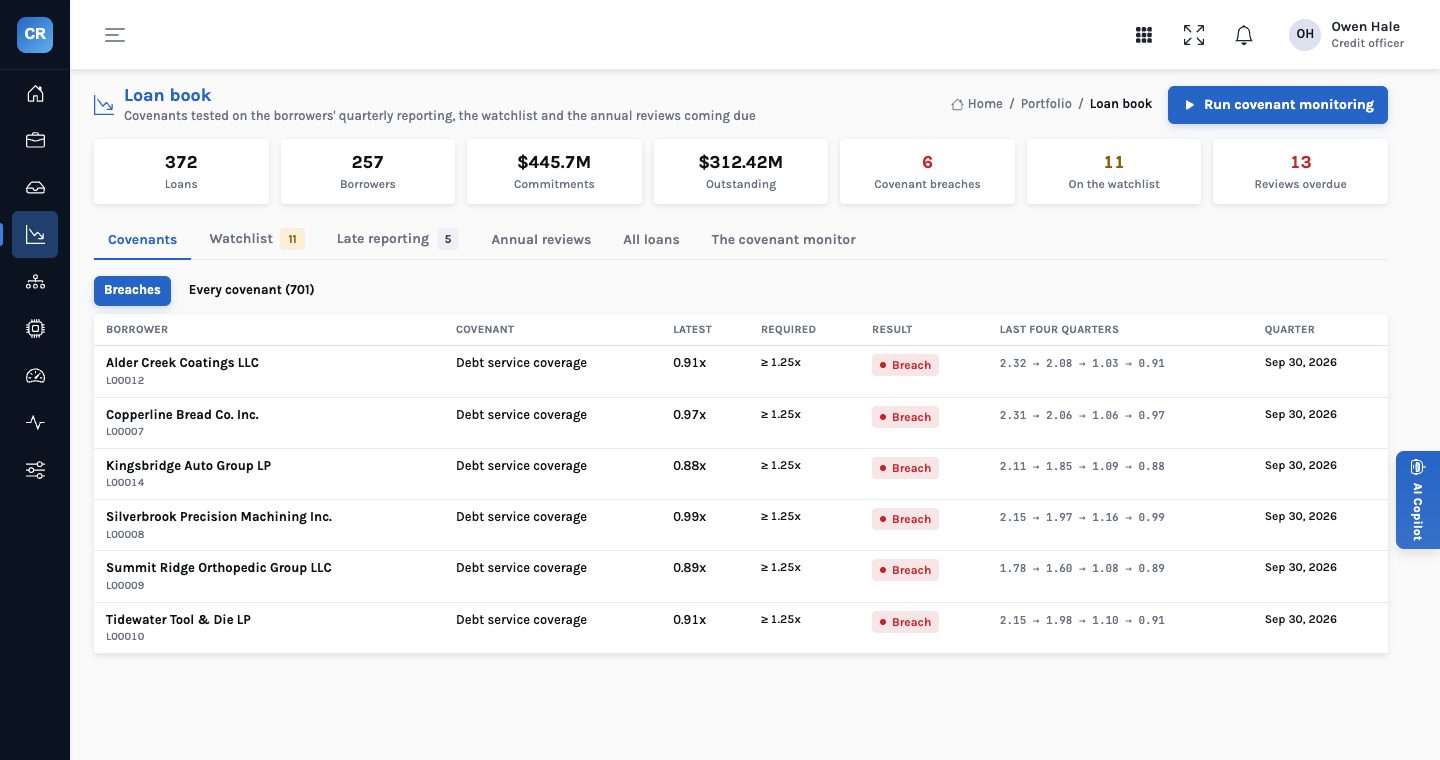
The trends tell the story the breach alone doesn’t. Every one of the six fell by between a third and a half in a single quarter, the quarter to 30 June 2026, and was already below its minimum then. Sudden drops of that size are a question for the relationship manager on day one: a lost contract, a one-off cost, a refinancing, or an error in the package. A trend rule can’t anticipate a cliff; it is there for the slower slide.
Declining coverage: the borrowers who still pass
The early-warning rule flags a borrower whose DSCR was lower in each of the last three quarters and has fallen by at least 15% over them, while still passing its covenant. Both the three quarters and the 15% are illustrative settings. Five borrowers meet it:
| Borrower | Loan | DSCR, last four quarters | Covenant |
|---|---|---|---|
| High Plains Contracting Inc. | L00026 | 2.19x → 1.99x → 1.76x → 1.56x | 1.25x |
| Eastlake Contracting LLC | L00024 | 2.35x → 2.11x → 1.87x → 1.66x | 1.25x |
| Yellowpine Logistics Inc. | L00022 | 2.34x → 2.10x → 1.88x → 1.65x | 1.25x |
| Willowmere Coatings LLC | L00021 | 2.23x → 2.01x → 1.78x → 1.58x | 1.25x |
| Kingsbridge Apartments LLC | L00020 | 2.19x → 1.97x → 1.75x → 1.55x | 1.20x |
Each of these would pass a covenant certificate comfortably today. Each has lost about 0.2x a quarter for three quarters. If the slope held, they would reach their minimums in two to three more quarters. That is the window in which a conversation with the borrower is cheap and a restructuring is optional.
The monitor computes the states on the left; only a person moves a borrower onto or off the watchlist.
The watchlist
The covenant monitor prepares watchlist additions for breaches and declining coverage. It never puts a borrower on the watchlist itself. In the demo, Owen Hale reviewed and added all eleven: five for declining coverage and six for covenant breaches, each with the detail that put it there. Clearing a borrower later takes a reason, which is kept with who cleared it and when.
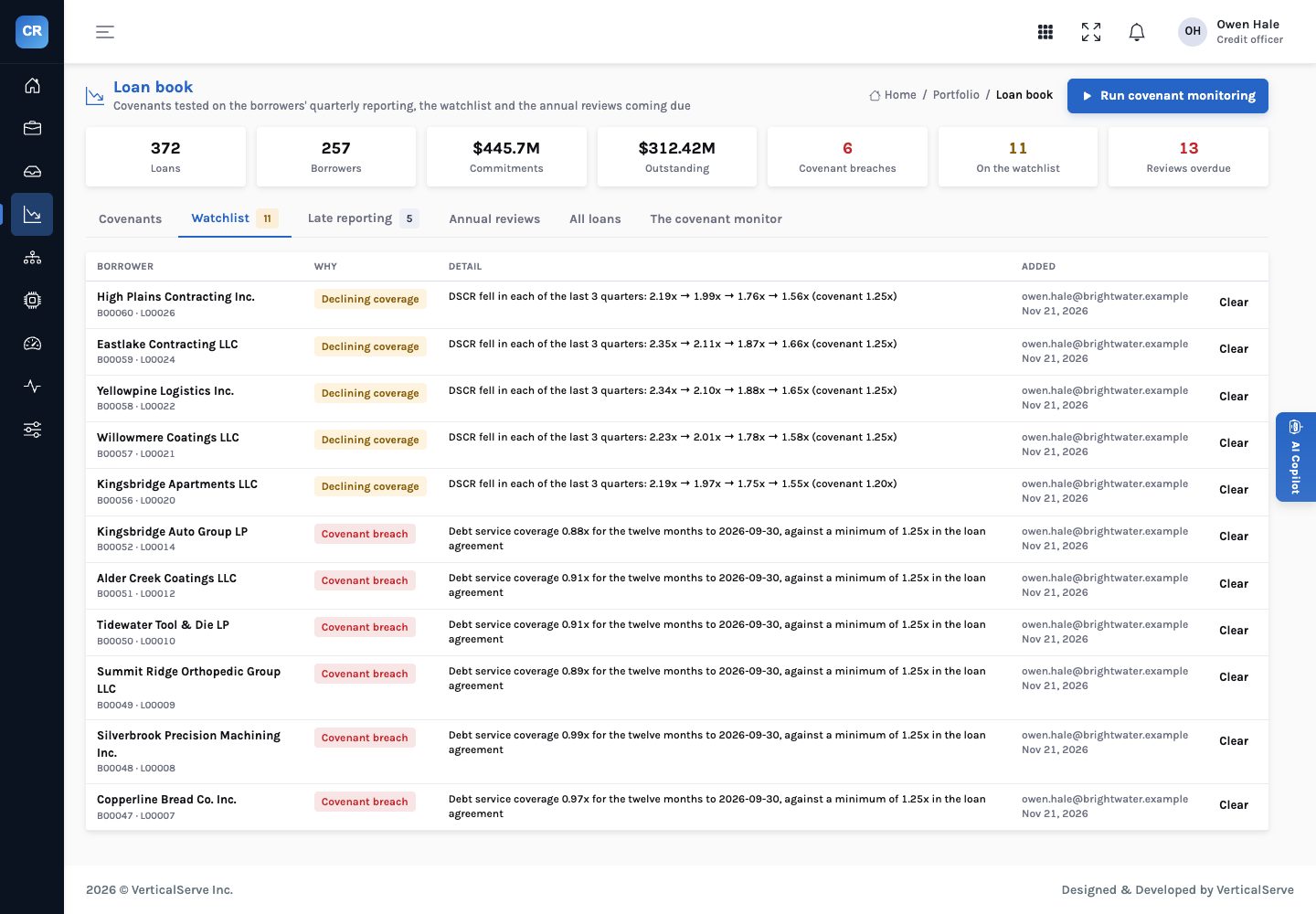
A watchlist entry is a bank’s internal flag that a credit needs closer attention. It is not, by itself, a regulatory risk rating. Whether a breached loan should be downgraded, to special mention or further, is a separate decision made on the credit’s full picture under the bank’s rating policy. A covenant breach also has consequences under the loan agreement, from a waiver to an amendment to a reservation of rights, that are for the bank and its counsel, not a monitoring system.
Late reporting
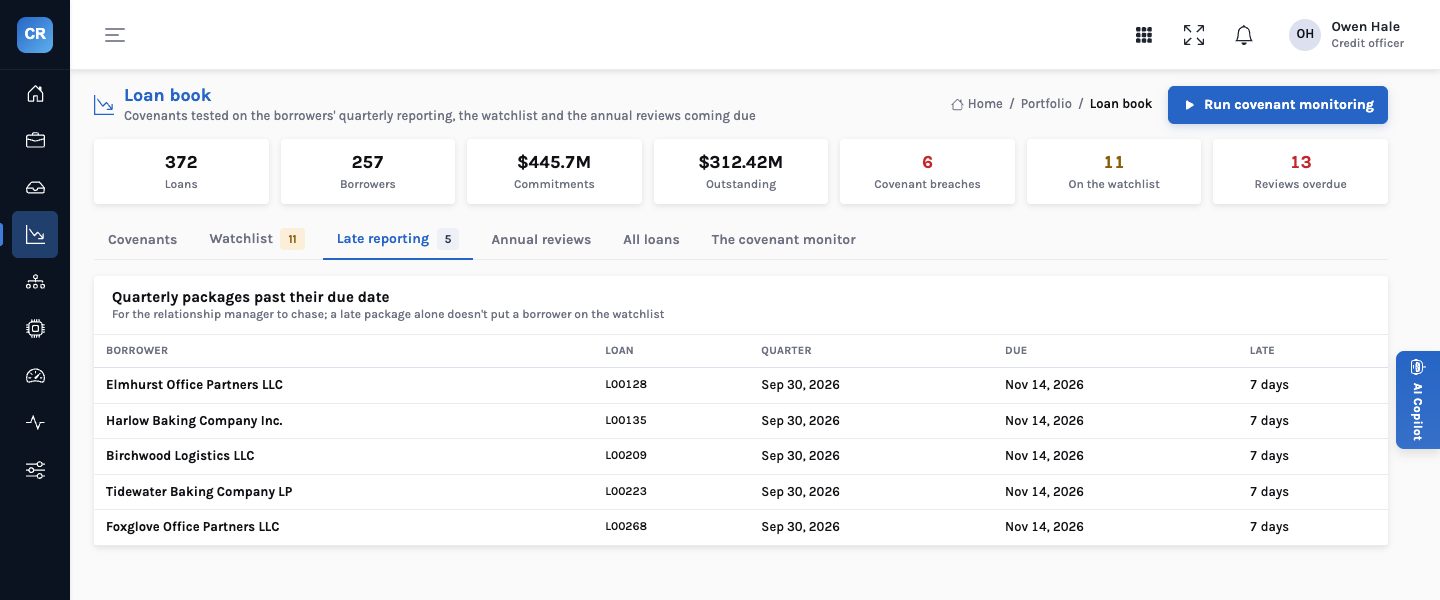
A package is late when nothing has arrived by quarter end plus the reporting days in the loan agreement. Five quarterly packages for the quarter to 30 September 2026 were due on 14 November and were 7 days late on the day of the run:
| Borrower | Loan | Quarter | Due | Days late |
|---|---|---|---|---|
| Elmhurst Office Partners LLC | L00128 | 30 Sep 2026 | 14 Nov 2026 | 7 |
| Harlow Baking Company Inc. | L00135 | 30 Sep 2026 | 14 Nov 2026 | 7 |
| Birchwood Logistics LLC | L00209 | 30 Sep 2026 | 14 Nov 2026 | 7 |
| Tidewater Baking Company LP | L00223 | 30 Sep 2026 | 14 Nov 2026 | 7 |
| Foxglove Office Partners LLC | L00268 | 30 Sep 2026 | 14 Nov 2026 | 7 |
Late reporting is deliberately kept off the watchlist. A week late is usually an accountant on holiday, not a deteriorating credit; the right first step is the relationship manager’s phone call. A package that stays late, or one that arrives with bad news, is a different matter, and the next run will show it.
Annual reviews
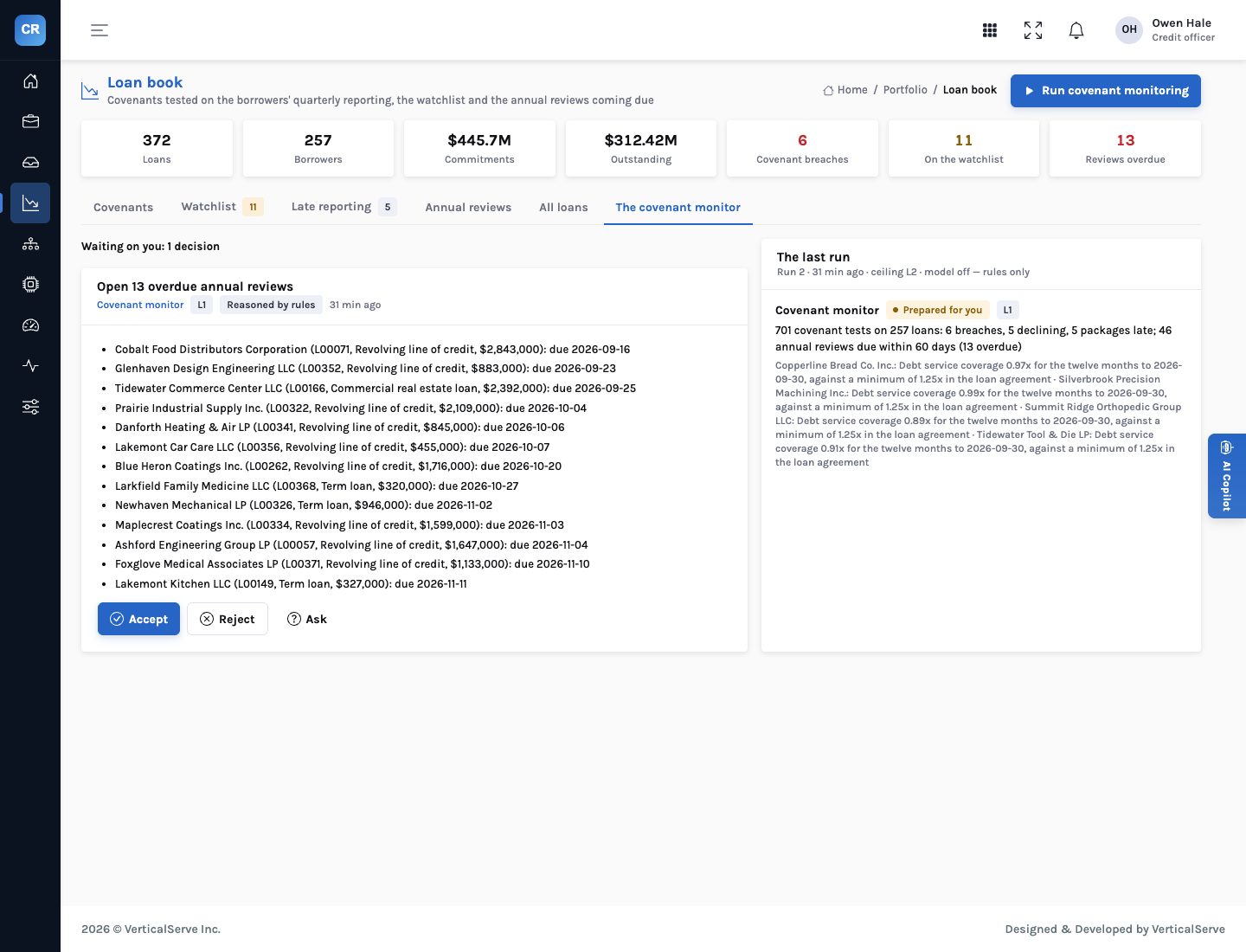
The run lists every annual review due within 60 days: 46 relationships, 13 already overdue. The oldest, Cobalt Food Distributors Corporation’s $2,843,000 revolving line (L00071), was due on 16 September 2026, 66 days earlier. The monitor prepares one decision for the overdue ones: “Open 13 overdue annual reviews”, listing each loan, product, commitment and due date. A person accepts, rejects or asks. Accepting opens an annual-review case for each, with the illustrative 30-day service level, owned and worked like any other case.
The lists cross. Ashford Engineering Group LP’s revolving line (L00057) is on the overdue list while the same borrower has a $4.4 million request in progress (see the house limit post). Kingsbridge Auto Group LP breached its covenant this quarter and its annual review falls due on 15 January 2027, within the 60 days; the review should start from the breach.
Who does what
The monitor never contacts a borrower, never adds to the watchlist and never opens a review on its own.
A cliff and a slide are different conversations. Ask the relationship manager what happened in the quarter.
Add, or reject the prepared addition with a reason. Each entry carries the figures that put it there.
A breach is evidence for the grade, not the grade. Re-grade under the bank’s policy where the picture has changed.
Waiver, amendment, reservation of rights: the bank’s decision, recorded outside the monitor.
A call first. Persistently late reporting is itself a signal.
Accept the monitor’s prepared decision or open them one by one; assign owners.
With a reason that names the fact: two quarters back above the covenant, a waiver and amendment signed.
A note on regulation
data
US supervisors expect banks to identify credit weaknesses promptly and to keep risk ratings current, with an independent credit risk review function assessing the portfolio. In the agencies’ rating definitions, special mention describes potential weaknesses that deserve management’s close attention. Under CECL, the allowance reflects expected losses using current conditions and reasonable forecasts, so timely information about borrowers matters there too.
Sources: Interagency Guidance on Credit Risk Review Systems (2020); OCC Comptroller’s Handbook, “Rating Credit Risk”; FASB ASC 326 (CECL). A summary; a bank’s own policies and its examiners’ expectations govern.
InsightCredit doesn’t rate loans for regulatory purposes, set the allowance or satisfy any of this guidance on its own. It makes the evidence timely and visible, and records who decided what.
What it means for each audience
For the chief credit officer
Every covenant in the book is tested each run, with its formula and trend, and the watchlist is a list of decisions a credit officer made, each with a reason.
Declining coverage gives two or three quarters of warning before a breach on the borrowers who slide.
For the credit team lead
Nobody keys quarterly packages into a tickler. The work starts at the eleven names that matter and the five packages to chase.
Overdue reviews become cases with owners and due dates instead of a list in someone’s inbox.
For the board
The board’s view of the book is current to the latest quarter: how many loans breach, how many are sliding, how many reviews are late.
Each figure traces to a borrower’s reporting and a person’s decision.
Metrics to track
What to be careful about
- Garbage in. The tests use the reporting the borrower sent. Company-prepared quarterly figures are not audited; a surprising quarter may be an error before it is a crisis.
- Definitions live in the loan agreement. How EBITDA, debt service and tangible net worth are defined for a covenant can differ from the standard formulas. Configure each covenant to its agreement.
- The early-warning rule is illustrative. Three quarters and 15% were set for the demo. Too sensitive and the watchlist fills with noise; too loose and it misses the slide.
- A cliff beats any trend rule. Every breach in this run fell by a third or more in one quarter. Monitoring shortens the time to notice; it doesn’t predict a lost contract.
Monitoring is about the few results that aren’t passes.
Test the whole book every quarter, show the trend behind every result, and let a credit officer decide, with a reason, who needs closer attention.