A request can be sound on its own and still be too much for the bank. An engineering firm with coverage above 1.7x and leverage under 1x asks to borrow $4.4 million. Taken alone it is an ordinary senior credit officer decision. Taken with the two other companies its majority owner controls, it pushes the group past the limit the bank set for any one family of related borrowers. That is not a question about the engineering firm. It is a question about the bank’s concentration, and it belongs with the credit committee.
In short
- Two exposures, both computed. Relationship exposure is the borrower’s existing commitments plus this request: $10,277,000. Group exposure adds the related companies: $15,966,000.
- Against an illustrative house limit of $15,000,000, the Iyer related companies group would be at 106%, $966,000 over. The control refers the request to the credit committee.
- A second exception rides along. Collateral coverage is 0.91x: $7,845,434 lendable against $8,630,000 secured. Both exceptions need a recorded mitigant before submission.
- The committee decides; the system records. A senior credit officer records the committee’s decision with the meeting date and minute reference. Nobody on the case can approve it alone.
The situation
The case uses InsightCredit’s demo data for Brightwater Commercial Bank. The bank, the borrowers, the people, the appraiser and every figure are fictional; the house limit, the advance rates and the approval authorities were set for the demo.
CR-2026-000009, Ashford Engineering Group LP, is a Kentucky engineering services partnership founded in 2012 and an existing customer. It asks for an increase: a $4,400,000 term loan over 84 months, amortizing, at an indicative 8.71% fixed ($70,146 a month), to acquire a competitor’s contracts and equipment. The relationship manager is Dana Whitfield; the case owner is Nadia Brooks, credit analyst; the illustrative service level for an increase gives it 10 days, due 1 December 2026.
On its own figures Ashford is a strong borrower:
| Measure | Value | How it is computed |
|---|---|---|
| Revenue FY2023 / FY2024 / FY2025 | $17,603,377 / $19,318,911 / $19,081,872 | From the three statements, each cell linked to its line |
| EBITDA FY2025 | $2,224,509 (11.7% margin) | Operating income + depreciation and amortization |
| Historical DSCR FY2023 / 2024 / 2025 | 6.74x / 5.77x / 5.06x | EBITDA / (interest + current portion of long-term debt) |
| Pro forma DSCR | 1.74x | $2,224,509 / ($439,932 existing + $841,752 for this request) |
| Global DSCR | 1.70x | $2,550,009 / $1,499,385, with two guarantors |
| Leverage (TL / TNW) | 0.74x | $2,420,869 / $3,272,047 |
| Current ratio | 3.35x | Current assets / current liabilities |
| Grade | 3 Satisfactory, 17 points | Illustrative scorecard; collateral coverage is the largest driver (8 points) |
All 34 checks pass. The tax returns agree with the statements. There is nothing wrong with Ashford. What changes the case is who else Ashford is.
Two kinds of exposure
InsightCredit computes exposure twice, because two different questions depend on it.
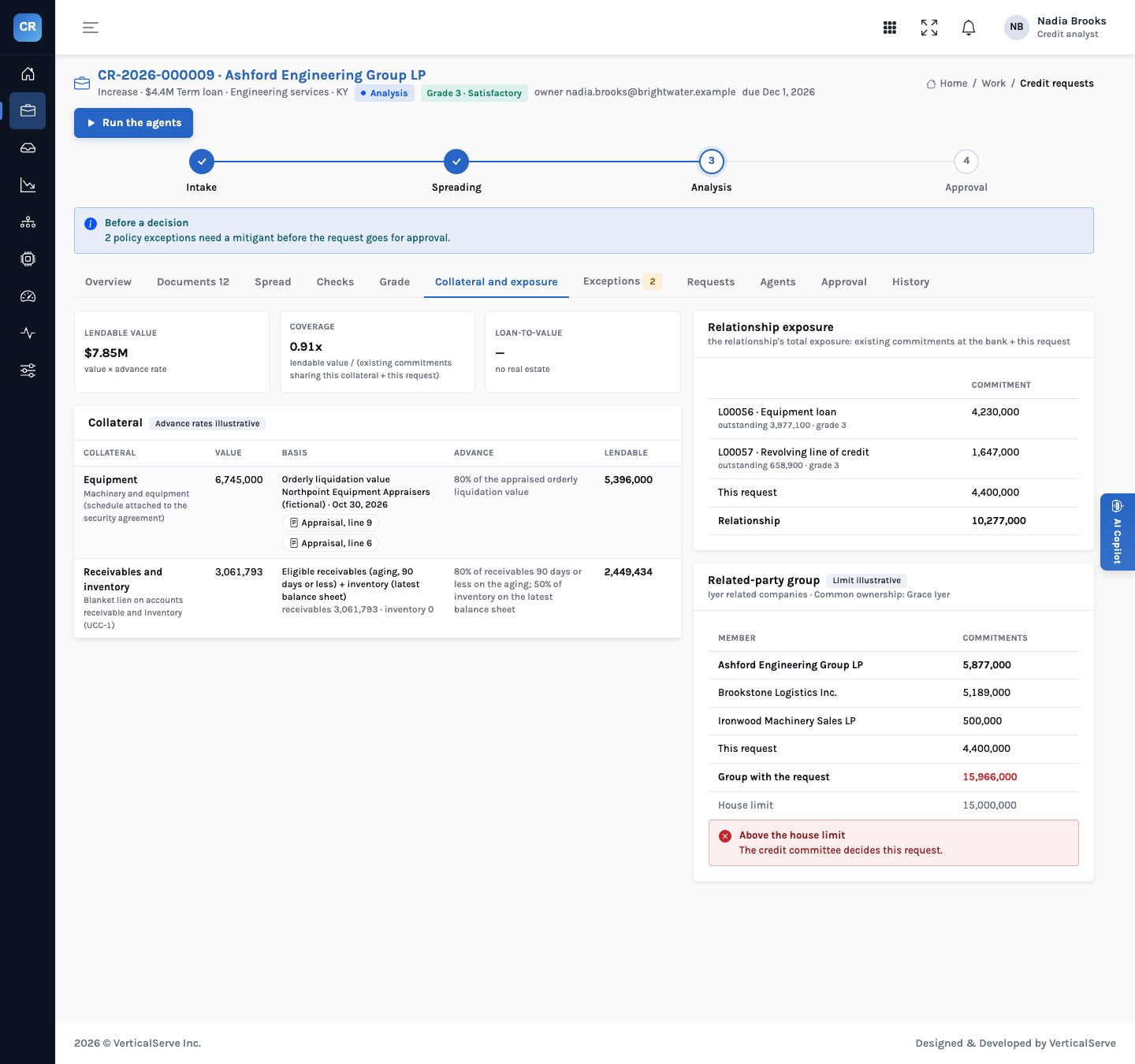
Relationship exposure is this borrower’s existing commitments at the bank plus this request. It decides the approval authority. Ashford already has two loans:
| Loan | Product | Commitment | Outstanding | Grade |
|---|---|---|---|---|
| L00056 | Equipment loan | $4,230,000 | $3,977,100 | 3 |
| L00057 | Revolving line of credit | $1,647,000 | $658,900 | 3 |
| This request | $4,400,000 | |||
| Relationship | $10,277,000 |
Group exposure is every borrower in the same related-party group, aggregated against the house limit. Ashford belongs to the Iyer related companies group, recorded in the bank’s data on the basis of common ownership by Grace Iyer, who owns 51% of Ashford and guarantees this loan:
| Member | Loans | Commitments | Outstanding |
|---|---|---|---|
| Ashford Engineering Group LP | 2 | $5,877,000 | $4,636,000 |
| Brookstone Logistics Inc. | 2 | $5,189,000 | $3,908,100 |
| Ironwood Machinery Sales LP | 1 | $500,000 | $284,700 |
| Group today | 5 | $11,566,000 | |
| This request | $4,400,000 | ||
| Group with the request | $15,966,000 | ||
| House limit (illustrative) | $15,000,000 |
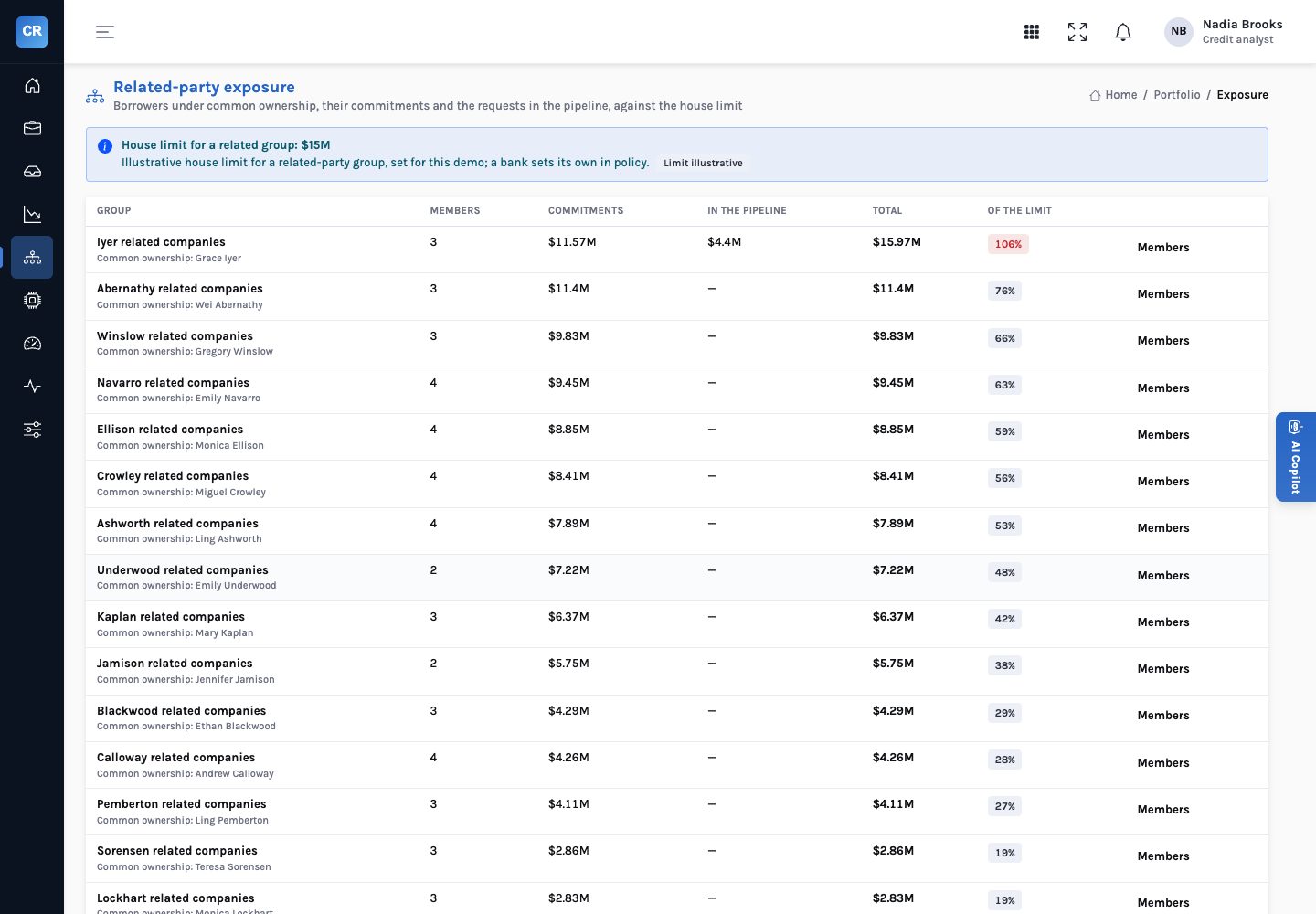
The group is at 77% of the limit today and would be at 106% with the request. No other group in the demo book is close: the next largest, at $11,398,000, uses 76%.
Why concentration gets missed
- Each request is reviewed on its own. The analyst on Ashford sees Ashford. Brookstone Logistics may sit with another relationship manager and another analyst.
- Groups live in a different system. Related-party links are often kept in a spreadsheet or a field in the core system that the credit file doesn’t read.
- Pipeline is invisible. Committed loans are counted; requests in progress for other members of the group often aren’t.
- The limit is a number in a policy document. Nobody is prompted to compare against it, so the comparison happens if someone remembers.
The analyst totals the borrower’s own loans for the authority grid. Group exposure is checked against a separate list, if at all, and pipeline requests for other members are missed.
The case aggregates the group’s commitments with this request, compares them with the house limit, and a policy control refers it to the credit committee when it would go over.
How InsightCredit handles it
Three independent reasons land on the same authority. Each is stated on the case. All thresholds are illustrative.
The exposure page
Outside any one case, the related-party exposure page lists every group with its members, commitments, the requests in progress, and the percentage of the house limit each group would use. A chief credit officer sees the Iyer group at 106% before the case reaches committee, and sees which other groups are near enough to watch.
The collateral shortfall
The new loan would be secured alongside the existing equipment loan. The collateral engine takes its values from the documents the reader took, never typed in:
| Collateral | Value | Basis | Lendable |
|---|---|---|---|
| Machinery and equipment | $6,745,000 | Orderly liquidation value, Northpoint Equipment Appraisers (fictional), 30 Oct 2026; 80% advance | $5,396,000 |
| Receivables and inventory (UCC-1) | $3,061,793 | Receivables 90 days or less on the aging; no inventory on the balance sheet; 80% advance | $2,449,434 |
| Total | $7,845,434 |
Against $8,630,000 of secured exposure (the $4,230,000 equipment loan and the $4,400,000 request), that is coverage of 0.91x, and the illustrative COLLATERAL_SHORTFALL control refers it. It is also why collateral is the biggest factor in Ashford’s otherwise good grade.
The exceptions and their drafts
Two refers become two policy exceptions. The policy agent drafts a mitigant for each from the engines’ figures, and holds them for a person:
| Exception | The policy agent’s draft mitigant |
|---|---|
| Collateral coverage below 1.00x | Coverage 0.91x (lendable $7,845,434 against $8,630,000). Mitigants: pro forma DSCR of 1.74x; global DSCR of 1.70x; guarantors’ liquid assets of $1,534,000; unlimited personal guarantees from Grace Iyer, Vikram Navarro. |
| Related-party group above the house limit | Group exposure $15,966,000 with this request against the house limit of $15,000,000. Mitigants: this borrower’s pro forma DSCR of 1.74x; unlimited personal guarantees from Grace Iyer, Vikram Navarro. |
The first draft is a reasonable start. The second is thinner, and it should be: the house limit is not about Ashford’s coverage. It is about how much of the bank depends on one owner’s companies. The analyst’s mitigant for that exception needs to speak to the group: how Brookstone Logistics and Ironwood Machinery Sales are performing, whether the members depend on each other for revenue, and whether the $966,000 overage is temporary (for example, amortization on existing loans bringing the group back under the limit within a stated period) or a lasting decision to hold more.
One more thing a careful analyst would notice: Grace Iyer, who ties the group together, reports $1,812,000 of net worth and $1,023,000 of contingent liabilities, much of which may be guarantees of the other group members’ debt. The same person standing behind every member is not three independent sources of support.
Authority: three reasons, one answer
The approval tab states why the request needs the credit committee, in the order the engine found the reasons:
- Relationship exposure $10,277,000: above the illustrative $10 million senior credit officer limit.
- A referred policy exception: at least a senior credit officer.
- The related-party group would exceed the house limit: the credit committee.
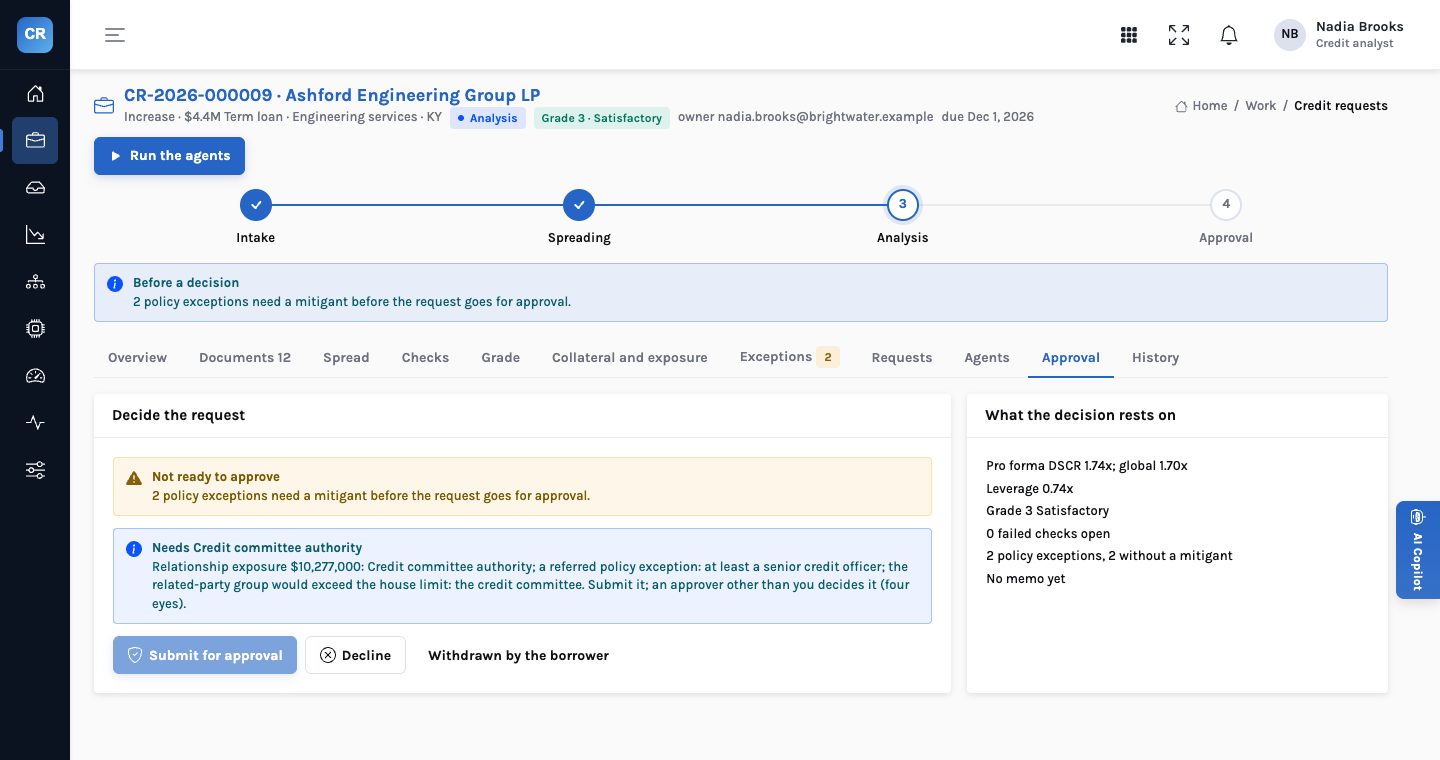
Even with the house limit removed, the relationship exposure alone would take it past a senior credit officer. The group test matters most for smaller requests, where a modest loan to a small member of a large group would otherwise be approved within one officer’s authority.
Asking the copilot
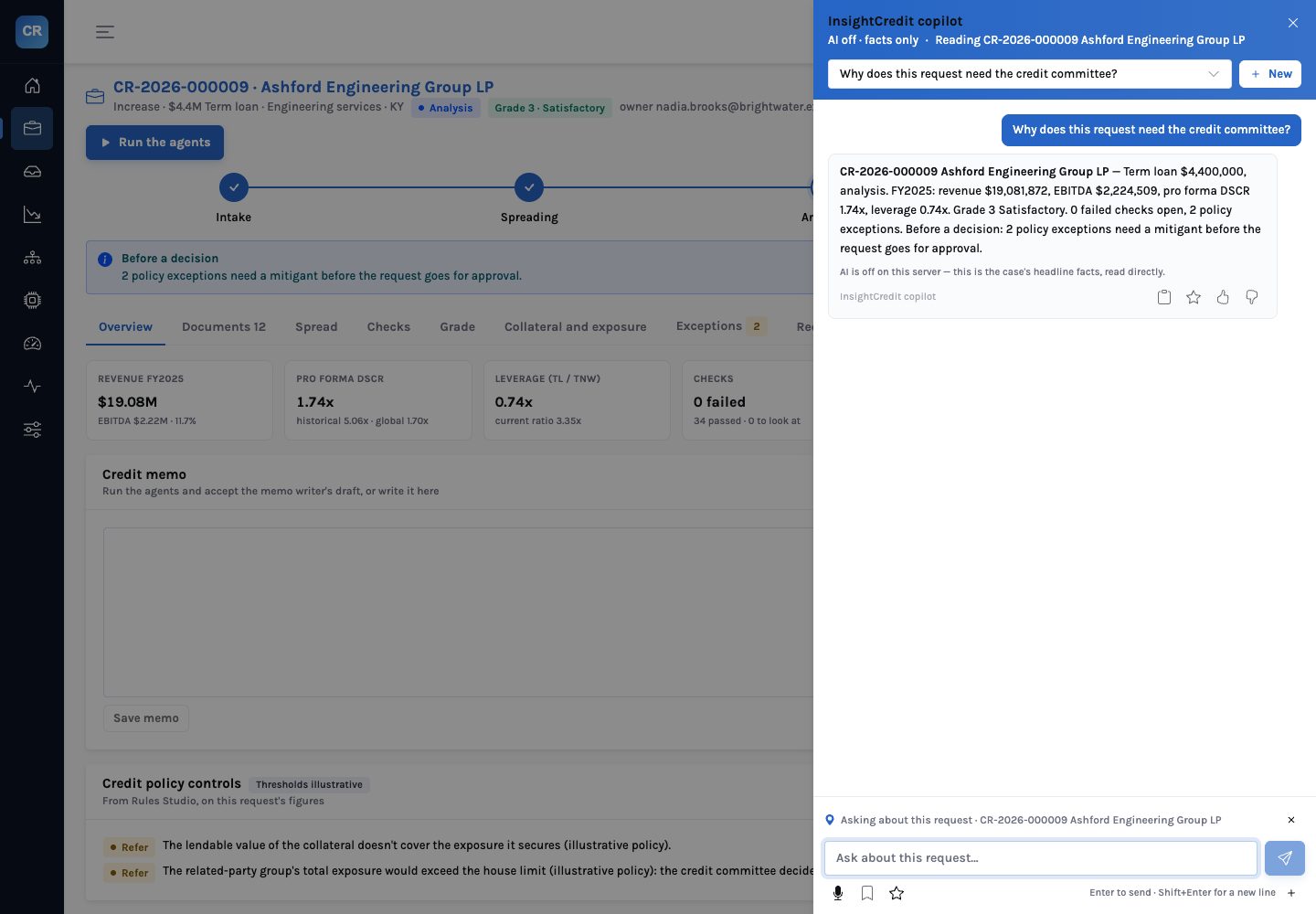
A reviewer can ask the read-only copilot about the case. With the model off, as in this demo, it answers from the case’s facts, read directly, and says so. With a model on, every figure and name it gives is checked against what its tools returned. It cannot change anything.
Who does what
The submitter never approves. The committee decides; a senior credit officer records it on the case.
Check the members and the basis of the grouping in the bank’s records. A missing member understates exposure; a wrong one overstates it.
The other members’ grades, covenant results and reviews. Ashford’s own revolving line, L00057, has an annual review due 4 November 2026 that the covenant monitor lists as overdue.
Start from the agent’s draft; say why the bank should hold more than its limit, for how long, and what brings it back under.
Submission stays disabled until every referred exception has one.
The supervisor agent prepares the submission; the analyst sends it.
Approve, approve with conditions (a reduced amount, a paydown elsewhere in the group, additional collateral) or decline.
With the committee’s meeting date and minute reference. The decision record keeps the exceptions, mitigants, authority and why.
The committee’s choices
| Option | What it means for the group | What goes on the record |
|---|---|---|
| Approve over the limit | Group at $15,966,000, 106% of the house limit | The overage, the reason the committee accepted it, and any review date set for it |
| Approve a smaller amount | At $3,434,000 or less, the group stays within $15,000,000 | The revised amount and its recomputed coverage and exposure |
| Approve with a paydown or more collateral | A condition that brings coverage to 1.00x or the group under the limit | Each condition, worded so it can be tested |
| Decline | Group unchanged at $11,566,000 | The reason, recorded on the case and the decision record |
A note on regulation
data
A house limit is the bank’s own policy and sits below the legal lending limit. For national banks, the legal limit on loans to one borrower is generally 15% of capital and surplus, plus a further 10% for loans fully secured by readily marketable collateral, and the rules say when loans to related borrowers must be combined. Those combination tests (such as common enterprise and direct benefit) are narrower and more technical than grouping by common ownership. State-chartered banks follow their state’s limits.
Sources: 12 CFR Part 32 (lending limits, national banks and federal savings associations), including 32.3 and 32.5. A summary, not legal advice; the bank’s counsel and policy decide how its groups map to the legal tests.
InsightCredit doesn’t compute the legal lending limit or decide whether loans must be combined under it. It aggregates the groups the bank records against the house limit the bank sets, and makes the result impossible to miss on the case.
What it means for each audience
For the chief credit officer
Concentration is tested on every request, pipeline included, and a group over the house limit cannot be approved below the credit committee.
The exposure page shows every group’s use of the limit at any time, not only when a request comes in.
For the credit team lead
The analyst doesn’t assemble the group from other people’s files. The tab shows members, commitments and the limit; the work is the group mitigant.
The authority and why are stated on the case, so nobody routes it wrongly.
For the board
The house limit is a decision the board makes about how much the bank stakes on one family of companies. Each time the bank goes over it, the committee says so, on the record.
Overages are visible, deliberate and reviewable.
Metrics to track
What to be careful about
- The grouping is only as good as the data. InsightCredit aggregates the groups in the bank’s records. If a related company isn’t linked there, it isn’t counted.
- Commitments, not just outstandings. The group is measured on commitments, so an undrawn line counts in full. That is the conservative choice; make sure policy agrees.
- Debt service from the statements. Pro forma DSCR uses the latest statement’s interest and current maturities. For an existing customer, compare it with the bank’s own payment schedule on the existing loans; the two can differ.
- Every limit here is illustrative. The $15 million house limit, the $2.5 million and $10 million authorities and the 80% advance rates were set for the demo.
A good borrower can still be too much of the bank.
Measure every request against the group it belongs to, count the pipeline, and when the group passes the limit, let the committee decide on the record.