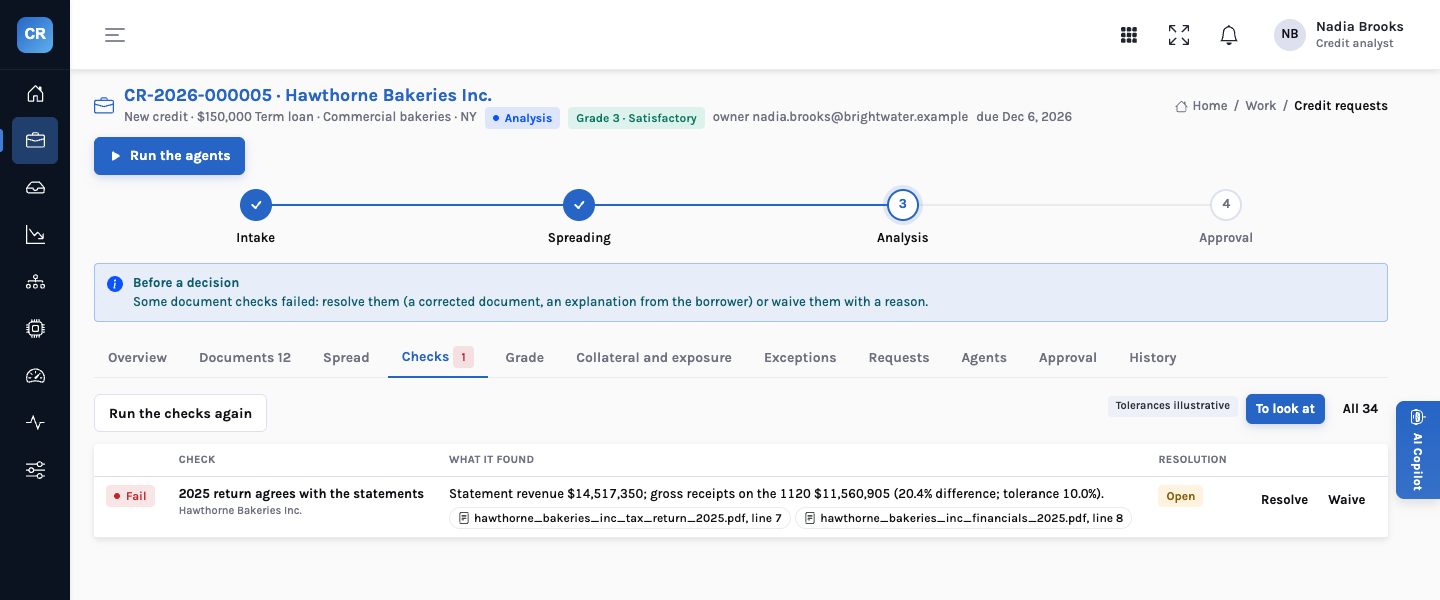
Hawthorne Bakeries Inc. has been baking in New York since 1986. It asks for a $150,000 term loan for a plant expansion. Its accountant-reviewed statements show revenue of $14,517,350 for 2025, coverage of 1.90x with the new loan, and a grade of 3. Its 2025 corporate tax return, Form 1120, reports gross receipts of $11,560,905. The two documents describe the same company and the same year, and they differ by $2,956,445.
In short
- The statements and the return agreed for two years, then didn’t. 2023 and 2024 agree within half a percent. 2025 differs by 20.4%.
- Every ratio is built on the statements. If statement revenue is wrong, coverage, margins and the grade are wrong with it. That is why this one check matters more than all of them.
- The reader takes the whole return, not just one line. Cost of goods sold and interest agree to the dollar; the return’s taxable income is a loss of $2,140,783 while the statements book $219,784 of income tax.
- The agent asks for the CPA’s reconciliation; a person decides what it proves. Nothing is sent to the borrower, and no check is cleared, without an analyst.
The situation
This case runs on InsightCredit’s demo data: a fictional bank, Brightwater Commercial Bank, with
fictional borrowers, accountants, guarantors and figures. The case is CR-2026-000005, a new
credit for Hawthorne Bakeries Inc., a C corporation in commercial baking (NAICS 311812). Helen Marsh is
the relationship manager; Nadia Brooks owns the case.
| Term | Requested |
|---|---|
| Product | Term loan, $150,000 |
| Purpose | Plant expansion |
| Term and amortization | 84 months, fully amortizing, at an indicative 8.10% fixed ($2,345 a month) |
| Guarantors | Leah Russo (60%) and Teresa Zhou (40%), unlimited personal guarantees |
| Statements | Reviewed, prepared by Marlowe Brandt LLP (fictional), FY2023 to FY2025 |
By any ratio this is a good credit. Pro forma debt service coverage is 1.90x, global cash flow 2.28x, leverage 1.37x, collateral coverage 8.35x, and the scorecard gives it 12 points, grade 3, Satisfactory. No policy control fires. Thirty-three of the case’s thirty-four checks pass. The one that fails compares each year’s statement revenue with the gross receipts on that year’s return:
| Year | Statement revenue | Gross receipts on the 1120 | Difference | Result |
|---|---|---|---|---|
| 2023 | $12,816,511 | $12,877,172 | −0.5% | Pass |
| 2024 | $14,023,813 | $13,960,080 | 0.4% | Pass |
| 2025 | $14,517,350 | $11,560,905 | 20.4% | Fail |
The difference is measured against statement revenue: (14,517,350 − 11,560,905) / 14,517,350 =
2,956,445 / 14,517,350 = 20.4%, against an illustrative tolerance of 10%. In the documents, the revenue is
line 8 of hawthorne_bakeries_inc_financials_2025.pdf and the gross receipts are line 7 of
hawthorne_bakeries_inc_tax_return_2025.pdf. (Those are lines of the PDFs’ text, not
line numbers on the IRS form; on Form 1120, gross receipts or sales is line 1a.)
Why this gets missed
Comparing statements to returns is in every credit policy. It still gets skipped, or done loosely, for reasons that are easy to understand:
- The returns arrive separately and later. The statements are spread when they come in; the returns are filed in the folder when they come in, often weeks after, and the comparison never gets done because the spread is already “finished”.
- Small differences are normal, so analysts learn to expect them. Timing, returns and allowances, and book-to-tax adjustments all produce a percent or two. A 20% difference in one year out of three looks, at a glance, like one of those.
- Only one line is compared, if any. Revenue to gross receipts is the usual test. Nobody lays the rest of the return beside the income statement unless something already looks wrong.
- The credit looks strong. A 40-year-old business with 1.90x coverage and reviewed statements is not the file anyone expects a problem in.
Why lenders weigh the return
A business tax return is signed under penalties of perjury and filed with the IRS; financial statements prepared for a lender carry no such declaration, and a review engagement gives only limited assurance. The incentives also run in opposite directions: a borrower gains from showing a bank more income and the IRS less. When the two documents agree, each supports the other. When they don’t, the statements, and every ratio built on them, are what come into question.
How InsightCredit finds it
The document reader takes each business return (Form 1120, 1120-S or 1065) from the PDF’s text layer: gross receipts, cost of goods sold, total income, officer compensation, interest, depreciation, total deductions, ordinary income and taxable income, each with its line and exact text. The spreading agent then reconciles each year’s statement revenue with that year’s gross receipts, and the check fails above the tolerance.
Every year is reconciled, not just the latest. Two years agree; the break is in 2025.
What the rest of the return says
Because the reader takes the whole return, the analyst can lay the 2025 return beside the 2025 income statement line by line. InsightCredit only tests gross receipts against revenue; the rest of this comparison is for a person, and it is where this case gets interesting:
| Line | 2025 statements | 2025 Form 1120 | Reading |
|---|---|---|---|
| Revenue / gross receipts | $14,517,350 (line 8) | $11,560,905 (line 7) | The difference |
| Cost of goods sold | $9,821,371 (line 9) | $9,821,371 (line 8) | Identical to the dollar |
| Interest | $183,499 (line 14) | $183,499 (line 11) | Identical to the dollar |
| Officer compensation | — | $446,878 (line 10); $224,660 in 2024 | Nearly doubled on the return |
| Total deductions | — | $3,872,446 (line 13) | |
| Income before taxes / taxable income | $879,138 (line 16) | $(2,140,783) (line 14) | A profit in one, a loss in the other |
| Income tax expense | $219,784 (line 17) | — | Tax booked on a year the return shows a loss |
Cost of goods sold and interest agreeing to the dollar suggests the two documents come from the same books for the same entity, which rules out some of the easy explanations. A different entity, or a consolidation, would rarely produce identical cost of sales. What differs is the top line, and the deductions below it. A return that shows a $2.1 million taxable loss next to statements that book income tax expense is a question for the borrower’s CPA, whoever is right.
Two other pieces of evidence point the other way, and a fair analyst notes both:
- Deposits: the bank statement shows $3,559,410 deposited over three months, $14,237,640 a year, 98.1% of the statement revenue. That supports the statements, though the bank statement covers months in 2026, not fiscal 2025.
- Receivables: the aging at 31 December 2025 totals $1,249,815, exactly the balance sheet figure. Receivables moved from $1,050,163 to $1,249,815 over 2025, nowhere near enough on its own to explain a gap of nearly $3 million as a cash-versus-accrual difference.
Why the difference matters more than the ratios
Every ratio on the case descends from the statements. The return is the independent check on the root.
Pro forma coverage of 1.90x is computed as FY2025 EBITDA of $1,651,202 over debt service of $867,131 ($838,986 existing plus $28,145 for this request). EBITDA is operating income plus depreciation and amortization from the same statement. If $2,956,445 of revenue isn’t real, the coverage isn’t either. The ratios are internally consistent, and the statements add up; that only shows the statements agree with themselves. The reconciliation to the return is the first test that uses a document the borrower filed with someone else.
Every number on the credit summary is green. The return sits in the file, unread beyond the first page.
The case leads with one open check that quotes two lines. Approval waits until someone explains the $2,956,445.
Asking the borrower
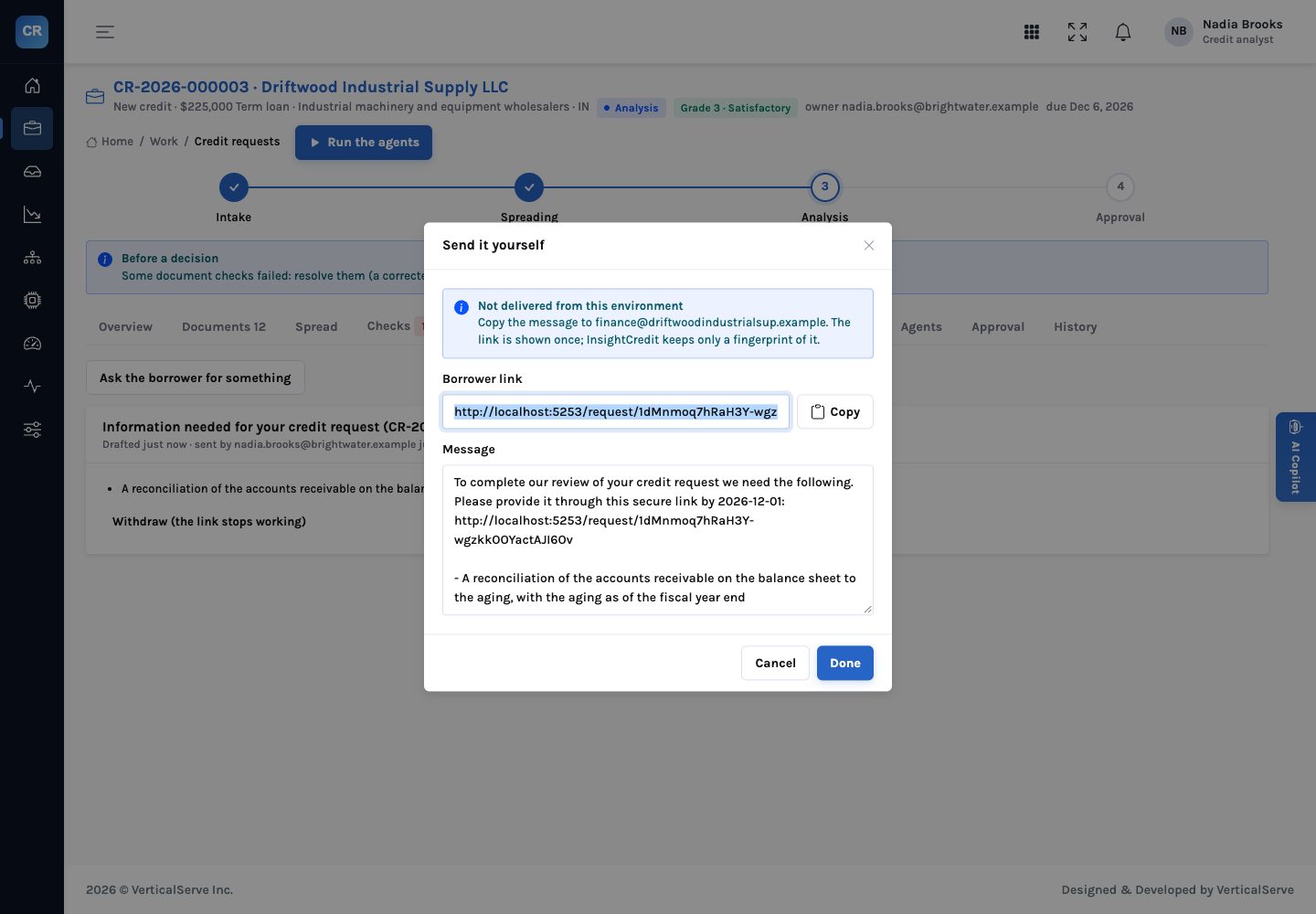
The spreading agent prepares a decision on the Agents tab: “Ask Hawthorne Bakeries Inc. to explain 1 difference.” The item it drafts is “An explanation of the difference between the revenue on the financial statements and the gross receipts on the tax return, with the CPA’s reconciliation.” It is drafted at L1: the agent prepares, a person does the work.
The analyst can add to it before sending. On this case she might ask for the filed return’s
Schedule M-1, which reconciles income per books with income per return, and for an explanation of the
officer compensation. The message must keep the [request link], which becomes the
borrower’s own link without a login when she sends it.
Who does what
Within credit officer authority for this $150,000 exposure. The submitter can never approve.
Takes each return’s lines with their text: gross receipts, cost of goods sold, deductions, taxable income.
Compares statement revenue with gross receipts for each year on file; fails any year over the tolerance.
Prepares a question asking for the CPA’s reconciliation. The analyst accepts it and edits it.
Lays the return beside the income statement and decides what else to ask. This part is judgement, not a check.
Nothing reaches the borrower until a person sends it.
With the reconciliation in hand, resolves the check with the explanation, or waives it with a written reason.
Approves or declines; a decline needs a reason.
Outcomes, and what each means
| What comes back | What happens | Likely outcome |
|---|---|---|
| A CPA reconciliation showing an identifiable, documented difference | The analyst resolves the check with the explanation and keeps the reconciliation on the case | Proceed, with the analyst’s view of which revenue figure to underwrite |
| An amended 2025 return that agrees with the statements | The reader takes it on upload; the reconciliation reruns and passes | Proceed; perhaps verify the filed return independently |
| Corrected statements with lower revenue | The spread, the ratios, the grade and the controls all rerun | Decide on the new figures, which may need a different authority or a mitigant |
| No reconciliation, or one that doesn’t reconcile | The check stays open; the case can’t go for approval | Decline, with that reason on the record |
What the decision record keeps
The memo writer’s draft for this case lists the figures from the engines and ends with the open issue: “Open: 2025 return agrees with the statements — Statement revenue $14,517,350; gross receipts on the 1120 $11,560,905 (20.4% difference; tolerance 10.0%).” Once the check is resolved or waived, the resolution, its note and who gave it stay on the case with the CPA’s document. The decision record keeps the verdict, the grade, pro forma and global coverage, leverage, the authority and why, who submitted and who decided, and any conditions, such as filed returns each year within a set number of days of filing.
What it means for each audience
For the chief credit officer
Statement-to-return reconciliation is one of the few tests in commercial underwriting that uses a document the borrower filed with a third party. Running it on every year of every case, with a written tolerance, is a control, not a habit.
If the bank wants a tighter tolerance for company-prepared or compiled statements, that is a setting (CREDIT_TOL_TAX_REVENUE).
For the credit team lead
The analyst sees the break on the day the returns are read, with both lines quoted, rather than at the end of the spread or not at all.
Because the whole return is taken, the follow-up questions are specific: officer compensation, the taxable loss, the Schedule M-1.
For the board
A strong-looking credit can rest on numbers the borrower told the IRS were different.
The bank lends on the figures it has tested, and the file shows how it tested them.
What to be careful about
- Differences have innocent causes. Accounting methods, a fiscal year that differs from the tax year, returns and allowances, and entity structure can all separate book revenue from gross receipts. The check asks the question; it doesn’t assume the answer.
- The tolerance is illustrative. 10% was set for the demo. Many credit teams would want any difference above a few percent explained.
- A return in the file is still the borrower’s copy. InsightCredit reads the PDF it was given; it doesn’t verify that the return was filed. Banks that want that confirmation usually request an IRS transcript with the borrower’s consent (Form 4506-C); that is outside the product.
- Only gross receipts is tested. The other lines the reader takes are there for a person to compare. The taxable loss and the officer compensation on this case are observations an analyst makes, not checks the product raises.
The statements tell the bank what the business earned. The return tells the IRS.
When they disagree by $2,956,445, every ratio waits until someone explains which one is the business.